
Leadership Presence in Emails: How Your Writing Signals Authority

Every email you send is a micro-audition for leadership. Leadership presence in emails comes down to three signals: decisive tone, clean structure, and strategic word choice. Professionals who master these signals get faster responses, more buy-in, and greater respect — even from people who have never met them in person. The good news? Unlike charisma in a room, email authority is a learnable, repeatable skill you can improve starting with your very next message.
What Is Leadership Presence in Emails?
Leadership presence in emails is the ability to communicate authority, clarity, and confidence through written digital communication. It's the written equivalent of walking into a room and commanding attention — except you're doing it with subject lines, sentence structure, and tone.
When someone reads your email and immediately thinks, "This person knows what they're doing," that's leadership presence at work. It's not about being aggressive or using corporate jargon. It's about writing in a way that signals competence, decisiveness, and respect for the reader's time.
Think of it this way: leadership presence in emails is the gap between a message that gets buried and one that gets acted on.
Why Your Emails Are Undermining Your Authority (And You Don't Know It)
According to a 2023 report by the McKinsey Global Institute, the average professional spends 28% of their workweek reading and responding to email. That means your colleagues and leaders are forming impressions of you through email more often than through any other medium — including meetings.

Yet most professionals have never been taught how to write with authority. They default to habits that actively erode their credibility.
The Hidden Cost of Weak Email Communication
Consider this scenario: A senior director sends a project update to the VP of Operations. The email opens with:
"Hi! Just wanted to touch base and give a quick update on the project. I think we're mostly on track, but there might be a few things we need to look at? Let me know what you think!"That email contains five credibility killers: an exclamation point opening, hedging language ("I think," "mostly"), a vague qualifier ("a few things"), an upspeak question mark, and a passive close. The director may be doing excellent work, but the email signals uncertainty.
Research from the Journal of Personality and Social Psychology found that people who use hedging language are perceived as less competent and less hirable, even when their actual qualifications are identical to more direct communicators (Fragale, 2006).
If you've ever wondered why people don't take you seriously at work, your emails may be the first place to investigate.
Three Signals Leaders Scan for in Every Email
Senior leaders are ruthless email triagers. They scan for three things in the first five seconds:
- Clarity of purpose — Do I know what this person wants from me?
- Confidence of tone — Does this person sound like they're in command?
- Respect for my time — Is this concise and structured for quick reading?
If your email fails any one of these checks, it gets deprioritized — and so does your professional reputation.
The Authority Email Framework: 5 Elements That Signal Leadership
Let's break down the specific elements that create leadership presence in emails. I call this the CLEAR framework: Context, Lead with the ask, Evidence, Action step, and Restrained close.
C — Context (One Sentence Max)
Open with a single sentence that orients the reader. No pleasantries, no preamble.
Weak: "Hi Sarah, hope you had a great weekend! I wanted to follow up on the conversation we had last Thursday about the Q3 budget review, which I know has been a busy topic for everyone…" Strong: "Following up on our Thursday discussion about the Q3 budget review."A 2019 study by Boomerang analyzed over 300,000 emails and found that emails between 50 and 125 words had the highest response rates — above 50%. Longer emails saw response rates plummet. Context-setting is important, but it should never exceed one sentence.
L — Lead with the Ask
State what you need before you explain why. This is counterintuitive for most people, but it's how executives communicate. When you learn to write like an executive — concise, clear, and commanding — you'll notice that the request always comes first.
Weak: "So after reviewing the numbers and talking to the finance team and considering what we discussed, I was wondering if maybe we could get approval to shift $15K from the training budget to the Q3 campaign." Strong: "I'm requesting approval to reallocate $15K from the training budget to the Q3 campaign. Here's why."E — Evidence (Bulleted, Not Buried)
Support your ask with two to three data points or reasons formatted as bullets. Never bury evidence in dense paragraphs.
- Campaign is trending 22% above target; additional spend will accelerate results
- Training budget is 40% unallocated with no scheduled programs in Q3
- Finance team has pre-approved the reallocation category
A — Action Step (Specific and Time-Bound)
Tell the reader exactly what to do next and by when. Vague closings like "Let me know your thoughts" are authority killers.
Weak: "Would love to get your thoughts on this when you get a chance." Strong: "Can you approve this by Thursday so we can brief the agency on Friday?"R — Restrained Close
End with confidence, not apology. Drop the "Sorry for the long email" and "Thanks so much for your time!!!" Instead, close with a simple, professional sign-off.
Weak: "Thanks so much for considering this! Really appreciate it! 😊" Strong: "Thanks, Sarah. Happy to discuss if you'd like more detail."Before-and-After Rewrites for 4 Common Workplace Emails
Theory is useful. Templates are better. Here are four real-world email scenarios rewritten using leadership presence principles.
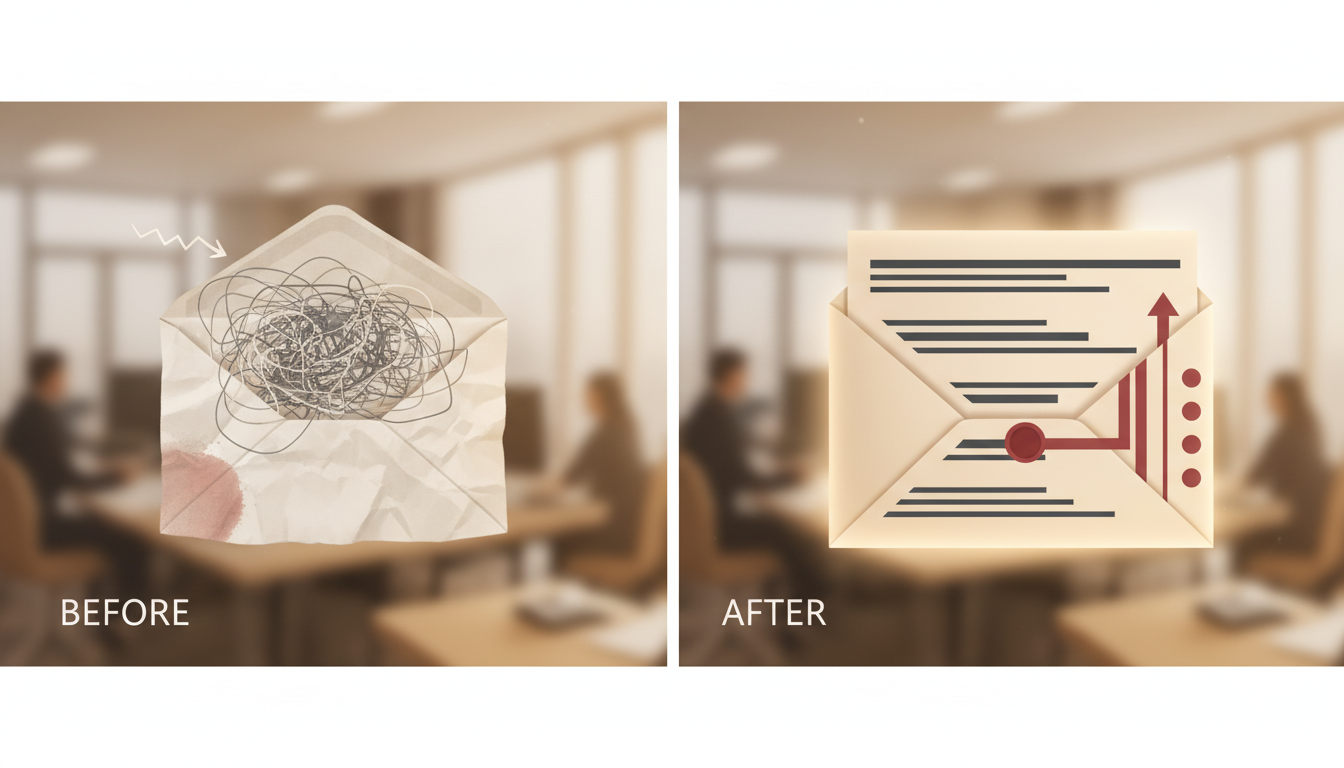
Rewrite #1: Pushing Back on an Unrealistic Deadline
If you've ever struggled with how to negotiate deadlines professionally, this template is for you.
Before: "Hi Mark, thanks for sending this over. I'm a little concerned about the timeline — it seems pretty tight and I'm not sure we can hit it without some issues? I'll try my best but just wanted to flag that it might be tricky. Let me know what you think!" After: "Hi Mark, I've reviewed the timeline. To deliver quality work, we need to adjust the deadline from March 5 to March 12. Here's why:- Design review requires 3 business days (currently allocated 1)
- Legal sign-off historically takes 4-5 days
- A rushed timeline risks rework, which would push us to March 15+
Notice what changed: hedging language was replaced with specifics. The question mark anxiety became a confident recommendation. The vague "flag" became a concrete alternative.
Rewrite #2: Sharing Bad News Upward
Before: "Hi Lisa, so unfortunately there's been a bit of a problem with the vendor delivery. I'm really sorry about this — I should have caught it earlier. I'm not totally sure what happened but I'm looking into it and will try to get back to you soon." After: "Hi Lisa, flagging a vendor issue that impacts our April 10 launch date. What happened: The vendor delivered the wrong component specifications on March 28. We identified the error on March 30. Impact: 5-day delay on assembly, pushing launch to April 15. Corrective action: I've escalated with the vendor (call scheduled for tomorrow at 9 AM) and briefed the production team on a parallel workaround. I'll send an updated timeline by Wednesday. Happy to discuss live if helpful."This version demonstrates leadership presence in a crisis — calm, structured, and solution-oriented even when delivering unwelcome news.
Rewrite #3: Introducing Yourself to a New Team
When you're establishing authority in a new team, your first email sets the tone for everything that follows.
Before: "Hi everyone!! I'm so excited to be joining the team! A little about me — I've been in marketing for about 10 years and have done a bunch of different things. I'm really looking forward to getting to know all of you and learning how things work here. Feel free to reach out anytime!" After: "Hi team, I'm Jordan Chen, your new Director of Marketing starting Monday. Quick background: 10 years in B2B marketing, most recently leading demand gen at Acme Corp where we scaled pipeline from $12M to $34M in 18 months. My approach: I'll be scheduling 1:1s with each of you over the next two weeks to learn your priorities, challenges, and what's working well. I want to listen before I act. Looking forward to building something great together."Rewrite #4: Following Up Without Sounding Desperate
Before: "Hi! Just bumping this to the top of your inbox 😊 I know you're super busy so no rush at all, but just wanted to check in on the proposal I sent last week? Totally understand if you haven't had a chance to look at it yet!" After: "Hi David, circling back on the proposal I sent March 22 (subject: Q3 Partnership Proposal). To keep our timeline on track, I'd need your feedback by this Friday. If the scope needs adjusting, I'm happy to set up a 15-minute call to align. Would Thursday or Friday work for a quick discussion?"Words and Phrases That Build (or Destroy) Email Authority
Language is the raw material of leadership presence in emails. Small word swaps create outsized perception shifts.
Power Language to Adopt
According to research published in the Harvard Business Review, leaders who use action-oriented, specific language are rated 34% higher on perceived competence than those who use passive or tentative phrasing (HBR, 2021).
Here are direct swaps you can make today. For a deeper dive, explore our guide on power language at work.
| Instead of this… | Write this… |
|---|---|
| I think we should… | I recommend… |
| Just wanted to check in… | Following up on… |
| Sorry to bother you… | Flagging for your review… |
| Does that make sense? | Let me know if you have questions. |
| I feel like… | Based on the data… |
| Hopefully we can… | The plan is to… |
| I'm not sure, but… | My assessment is… |
The Over-Apologizing Trap
A study by Karina Schumann and Michael Ross at the University of Waterloo found that women apologize significantly more frequently than men in professional settings — not because they commit more offenses, but because they have a lower threshold for what constitutes an offense (Psychological Science, 2010).
Unnecessary apologies in emails — "Sorry for the delay," "Sorry to ask," "Apologies if this is a dumb question" — erode authority for everyone, regardless of gender. If you recognize this pattern in yourself, our guide on how to stop over-apologizing at work offers specific replacement scripts.
The rule is simple: apologize when you've genuinely caused harm. For everything else, replace the apology with action.
Your emails are your leadership brand on display. The Credibility Code gives you the complete system for communicating with authority — in emails, meetings, presentations, and high-stakes conversations. Discover The Credibility Code
Formatting Tactics That Signal Executive-Level Thinking
Leadership presence in emails isn't just about what you say — it's about how the message looks on screen. Formatting is a trust signal.
The 3-Line Rule for Senior Leaders
When emailing executives, apply the 3-line rule: no paragraph should exceed three lines on a mobile screen. According to Litmus's 2023 State of Email report, 41% of email opens now happen on mobile devices. A wall of text on a phone screen is an instant credibility hit.
If you regularly communicate with the C-suite, this formatting discipline is non-negotiable.
Use Headers in Long Emails
For emails longer than 150 words, use bold headers to create scannable sections:
- Background:
- Recommendation:
- Next Steps:
This mirrors how executives structure their own communication and signals that you think at their level.
Strategic Use of Bold and Bullets
Bold your key ask or deadline so it's visible during a 5-second scan. Use bullets for any list of three or more items. Never use ALL CAPS (it reads as shouting) and limit exclamation points to one per email maximum — or zero when communicating upward.
Frequently Asked Questions
How do I show leadership presence in emails without sounding arrogant?
Leadership presence is about clarity and confidence, not arrogance. Focus on being direct, specific, and solution-oriented. Replace hedging language with clear recommendations, but always leave room for input: "I recommend X. Open to other approaches if you see a better path." Arrogance dismisses others; leadership presence invites collaboration from a position of strength.
What is the difference between leadership presence in emails vs. meetings?
In meetings, you have tone of voice, body language, and real-time interaction to convey authority. In emails, you rely entirely on word choice, structure, and formatting. Email presence requires more intentional craft because you can't course-correct in real time. The principles overlap — clarity, confidence, brevity — but email demands tighter editing and more strategic formatting.
How long should a professional leadership email be?
Research from Boomerang shows emails between 50 and 125 words get the highest response rates. For routine communication, aim for under 150 words. For complex updates or proposals, stay under 300 words and use headers and bullets to maintain readability. If your email exceeds 300 words, consider whether a meeting or shared document would be more effective.
Can email tone really affect my career advancement?
Absolutely. A 2022 survey by Grammarly and The Harris Poll found that 72% of business leaders said effective written communication increased their team's productivity, and poor writing led to misunderstandings that cost time and trust. Your emails are a daily demonstration of your communication skills — the same skills that help you get promoted and earn credibility with decision-makers.
How do I write authoritative emails as a new or junior employee?
Start with structure. Use the CLEAR framework (Context, Lead with the ask, Evidence, Action step, Restrained close) regardless of your seniority. Avoid qualifiers like "I'm new, so this might be wrong, but…" Instead, present your ideas with evidence and let the work speak. Our guide on building professional credibility fast at a new job covers this in depth.
Should I use emojis in professional emails?
Use them sparingly and only in lateral or downward communication with colleagues you know well. Never use emojis in emails to senior leaders, clients, or external stakeholders. A smiley face in a high-stakes email undercuts the seriousness of your message. When in doubt, leave it out.
Build Presence People Notice Before You Say a Word
The Credibility Code gives you the specific verbal and nonverbal habits that make people treat you as the senior person in the room.
Discover The Credibility CodeRelated Articles

Body Language for Leadership Presence: A Complete Guide
Body language for leadership presence is the intentional use of nonverbal cues—posture, eye contact, gestures, facial expressions, and spatial positioning—to project authority, confidence, and credibility in professional settings. Research from UCLA professor Albert Mehrabian found that up to 55% of communication impact comes from nonverbal signals. This guide gives you a complete framework for mastering the physical cues that make people listen, trust, and follow your lead in meetings, presenta

Project Calm Authority Under Pressure: A Leader's Guide
To project calm authority under pressure, anchor yourself with a controlled exhale before responding, slow your speech rate by 10–15%, plant your feet or hands in a stable position, and choose deliberate language that acknowledges the situation without matching its chaos. Calm authority isn't the absence of stress—it's the visible management of it. Leaders who master this skill earn deeper trust, defuse escalations faster, and maintain decision-making clarity when it matters most.

Body Language That Conveys Authority: 12 Proven Signals
Body language that conveys authority includes expansive posture, deliberate hand gestures, sustained eye contact, controlled movement, and strategic use of space. Research from Harvard Business School shows that nonverbal cues account for over 55% of how your message is received. The 12 signals below—grouped into posture, gestures, eye contact, spatial positioning, and movement—are used by the most credible leaders to project confidence and command respect without saying a word.