
Managing Speaking Anxiety at Work: 8 Proven Methods

What Is Speaking Anxiety at Work?
Speaking anxiety at work is the physical and psychological stress response triggered by situations where you must communicate in front of colleagues, leaders, or stakeholders. It goes beyond formal presentation nerves. It includes the tightness in your chest before a team standup, the blank mind when a VP asks you a question, and the racing heart when you need to push back on a colleague's idea.
Unlike clinical glossophobia (the fear of public speaking), workplace speaking anxiety is situational and context-dependent. It often intensifies with perceived power dynamics — meaning you might speak fluently with your direct team but freeze when an executive is in the room. According to the National Institute of Mental Health, approximately 73% of the population experiences some degree of speech anxiety, making it one of the most common workplace challenges professionals face.
Why Generic Advice Fails — And What Actually Works
The Problem With "Just Be Confident"
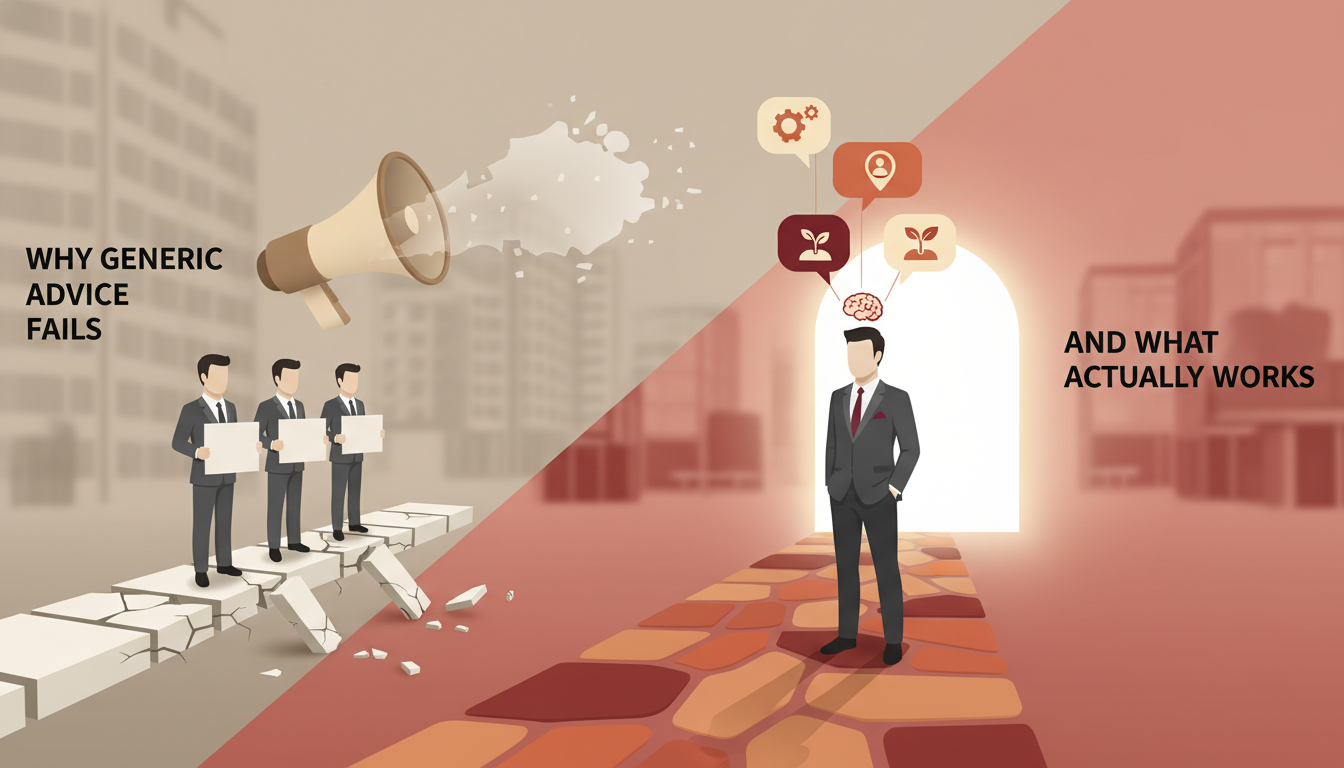
Most speaking anxiety advice falls into two categories: oversimplified platitudes ("just relax," "picture the audience in their underwear") or advice designed exclusively for keynote speakers. Neither addresses the reality of a mid-career professional who needs to explain a project delay to their skip-level manager in three minutes.
The reason generic advice fails is neurological. Speaking anxiety activates your amygdala — the brain's threat detection center. Once triggered, your prefrontal cortex (the part responsible for clear thinking and articulate speech) goes partially offline. Telling yourself to "just be confident" doesn't override this hardwired survival response. You need techniques that work with your nervous system, not against it.
The Everyday Speaking Moments That Trigger Anxiety
Formal presentations get all the attention, but research from the Chartered Institute of Personnel and Development (CIPD) found that 60% of employees report anxiety in routine workplace communication, not just high-profile speaking events. The real anxiety triggers include:
- Impromptu questions in meetings where you haven't prepared
- Status updates where you feel scrutinized by leadership
- Disagreeing with a peer or manager in real time
- Speaking up in large group settings like all-hands or town halls
- Being put on the spot by someone senior
If you've ever felt your voice tighten during a routine standup, you're not dealing with a presentation problem. You're dealing with a nervous system regulation problem. And that requires a different set of tools, which we'll cover next.
Method 1: Physiological Sigh — Reset Your Nervous System in 30 Seconds
How It Works
Stanford neuroscientist Dr. Andrew Huberman's research identified the "physiological sigh" as the fastest known method to reduce real-time stress. The technique involves a double inhale through the nose followed by a long exhale through the mouth. This specific breathing pattern deflates the tiny air sacs in your lungs (alveoli) that inflate during stress, which immediately signals your parasympathetic nervous system to calm down.
A 2023 study published in Cell Reports Medicine by Balban et al. found that cyclic sighing for as little as five minutes per day significantly reduced anxiety and improved mood more effectively than mindfulness meditation.
When to Use It at Work
Use the physiological sigh in the 30 seconds before you speak. You can do it silently at your desk before unmuting on a video call, in the hallway before walking into a meeting room, or even mid-sentence during a pause. No one will notice.
The 30-second protocol:- Inhale through your nose (fill lungs about 70%)
- Immediately take a second, shorter inhale on top of the first (fill to 100%)
- Exhale slowly through your mouth for 6-8 seconds
- Repeat twice
This pairs powerfully with learning how to control your voice when nervous presenting, because once your nervous system settles, your vocal quality naturally stabilizes.
Method 2: The "Pre-Frame" Technique — Defuse Anxiety Before You Speak
Cognitive Reframing in Real Time
Cognitive behavioral research shows that anxiety isn't caused by the speaking situation itself — it's caused by your interpretation of it. If your brain codes a team meeting as a "performance where I'll be judged," your stress response escalates. If it codes the same meeting as "a conversation where I'm sharing useful information," the response is dramatically lower.
The Pre-Frame Technique involves writing a single sentence before any speaking situation that redefines what the moment actually is. This isn't positive thinking — it's accurate thinking.
Pre-Frame Examples for Common Situations
| Situation | Anxious Frame | Pre-Frame |
|---|---|---|
| Team standup | "Everyone will notice I'm nervous" | "I'm giving a 60-second status update to people who need this info" |
| All-hands Q&A | "I'll sound stupid in front of 200 people" | "I'm asking a question that at least 20 others also have" |
| Presenting to leadership | "They're evaluating whether I'm competent" | "I'm the subject matter expert briefing decision-makers" |
| Disagreeing with a peer | "This could damage the relationship" | "I'm adding a perspective that strengthens the decision" |
Write your Pre-Frame on a sticky note, in your meeting notes, or in a text file you glance at before speaking. Over time, this rewires your default threat interpretation. For a deeper framework on this, see our guide on how to speak up in meetings when nervous.
Method 3: Structured Impromptu Frameworks — Eliminate the "Blank Mind" Problem
Why Impromptu Speaking Causes the Most Anxiety

A survey by Prezi and Harris Poll found that 70% of professionals consider presentation skills critical for career success, yet most anxiety occurs not during prepared presentations but during unscripted moments. The "blank mind" phenomenon happens because anxiety floods your working memory, leaving no cognitive resources for organizing thoughts in real time.
The solution isn't to prepare for every possible question. It's to have a universal structure you can pour any content into.
The PREP Framework for Any Impromptu Moment
P — Point (state your main idea in one sentence) R — Reason (explain why with one supporting reason) E — Example (give a brief, concrete example) P — Point (restate your main idea) Scenario: Your director asks in a meeting, "What's the status on the Henderson account?"Instead of rambling: "Well, we've been working on a few things, and there are some issues, but also some good stuff happening, and I think we need to..."
Use PREP: "The Henderson account is on track for the Q3 milestone. (Point) We resolved the integration issue last week, which was the main blocker. (Reason) Specifically, the engineering team patched the API conflict, and we've confirmed functionality with the client's QA team. (Example) So we're green for the Q3 delivery date." (Point)
This framework works for responding when put on the spot at work and eliminates the cognitive load that amplifies anxiety.
Method 4: Progressive Exposure — Build Tolerance Systematically
The Exposure Hierarchy for Workplace Speaking
Avoidance is the fuel of anxiety. Every time you stay silent in a meeting, let someone else present your work, or dodge a question, you reinforce your brain's belief that speaking is dangerous. Research in the Journal of Anxiety Disorders consistently shows that graduated exposure is the most effective long-term treatment for situational anxiety.
Build your own exposure hierarchy by ranking speaking situations from least to most anxiety-inducing on a 1-10 scale:
- (Level 2-3): Asking a clarifying question in a small team meeting
- (Level 4-5): Giving a prepared status update to your team
- (Level 5-6): Speaking up with an opinion in a cross-functional meeting
- (Level 6-7): Asking a question in an all-hands or town hall
- (Level 7-8): Presenting a project update to senior leadership
- (Level 9-10): Leading a meeting or presenting to the executive team
The Weekly Exposure Protocol
Commit to one speaking action per week that sits at your current edge — roughly a 5-6 on your personal scale. Don't jump to a 9. The goal is repeated success at a manageable challenge level, which rewires your brain's threat assessment over time.
Track your exposures in a simple log: date, situation, anxiety level before (1-10), anxiety level after, and one thing you did well. Most professionals who follow this protocol report a measurable decrease in baseline anxiety within 4-6 weeks. This approach aligns well with building daily workplace confidence exercises that actually work.
Method 5: Vocal Anchoring — Use Your Voice to Regulate Your Nerves
The Voice-Anxiety Feedback Loop
When you're anxious, your voice betrays you first. It rises in pitch, speeds up, and thins out. But the relationship works in reverse too: deliberately adjusting your vocal delivery sends calming signals back to your brain. A 2019 study published in PNAS (Proceedings of the National Academy of Sciences) demonstrated that vocal feedback directly influences emotional state — meaning how you sound literally changes how you feel.
Three Vocal Anchoring Techniques
1. The First-Sentence Drop: Before speaking, mentally rehearse your first sentence at a pitch slightly lower than your natural speaking voice. This single adjustment signals confidence to your audience and calm to your own nervous system. 2. The Power Pause: Instead of rushing to fill silence (a hallmark of anxious speaking), insert a deliberate 2-second pause after your first sentence. This gives your brain time to catch up and projects authority. Learn more about how to pause effectively in public speaking. 3. The Pace Lock: Choose a speaking pace of roughly 140-150 words per minute — slightly slower than conversational speed. Anxious speakers often race past 180 wpm. Consciously slowing down reduces the physiological arousal that feeds anxiety.These vocal techniques are covered in depth in our guide on how to sound confident in meetings even when you're not.
Method 6: The "Contribution Mindset" Shift
From Performance to Service
The single most powerful cognitive shift for managing speaking anxiety is moving from a performance mindset ("How am I coming across?") to a contribution mindset ("What does this group need from me right now?").
Research by Harvard Business School professor Alison Wood Brooks found that reappraising anxiety as excitement ("I'm excited to share this") was more effective at improving speaking performance than trying to calm down. But in everyday work settings, the contribution reframe is even more practical.
How to Apply It
Before any speaking moment, ask yourself one question: "What is the one thing this group needs to hear from me?"
This question does three things simultaneously:
- It redirects your attention from self-monitoring to audience service
- It forces you to identify a single clear message (reducing cognitive overload)
- It gives you a reason to speak that's bigger than your fear
This shift is foundational to how to stop sounding unsure when you speak at work — because certainty of purpose eliminates hesitation in delivery.
Build the Authority That Backs Up Your Voice. Managing anxiety is step one. The Credibility Code gives you the complete framework for building lasting professional authority — so you're not just managing nerves, you're building a reputation that speaks before you do. Discover The Credibility Code
Method 7: Strategic Preparation for High-Stakes Moments
The 5-Minute Anxiety-Proof Prep Method
For meetings or presentations where the stakes feel high, use this streamlined preparation framework. It's designed to take no more than five minutes and specifically targets the elements that trigger anxiety.
Step 1: Identify the Single Core Message (1 minute)Write one sentence that captures what you want your audience to remember. Not three points. One sentence.
Step 2: Anticipate the Top 2 Questions (2 minutes)What are the two most likely questions or challenges? Draft a one-sentence answer for each. According to a study by the University of Wolverhampton, pre-answering likely questions reduces presentation anxiety by up to 40%.
Step 3: Script Your First 15 Words (1 minute)Anxiety peaks in the first 10 seconds of speaking. Script and memorize your opening line to eliminate the most vulnerable moment.
Step 4: Decide Your Physical Anchor (1 minute)Choose one physical action to ground yourself: feet flat on the floor, hands resting on the table, or standing with weight evenly distributed. This gives your body a "home base" that counters the physical restlessness of anxiety.
This method pairs well with our frameworks for how to start a presentation with confidence and how to structure a presentation for executives.
Method 8: Post-Speaking Recovery — Break the Rumination Cycle
Why What Happens After Matters as Much as During
Anxious speakers often replay their speaking moments on a mental loop, fixating on every perceived mistake. This post-event rumination is what turns a single anxious moment into a chronic pattern. Research from Clark and Wells' cognitive model of social anxiety shows that post-event processing maintains and worsens anxiety over time.
The 3-Question Debrief
Within 30 minutes of a speaking situation, answer these three questions in writing (a phone note works fine):
- What went better than expected? (Forces your brain to register positive data it would otherwise discard)
- What is one specific thing I did well? (Builds evidence against your inner critic)
- What is one thing I'll adjust next time? (Channels rumination into productive planning)
This takes 90 seconds and interrupts the rumination cycle before it takes hold. Over weeks, your debrief notes become a concrete record of progress that your anxious brain can't argue with.
If a speaking moment goes particularly poorly, our guide on how to recover from a bad presentation at work provides a complete recovery framework.
Frequently Asked Questions
How long does it take to overcome speaking anxiety at work?
Most professionals using evidence-based techniques like progressive exposure and cognitive reframing report noticeable improvement within 4-6 weeks of consistent practice. Complete elimination isn't the goal — functional management is. Even seasoned executives experience pre-speaking nerves. The difference is they have reliable systems to regulate the response so it doesn't interfere with their delivery or message.
Is speaking anxiety a sign of incompetence?
Absolutely not. Speaking anxiety has no correlation with competence, intelligence, or expertise. Research from the Anxiety and Depression Association of America shows that high-performing professionals experience speaking anxiety at rates comparable to the general population. Many of the most credible voices in any organization have learned to manage anxiety — not eliminate it.
Speaking anxiety vs. imposter syndrome: What's the difference?
Speaking anxiety is a physiological stress response triggered by the act of speaking in front of others. Imposter syndrome is a cognitive pattern where you believe you don't deserve your position or achievements. They often co-occur — imposter syndrome amplifies speaking anxiety by adding a layer of "I'll be exposed as a fraud." Addressing both requires different strategies: anxiety management targets the body's stress response, while overcoming imposter syndrome targets belief patterns.
Can introverts manage speaking anxiety as effectively as extroverts?
Yes. Introversion and speaking anxiety are separate traits. Introverts may prefer less stimulation, but they can develop equal or greater speaking confidence through preparation and structured frameworks. In fact, introverts often excel at the preparation-based methods in this article. For a deeper dive, see our guide on how to be more confident at work as an introvert.
What should I do if my mind goes blank during a meeting?
Use the "Bridge and Reset" technique: pause, take one breath, and say a bridging phrase like "Let me make sure I address the key point here..." or "The most important thing to note is..." This buys you 3-5 seconds of processing time without signaling panic. Then use the PREP framework (Point, Reason, Example, Point) to structure whatever comes to mind. Having a framework for when you're put on the spot prevents blank-mind spirals.
Should I tell my manager about my speaking anxiety?
It depends on your relationship and workplace culture. If your manager is supportive and you trust them, sharing that you're actively working on your speaking confidence can lead to helpful accommodations — like advance notice before being called on, or opportunities to present in lower-stakes settings first. Frame it as a development goal, not a limitation: "I'm working on strengthening my presence in larger meetings. It would help to get the agenda in advance so I can prepare my contributions."
Speak So the Room Takes You Seriously
The Credibility Code covers the verbal patterns that make presenters sound authoritative, and the ones that make audiences tune out.
Discover The Credibility CodeRelated Articles

How to Handle Q&A After a Presentation Like a Pro
To handle Q&A after a presentation like a pro, prepare for likely questions in advance, use a structured response framework (like the PREP method: Point, Reason, Example, Point), and maintain confident body language throughout. When you don't know an answer, say so honestly and offer to follow up. Set clear ground rules at the start of Q&A, repeat each question for the audience, and always end on your terms by closing with a prepared final statement that reinforces your core message.

How to Sound Confident in a Presentation (Even When Nervous)
To sound confident in a presentation when nervous, focus on three controllable elements: slow your speaking pace by 20%, drop your vocal pitch at the end of sentences, and use deliberate pauses instead of filler words. Nervousness is invisible to your audience when you manage your voice, body, and breathing. The techniques below give you a tactical system to project authority — even when your heart is pounding and your hands are shaking.

How to Start a Speech Without Being Nervous: 6 Methods
The first 60 seconds of a speech determine whether your audience leans in or tunes out—and it's exactly when anxiety hits hardest. To start a speech without being nervous, use a combination of physiological resets (like controlled breathing and power posing), mental reframing techniques, and rehearsed power openers that give your brain a confident script to follow. These methods neutralize the fight-or-flight response *before* you reach the podium, so you open with authority instead of apology.