
Personal Brand Elevator Pitch: 10 Powerful Examples

A personal brand elevator pitch is a 30-to-60-second statement that communicates who you are, what you do, and the unique value you bring — all in a way that makes people remember you. The best pitches don't just describe your job title; they position you as an authority. Below you'll find 10 customizable elevator pitch examples for networking events, interviews, leadership meetings, and more, plus a proven framework for building your own from scratch.
What Is a Personal Brand Elevator Pitch?
A personal brand elevator pitch is a concise, rehearsed introduction — typically 30 to 60 seconds — that communicates your professional identity, expertise, and the specific value you deliver. Unlike a generic "what do you do" answer, it's a strategic positioning tool.
Think of it as your verbal business card, but one that actually leaves an impression. According to a 2023 study by LinkedIn, professionals who can clearly articulate their unique value are 40% more likely to be approached for career opportunities than those who default to job titles alone.
A strong personal brand elevator pitch answers three questions simultaneously: Who are you? What problem do you solve? Why should anyone care?
Why Most Elevator Pitches Fail (And What to Do Instead)
Before diving into the examples, it's worth understanding why the majority of professional introductions fall flat. If you've ever watched someone's eyes glaze over mid-introduction, you've experienced this firsthand.

The "Job Title Trap"
Most professionals default to stating their title and company: "I'm a Senior Project Manager at Acme Corp." That's a label, not a pitch. It tells the listener nothing about your impact, your perspective, or what makes you different from the 500,000 other senior project managers in the country.
Research from Princeton psychologists Janine Willis and Alexander Todorov found that people form judgments about competence and trustworthiness within one-tenth of a second. Your pitch needs to work fast — and a job title alone doesn't carry enough weight.
The "Kitchen Sink" Problem
The opposite mistake is cramming every accomplishment into 60 seconds. When you try to say everything, you communicate nothing. The listener can't find a thread to hold onto, and your credibility actually decreases because you sound unfocused.
If you've noticed that people don't take you seriously at work, an unfocused introduction could be part of the problem.
The Authority Framework: V.I.P.
The most effective personal brand elevator pitches follow what we call the V.I.P. Framework:
- V — Value Statement: Lead with the outcome you create, not the process you follow.
- I — Identity Anchor: Establish your area of expertise with a specific, memorable phrase.
- P — Proof Point: Include one concrete result, metric, or credential that backs your claim.
Every example below uses this structure. Master it, and you'll never stumble through an introduction again.
10 Personal Brand Elevator Pitch Examples (By Scenario)
Here are 10 ready-to-use templates, organized by the professional situations where you'll need them most. Each one is designed to be customized with your specific details.
Examples 1–3: Networking Events
Example 1 — The Results-Led Pitch (Marketing Professional)"I help B2B companies turn invisible brands into industry leaders. As a brand strategist with 12 years in SaaS, I've led repositioning campaigns that have driven over $40 million in pipeline growth. If your company is struggling to stand out in a crowded market, that's the problem I solve."Why it works: It leads with a compelling outcome ("turn invisible brands into industry leaders"), anchors identity ("brand strategist with 12 years in SaaS"), and delivers a proof point ("$40 million in pipeline growth"). Example 2 — The Problem-Solver Pitch (Operations Leader)
"Most companies lose 20 to 30 percent of their operational budget to inefficiency — and they don't even realize it. I'm an operations director who specializes in finding and fixing those hidden leaks. Last year, I redesigned the supply chain workflow for a mid-size manufacturer and saved them $2.3 million in the first quarter alone."Why it works: Opening with a problem statistic immediately hooks the listener. It positions you as someone who sees what others miss. Example 3 — The Mission-Driven Pitch (HR/People Leader)
"I build workplaces people don't want to leave. As a VP of People at a 2,000-person tech company, I've reduced turnover by 34 percent in two years by redesigning how we develop and promote talent. I believe the companies that win the next decade will be the ones that invest in their people first."Why it works: The mission statement ("build workplaces people don't want to leave") is memorable and emotionally resonant, while the metric keeps it grounded.
Examples 4–5: Job Interviews
Example 4 — The Strategic Fit Pitch (Finance Professional)"I'm a finance leader who translates numbers into strategy. Over the past eight years, I've helped three different companies navigate rapid growth — from Series B through IPO — by building financial models that don't just report what happened, but predict what's coming. I'm particularly drawn to this role because your team is at exactly that inflection point."Why it works: It demonstrates strategic thinking, not just technical skill. The closing line connects directly to the interviewer's context. For more on projecting confidence in these high-stakes moments, see our guide on how to project confidence in a job interview. Example 5 — The Career Pivot Pitch (Transitioning Professional)
"For the past decade, I led customer success teams at enterprise software companies — which really means I spent ten years learning exactly how customers think, what makes them stay, and what drives them away. Now I'm channeling that deep customer insight into product management, where I can solve those problems before they start."Why it works: It reframes a career change as a strategic evolution, not a random jump. The narrative thread — customer insight — connects past and future. If you're navigating a similar transition, our guide on writing a personal brand statement for a career change goes deeper.
Examples 6–7: Leadership Meetings and Internal Positioning
Example 6 — The Cross-Functional Authority Pitch (Project Lead)"I lead the digital transformation initiative that touches every department in this organization. My job is to make sure that when we modernize our systems, we don't just upgrade technology — we upgrade how 3,000 people work every day. We're currently six weeks ahead of schedule and 12 percent under budget."Why it works: In internal meetings, your pitch needs to establish scope and impact. The specifics (3,000 people, six weeks ahead, 12 percent under budget) signal competence instantly. This kind of precision is a hallmark of executive-level communication. Example 7 — The New Leader Pitch (Recently Promoted)
"I just took over the product engineering team, and my focus for the first 90 days is clear: reduce our release cycle from six weeks to three without sacrificing quality. I've done this twice before at previous companies, and the playbook starts with eliminating bottlenecks in our code review process."Why it works: It shows you have a plan, you've done it before, and you know exactly where to start. That's credibility compressed into four sentences.
Examples 8–9: Conference Panels and Public Speaking
Example 8 — The Thought Leader Pitch (Industry Expert)"I've spent 15 years studying why high-performing teams fail at scale — and the answer is almost never what leaders expect. I'm the author of 'Scaling Without Breaking' and I advise Fortune 500 companies on building organizational resilience. The one pattern I see everywhere? Companies optimize for speed when they should be optimizing for clarity."Why it works: It opens with a counterintuitive insight that makes the audience lean in. The credential (book, Fortune 500 clients) is woven in naturally, not bragged about. According to Edelman's 2024 Trust Barometer, 64% of people say they trust a "technical expert" more than any other source — positioning yourself as one matters. Example 9 — The Emerging Voice Pitch (Rising Professional)
"I'm a data scientist who believes the biggest threat to good decision-making isn't bad data — it's good data presented badly. I've built visualization frameworks used by over 200 analysts across three organizations, and I speak regularly about making data accessible to non-technical leaders."Why it works: You don't need 20 years of experience to have a compelling pitch. A clear point of view ("good data presented badly") combined with a tangible proof point (200 analysts, three organizations) builds authority regardless of tenure.
Example 10: Online and LinkedIn
Example 10 — The Digital-First Pitch (Remote Professional)"I help remote teams communicate as effectively as co-located ones. As a distributed work consultant, I've designed communication systems for 40+ fully remote companies, including three that scaled from 50 to 500 employees without adding a single unnecessary meeting. I write about async communication, remote leadership, and the future of work."Why it works: Digital pitches need to be scannable and specific. The metric ("40+ companies," "50 to 500 employees") does the heavy lifting. For more on building your professional brand in digital spaces, explore our guide on building a personal brand that gets you promoted.
How to Build Your Own Personal Brand Elevator Pitch (Step by Step)
Now that you've seen the examples, here's how to build yours from the ground up using the V.I.P. Framework.
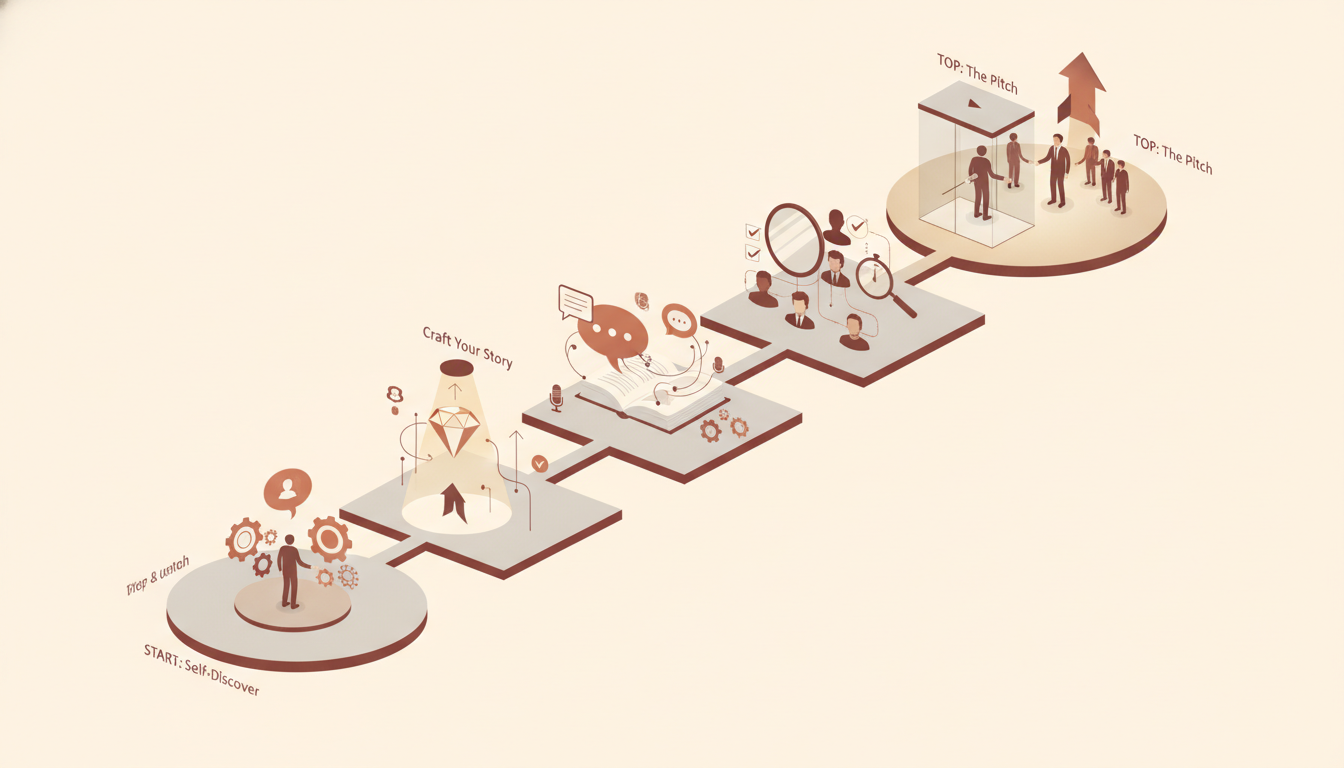
Step 1: Define Your Value Statement
Ask yourself: What outcome do I create for the people or organizations I serve?
Don't describe your process. Describe the result. A leadership coach doesn't "facilitate executive development sessions." They "help senior leaders double their team's performance in 90 days."
Write three versions of your value statement and read each one aloud. The one that feels most natural and specific is your winner.
Step 2: Anchor Your Identity
Choose a two-to-four-word phrase that captures your professional niche. This becomes your identity anchor — the phrase people will remember and repeat when they describe you to others.
Examples of strong identity anchors:
- "Remote work architect"
- "Revenue growth strategist"
- "Organizational resilience expert"
- "Customer retention specialist"
A 2022 study published in the Journal of Business and Psychology found that professionals who used a consistent, specific identity label were rated 28% more credible than those who used generic titles — even when their actual experience was identical.
Step 3: Select Your Proof Point
Pick one — and only one — concrete result, credential, or metric that validates your claim. The proof point should be:
- Specific (numbers, names, timeframes)
- Relevant to your audience
- Verifiable (or at least plausible)
Weak: "I've helped a lot of companies grow."
Strong: "I've helped three SaaS companies cross the $10M ARR mark in under 18 months."
Step 4: Assemble and Rehearse
Combine your three elements into a single, flowing statement. Then rehearse it — not by memorizing it word-for-word, but by practicing the structure until you can deliver it naturally in any context. Our guide on how to speak without notes offers techniques that work perfectly for this.
Aim for 60 to 90 words. Time yourself. If it takes more than 45 seconds to deliver at a natural pace, cut.
Common Mistakes to Avoid in Your Personal Brand Pitch
Even with a solid framework, there are pitfalls that can undermine your credibility.
Hedging and Qualifier Language
Phrases like "I basically help..." or "I sort of specialize in..." destroy authority before you've even started. A study by the University of Texas found that speakers who used hedging language were perceived as 35% less competent than those who made direct statements — even when the content was identical.
If you recognize this pattern in your own communication, our article on words that undermine your credibility at work identifies the 12 most common offenders and what to say instead.
Making It About You Instead of Your Impact
The best pitches are technically about you, but they feel like they're about the listener's world. "I'm a marketing director with 10 years of experience" is self-focused. "I help healthcare companies reach the patients who need them most" is impact-focused. Same person, completely different impression.
Forgetting to Adapt by Context
Your networking pitch shouldn't be identical to your interview pitch. The V.I.P. structure stays the same, but the emphasis shifts:
| Context | Lead With | Emphasize |
|---|---|---|
| Networking event | Value statement | Memorable identity anchor |
| Job interview | Value + strategic fit | Proof points relevant to the role |
| Leadership meeting | Scope of impact | Specific metrics and timeline |
| Conference/panel | Counterintuitive insight | Thought leadership credentials |
| LinkedIn/online | Clear niche | Searchable keywords and specifics |
Build the Presence Behind the Pitch. A great elevator pitch opens doors — but what happens after you walk through them? Discover The Credibility Code to develop the communication authority that makes every word you say land with impact. Discover The Credibility Code
How to Deliver Your Pitch With Commanding Presence
The words are only half the equation. How you deliver your pitch determines whether people perceive you as confident or rehearsed, authoritative or anxious.
Vocal Delivery That Signals Authority
End your sentences with a downward inflection — a vocal period, not a question mark. Upward inflection (known as "uptalk") makes even the most impressive credentials sound uncertain.
Pace matters too. Research from the University of Michigan's Institute for Social Research found that speakers who spoke at a moderate pace (about 3.5 words per second) were rated as more credible and persuasive than either fast or slow speakers. For a deeper dive into vocal techniques, see our guide on executive speaking cadence techniques that command.
Body Language That Reinforces Your Words
Stand with your weight evenly distributed. Make eye contact for 3 to 5 seconds at a time. Keep your hands visible and use deliberate, contained gestures. Avoid crossing your arms, touching your face, or shifting your weight — all of which signal discomfort and undercut your message.
The Power of the Pause
After you deliver your value statement, pause for a full beat before continuing. This signals confidence and gives your listener time to absorb what you've said. Most people rush through their pitch because silence feels uncomfortable — but that pause is what separates a forgettable introduction from a commanding one.
Frequently Asked Questions
How long should a personal brand elevator pitch be?
A personal brand elevator pitch should be 30 to 60 seconds — roughly 60 to 90 words when spoken at a natural pace. Anything shorter lacks substance; anything longer risks losing your listener's attention. The goal is to say enough to spark curiosity and invite a deeper conversation, not to tell your entire career story in one breath.
What is the difference between an elevator pitch and a personal brand statement?
An elevator pitch is a spoken, conversational introduction designed for live interactions — networking events, interviews, meetings. A personal brand statement is typically a written, polished sentence used on LinkedIn profiles, resumes, and bios. The pitch is dynamic and adaptable by context; the statement is fixed and optimized for reading. Both should communicate the same core value, but in different formats.
How do I write an elevator pitch if I don't have impressive metrics?
You don't need Fortune 500 results to build a compelling pitch. Focus on the problem you solve and who you solve it for rather than specific numbers. For example: "I help early-stage startups build their first customer success function from scratch — so founders can stop firefighting support tickets and focus on growth." The specificity of the problem replaces the need for large-scale metrics.
Can I use the same elevator pitch for every situation?
No — and you shouldn't. The V.I.P. Framework (Value, Identity, Proof) stays consistent, but you should adjust emphasis depending on context. At a networking event, lead with a memorable value statement. In a job interview, emphasize proof points that align with the role. In a leadership meeting, focus on scope and metrics. Keep three to four versions rehearsed and ready.
How do I practice my elevator pitch without sounding rehearsed?
Practice the structure, not the exact words. Rehearse your V.I.P. elements — value statement, identity anchor, proof point — in different orders and with slightly different phrasing each time. Record yourself on your phone and listen back. The goal is fluency with the framework, not memorization of a script. After 10 to 15 practice rounds, it will feel as natural as answering "how was your weekend?"
How often should I update my personal brand elevator pitch?
Update your pitch every time you hit a significant career milestone — a new role, a major project completion, a promotion, or a shift in professional focus. At minimum, revisit it every six months. Your pitch should reflect your current authority and trajectory, not where you were a year ago. Keeping it fresh is part of building a personal brand for career advancement.
Make Your Expertise Obvious in the First Minute
The Credibility Code helps you describe your work with clarity and authority, whether you are introducing yourself, interviewing, or presenting.
Discover The Credibility CodeRelated Articles

How to Introduce Yourself Professionally: Authority Scripts
To introduce yourself in a professional setting with authority, use this three-part formula: Lead with your name and role, state the specific value you deliver, and connect it to your audience's context. For example: "I'm Sarah Chen, Head of Product at Meridian — I help enterprise teams cut product launch cycles by 40%." Skip generic job descriptions. Instead, frame your introduction around outcomes, relevance, and a clear reason for the other person to remember you.

How to Introduce Yourself Professionally in Any Setting
To introduce yourself professionally, lead with your name, state your role and the specific value you deliver, and tailor your message to the audience in front of you. The best professional introductions are under 30 seconds, focus on credibility rather than job titles alone, and end with a connection point — a question, shared interest, or clear reason the listener should care. This "credibility-first" approach replaces forgettable introductions with ones that signal authority and invite conver

Personal Brand Statement Examples for Leaders (With Formula)
A personal brand statement for leaders is a concise 1-2 sentence declaration that communicates who you are, the specific value you deliver, and the unique leadership perspective you bring. The best formula is: "I help [audience] achieve [outcome] through [unique approach]." Below, you'll find 15+ real-world examples across industries and seniority levels, a proven three-part formula, and a self-guided worksheet to craft your own authority-building brand statement today.