
Speak with Confidence in High-Stakes Meetings: 8 Keys

What Is High-Stakes Meeting Confidence?
High-stakes meeting confidence is the ability to communicate your ideas with clarity, composure, and authority when the professional consequences of the conversation are significant. This includes board presentations, executive reviews, budget defenses, client pitches, cross-functional escalations, and any meeting where decisions, funding, or your professional reputation are on the line.
Unlike casual meeting participation, high-stakes confidence requires managing heightened physiological stress while simultaneously delivering structured, persuasive communication. It's not about eliminating nerves—it's about channeling them into a performance that projects calm credibility, even when your heart rate says otherwise.
Key 1: Structure Your Message Before You Enter the Room
The single biggest differentiator between professionals who flounder in high-stakes meetings and those who command them is preparation structure—not preparation volume. You don't need to rehearse for hours. You need the right framework loaded into your mind before you sit down.

Use the "Bottom Line Up Front" (BLUF) Framework
Military and executive communicators share one principle: lead with the conclusion. In a high-stakes meeting, your audience—whether it's the CFO, a cross-functional steering committee, or a board of directors—doesn't want to follow your thought process. They want your answer, then your reasoning.
Structure every key point using this sequence:
- State your position (one sentence)
- Provide your strongest supporting evidence (two to three data points)
- Name the implication or recommendation (one sentence)
For example, instead of saying, "We looked at several vendors and evaluated pricing, and after reviewing the data we think…" try: "I recommend we go with Vendor B. They reduce our implementation timeline by six weeks and cost 18% less annually. This gets us to market before Q3."
According to a study published in the Harvard Business Review, executives say they lose patience with presenters who take too long to get to the point within the first 60 seconds of a presentation (HBR, 2023). Leading with your conclusion respects their time and immediately positions you as someone who thinks at their level.
Prepare for the Three Most Likely Challenges
High-stakes meetings almost always involve pushback. The difference between looking rattled and looking authoritative is whether you've anticipated the objections.
Before any critical meeting, write down the three most likely challenges to your position. For each one, prepare a calm, concise response using this format: Acknowledge → Reframe → Redirect.
Example: If you're defending a budget increase and someone asks, "Why can't your team do this with existing resources?"- Acknowledge: "That's a fair question, and we did explore that option."
- Reframe: "What we found is that using existing resources would delay delivery by two quarters and increase our risk of losing the contract."
- Redirect: "The incremental investment actually protects $2.4M in projected revenue."
This technique is explored in more depth in our guide on how executives structure their thinking before speaking.
Build a One-Page "Meeting Brief" for Yourself
Create a single-page document you review five minutes before the meeting. Include:
- Your primary message (one sentence)
- Three supporting points (one sentence each)
- Three anticipated objections with responses
- One question you want to ask (this keeps you engaged, not just defensive)
This isn't a script. It's a mental scaffold. Research from the University of Chicago found that structured preparation reduces anxiety by up to 25% compared to unstructured "winging it" approaches (Beilock, 2010). The brief gives your brain something concrete to hold onto when adrenaline hits.
Key 2: Manage Your Adrenaline in Real Time
Confidence in high-stakes meetings isn't just a communication skill—it's a physiological skill. When the stakes rise, your sympathetic nervous system activates. Your heart races, your breathing shallows, your voice tightens, and your thinking narrows. The professionals who look calm under pressure aren't calm. They've learned to regulate their stress response in real time.
The 4-4-6 Breathing Reset
Before and during the meeting, use tactical breathing to downregulate your nervous system:
- Inhale through your nose for 4 seconds
- Hold for 4 seconds
- Exhale slowly through your mouth for 6 seconds
The extended exhale activates your parasympathetic nervous system—the "rest and digest" response that counteracts fight-or-flight. Navy SEALs use a version of this technique (box breathing) before high-pressure operations. You can use it in the elevator on the way to the boardroom, or silently during a meeting while someone else is speaking.
For a deeper dive into pre-meeting anxiety management, see our article on how to build confidence before a presentation fast.
Recognize and Interrupt the "Spiral" Pattern
Adrenaline creates a predictable spiral: your body tenses, you start speaking faster, you hear yourself rushing, you feel more anxious, and the cycle accelerates. The key is to interrupt the cycle early.
Your interrupt tools:
- Plant your feet flat on the floor. This physical grounding sends a safety signal to your brain.
- Slow your first sentence deliberately. Even if the rest speeds up, a controlled opening resets the room's perception.
- Take a sip of water. This is a socially acceptable pause that buys you three to five seconds of composure.
A study in the Journal of Experimental Psychology found that people who used physical grounding techniques showed measurably lower cortisol levels during high-pressure verbal tasks (Jamieson et al., 2012). Your body can lead your mind back to calm.
Key 3: Project Calm Authority Through Vocal Control
Your voice is the most immediate signal of confidence or uncertainty. In high-stakes meetings, listeners unconsciously evaluate your authority based on vocal patterns within the first few seconds. The good news: vocal authority is a skill, not a personality trait.
Eliminate Uptalk and Vocal Fry Under Pressure
When adrenaline hits, two vocal patterns tend to emerge:
- Uptalk — your statements sound like questions, with a rising pitch at the end. ("We should move forward with this plan?")
- Vocal fry — a creaky, low-energy tone that signals uncertainty or disengagement.
The fix for uptalk: consciously drop your pitch at the end of declarative statements. Practice saying "We recommend Option A" with a downward inflection on "A." This tiny shift changes how your entire statement is perceived.
According to research from Quantified Communications, speakers who use a steady, downward-inflecting vocal pattern are rated 38% more competent and 32% more trustworthy by listeners (Quantified Communications, 2018).
Master the Power of the Deliberate Pause
The most confident communicators in any boardroom share one habit: they pause. Not because they've lost their place—but because they know silence projects authority.
Use pauses in three specific moments:
- After you're asked a question — pause for two seconds before answering. This signals that you're thinking, not reacting.
- Before your key point — a one-second pause before your most important statement creates emphasis.
- After you've made your point — resist the urge to fill silence. Let your statement land.
For more vocal techniques, explore our guide on how to sound confident in a meeting when anxious.
Say it once, and be taken seriously. The Authority Toolkit gives you 8 frameworks, the 7 shifts that make speech sound sure, and 100+ phrases for meetings and email, so the point lands the first time you make it. Get The Authority Toolkit — $27
Key 4: Anchor Your Body Language in Stillness
In high-stakes settings, nervous energy leaks through your body before it ever reaches your voice. Fidgeting, swaying, touching your face, adjusting your glasses—these micro-movements signal anxiety to everyone in the room, even if your words are strong.

The "Stillness Triangle"
Anchor your physical presence using three points of stillness:
- Hands — Rest them on the table, lightly clasped or open. When you gesture, use deliberate, controlled movements, then return to stillness.
- Torso — Sit upright but not rigid. Lean slightly forward when making a key point. Avoid rocking or swaying.
- Eyes — Maintain steady, unhurried eye contact. In a group, hold eye contact with one person for a full sentence before moving to the next.
Research from Princeton University's psychology department found that observers form judgments about a person's competence in as little as 100 milliseconds based on visual cues (Todorov et al., 2006). Your body tells the room whether to take you seriously before you've finished your first sentence.
For a comprehensive breakdown of authority-signaling body language, read our guide on body language that conveys authority: 12 proven signals.
What to Do With Your Hands When You're Nervous
This is one of the most common questions professionals ask about high-stakes meetings. Here's the rule: your hands should either be still or purposeful.
Avoid: clicking pens, tapping the table, touching your hair or face, gripping your notes, fidgeting with jewelry. Do: Use open-palm gestures when presenting options. Steeple your fingertips briefly when making a definitive point. Rest your hands visibly on the table when listening—this signals openness and composure.Key 5: Handle Tough Questions Without Losing Composure
The moment that separates credible professionals from uncertain ones in high-stakes meetings is the Q&A—the unscripted, unpredictable moment when someone challenges your data, your logic, or your recommendation. How you respond in these moments defines your authority more than any prepared remark.
The "Acknowledge, Bridge, Deliver" Method
When hit with a tough question—especially one designed to put you on the spot—use this three-step framework:
- Acknowledge the question without being defensive. ("That's an important consideration.")
- Bridge to your prepared ground. ("What our analysis shows is…")
- Deliver your answer with a downward vocal inflection and a pause at the end.
- Acknowledge: "That's a fair question, and last quarter's delays informed how we built this plan."
- Bridge: "We've added two-week buffers at each milestone and secured a dedicated QA resource this time."
- Deliver: "I'm confident this timeline is achievable. And I'll flag any risk within 48 hours if something shifts."
Notice: no defensiveness, no over-explaining, no apologizing. For more scripts for handling challenging moments, see our article on handling tough questions in meetings.
When You Don't Know the Answer
One of the biggest fears in high-stakes meetings is being asked something you can't answer. The worst response is to fake it—experienced executives can spot bluffing instantly, and it destroys credibility faster than admitting uncertainty.
Instead, use this formula:
"I don't have that specific figure in front of me. I'll confirm it by [specific time] and send it to the group. What I can tell you now is [related point you do know]."This response demonstrates three things simultaneously: honesty, accountability, and the ability to redirect without losing the thread. It's a hallmark of communicating with executive presence.
Key 6: Control the Pace—Don't Let the Room Rush You
One of the most common mistakes in high-stakes meetings is rushing. When adrenaline surges, your internal clock speeds up. What feels like a normal pace to you sounds frantic to the room. Controlling your pace is one of the most powerful—and underused—confidence signals available to you.
The "Half-Speed First Sentence" Technique
Whatever speed feels natural, cut it in half for your first sentence. This accomplishes three things:
- It forces you to breathe.
- It signals to the room that you're in control.
- It sets a deliberate pace for everything that follows.
For more techniques on managing your speaking pace, see our guide on how to stop rushing when presenting.
Use Silence as a Strategic Tool
Most professionals fill silence out of discomfort. In a high-stakes meeting, silence after a strong statement communicates confidence. It says, "I've made my point. I don't need to qualify it."
Practice this: after you make your key recommendation, stop talking. Count to three silently. Let the room absorb what you've said. The urge to add "Does that make sense?" or "I hope that's clear" is strong—resist it. Those phrases undermine the authority of everything you just said.
Key 7: Read the Room and Adapt in Real Time
High-stakes meetings are dynamic. The agenda shifts, the energy in the room changes, a senior leader redirects the conversation. Professionals who project confidence in these moments aren't just good speakers—they're good readers.
Watch for Decision-Maker Signals
Pay attention to the body language and verbal cues of the most senior person in the room:
- Leaning forward, nodding → They're engaged. Stay on your current track.
- Checking their phone, leaning back → You're losing them. Cut to your conclusion.
- Furrowing brow, crossing arms → They have a concern. Pause and ask, "I want to make sure I'm addressing your key question—what's most important to you here?"
This adaptability is a hallmark of leadership presence in meetings. It shows you're not just delivering a monologue—you're leading a conversation.
Know When to Stop Talking
One of the most counterintuitive confidence moves in a high-stakes meeting is knowing when to stop. Many professionals, driven by anxiety, over-explain their position. They keep adding supporting points long after the room has been convinced.
The rule: once you see agreement—nodding, verbal affirmation, someone writing down your recommendation—stop. Say, "I'll pause there. Happy to go deeper on any of these points." Then wait.
Key 8: Debrief Every High-Stakes Meeting to Build Compounding Confidence
Confidence in high-stakes meetings isn't built in a single moment. It compounds over time through deliberate reflection. The professionals who seem "naturally" confident in boardrooms have simply logged more reps—and, critically, they've reviewed those reps.
The 5-Minute Post-Meeting Debrief
Within 30 minutes of every high-stakes meeting, spend five minutes answering three questions:
- What went well? (Be specific. "I paused before answering the CFO's question and it landed well.")
- What would I do differently? (Not "what went wrong"—what would I adjust?)
- What's one thing I'll practice before the next one? (Pick one skill: pacing, pausing, eye contact, structure.)
This debrief habit creates a feedback loop that accelerates your growth exponentially. A study by Giada Di Stefano and colleagues at Harvard Business School found that employees who spent 15 minutes reflecting at the end of each day performed 23% better after 10 days than those who didn't (Di Stefano et al., 2014). Five minutes of targeted reflection after a high-stakes meeting works the same way.
Build a "Confidence Evidence File"
Create a running document—a simple note on your phone or a folder in your files—where you record specific moments of confidence from high-stakes meetings. "Handled the VP's pushback on timeline without getting defensive." "Paused for two seconds before answering and got a nod from the CEO."
This isn't vanity. It's evidence. When imposter syndrome shows up before your next board presentation, you'll have concrete proof that you've performed under pressure before—and performed well.
Frequently Asked Questions
How do I stop my voice from shaking in a high-stakes meeting?
Voice shaking is caused by tension in your vocal cords, which tightens under adrenaline. Before the meeting, hum quietly for 30 seconds to warm and relax your vocal cords. During the meeting, focus on exhaling fully before speaking—shallow breathing is the primary trigger for vocal tremor. Speaking slightly slower than feels natural also reduces the shaking effect. For more detailed vocal techniques, see our guide on how to stop your voice shaking during a presentation.
What's the difference between confidence and arrogance in meetings?
Confidence is grounded in preparation and composure—you state your position clearly, welcome questions, and acknowledge what you don't know. Arrogance dismisses other perspectives, avoids admitting uncertainty, and talks over others. The key differentiator is curiosity: confident professionals ask questions and listen. Arrogant ones only broadcast. If you're worried about crossing the line, you're almost certainly on the right side of it.
How do I speak confidently in a meeting when I'm the most junior person?
Being junior doesn't disqualify you from contributing with authority. Focus on what you uniquely know—frontline data, customer feedback, implementation details—that senior leaders may not have. Use the BLUF framework to structure your points concisely, and preface with context, not apology: "Based on what I'm seeing in the field…" rather than "I might be wrong, but…" Our article on how to be taken seriously as a young professional covers this in depth.
How much should I prepare for a high-stakes meeting?
Preparation quality matters more than quantity. Thirty minutes of focused, structured preparation using a one-page meeting brief typically outperforms three hours of unfocused review. Focus on your core message, three supporting points, and three likely objections. Over-preparing can actually increase anxiety by creating pressure to remember everything perfectly. Aim for "prepared enough to be flexible," not "scripted."
How do I recover if I stumble or lose my train of thought in a meeting?
Pause. Take a breath. Say, "Let me restate that clearly," and start your point over. This is far more effective than rushing to fill the gap with filler words. Every experienced executive has lost their train of thought in a meeting—what separates the credible ones is how calmly they recover. The pause itself projects composure. Our guide on handling public speaking mistakes gracefully offers more recovery techniques.
Can introverts be confident in high-stakes meetings?
Absolutely. Introversion is about where you get your energy, not your ability to communicate with authority. Many of the most effective high-stakes communicators are introverts who leverage their natural strengths—deep preparation, thoughtful responses, and active listening. The frameworks in this article—structured preparation, deliberate pacing, and strategic pausing—actually favor introverted communication styles. Introverts don't need to become extroverts; they need systems that channel their strengths.
Stop Sounding Uncertain in Everyday Conversations
8 communication frameworks, the 7 speech shifts with 30 before-and-after rewrites, 6 email templates, and 100+ phrases for speaking and writing with calm authority at work. PDF.
Get The Authority Toolkit — $27Related Articles

How to Speak With Authority in Any Meeting: A Framework
Speaking with authority in a meeting comes down to five core elements: strategic preparation, deliberate vocal control, precise word choice, confident body language, and purposeful pausing. The professionals who command attention aren't louder or more aggressive — they're more intentional. They slow their pace, eliminate filler words, lead with conclusions, and use silence as a tool. This framework breaks down each element into specific, repeatable techniques you can apply in your very next meet
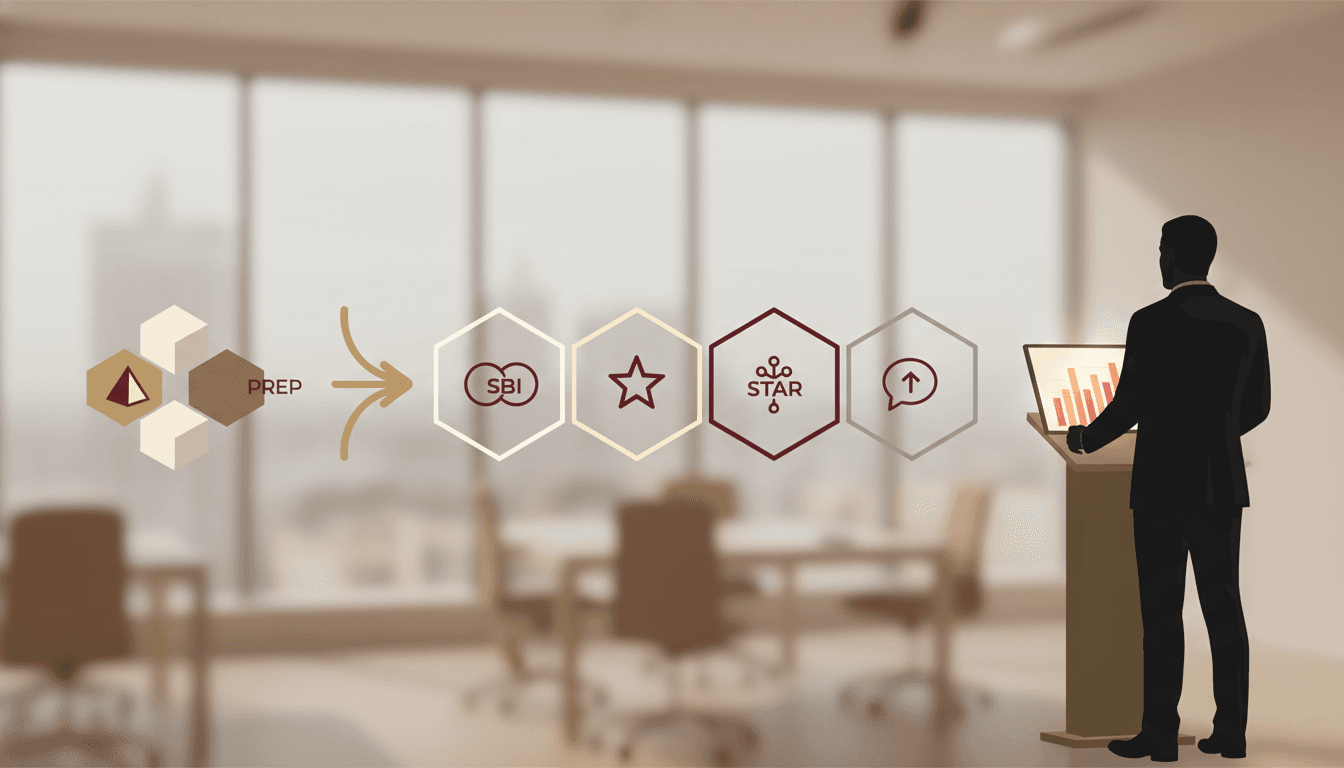
5 Professional Communication Frameworks Leaders Use Daily
The difference between professionals who get heard and those who get overlooked often comes down to one thing: structure. The most effective leaders don't wing their messages—they use professional communication frameworks to organize their thinking before they speak or write. The five most widely used professional communication frameworks are PREP (Point, Reason, Example, Point), SBI (Situation, Behavior, Impact), the Minto Pyramid, STAR for Influence (Situation, Task, Action, Result), and the W

How to Sound Authoritative: 9 Vocal & Language Shifts
To sound authoritative, focus on nine specific shifts: lower your pitch at the end of sentences, eliminate filler words, use the strategic pause, speak at a measured pace, project from your diaphragm, replace hedging language with declarative statements, use precise numbers instead of vague qualifiers, structure thoughts before speaking, and match your body language to your words. These vocal and language changes signal confidence, competence, and credibility — without sounding aggressive.