
Confident Communication Examples for the Workplace (Before & After)
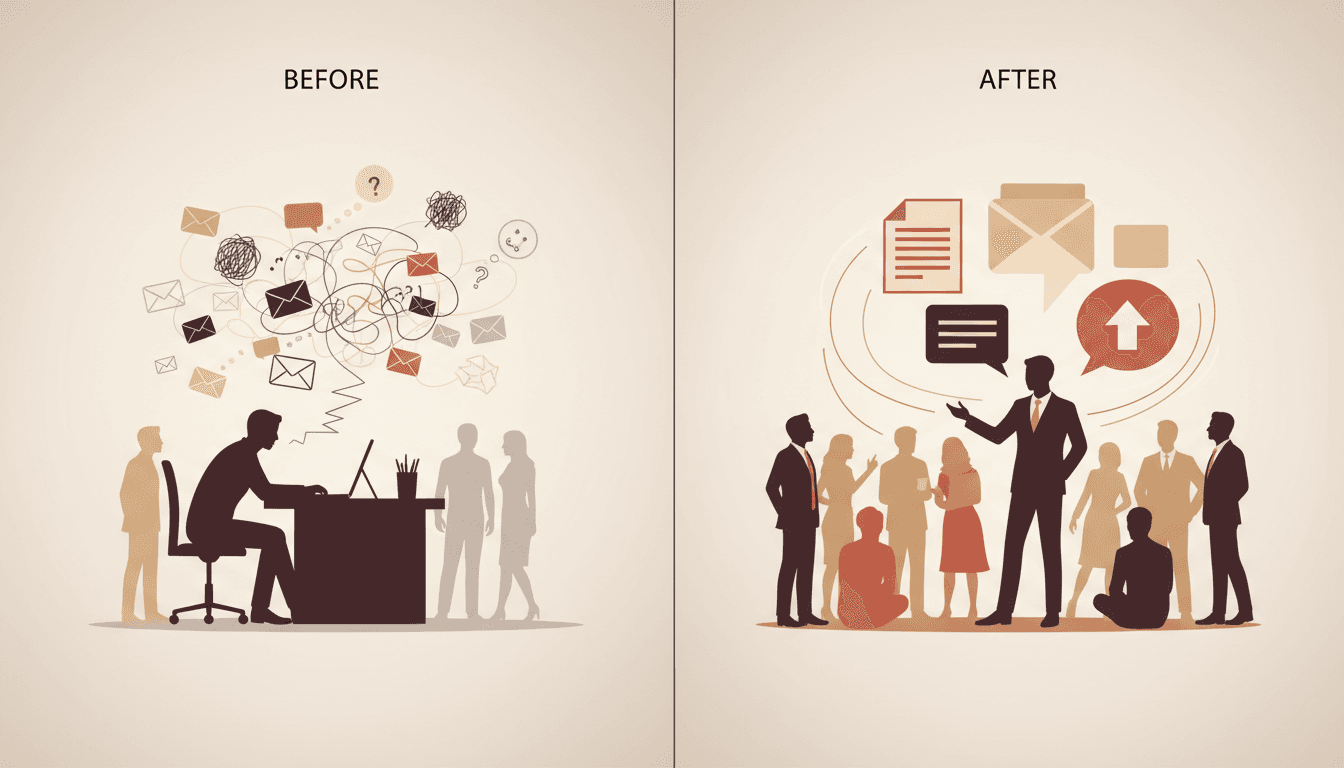
Confident communication in the workplace means replacing vague, apologetic, or hedging language with clear, direct, and purposeful phrasing — in emails, meetings, presentations, and one-on-one conversations. The difference between being overlooked and being respected often comes down to specific word choices. Below, you'll find more than 30 side-by-side before-and-after examples you can use immediately to sound more credible, assertive, and authoritative at work.
What Is Confident Communication in the Workplace?
Confident communication is the practice of expressing ideas, requests, and opinions in a clear, direct, and composed manner — without over-apologizing, hedging, or undermining your own message. It's not about being loud or aggressive. It's about choosing language and delivery that signal competence and self-assurance.
In a workplace context, confident communication shows up in how you write emails, how you contribute in meetings, how you present to leadership, and how you handle difficult conversations. According to a 2023 LinkedIn Workplace Learning Report, communication skills have been the #1 most in-demand soft skill for four consecutive years — and confidence is the differentiator between adequate communicators and truly influential ones.
For a deeper dive into the overall framework, see our guide on how to develop a confident communication style.
Before & After: Confident Communication in Emails
Email is where most professionals first undermine their credibility. The words you choose in writing create a lasting impression — one that people can re-read and judge. Small language shifts make a dramatic difference.
Eliminating Apologetic Openers
Weak email language almost always starts with an unnecessary apology or permission-seeking phrase. Here's what that looks like — and what to replace it with:
Before: "Sorry to bother you, but I was wondering if you might have a chance to look at the Q3 report when you get a moment?" After: "Could you review the Q3 report by Thursday? I'd like to incorporate your feedback before the leadership meeting." Before: "I'm not sure if this is the right person to ask, but I think maybe we should consider adjusting the timeline?" After: "I'd recommend adjusting the timeline. Here's why — and what I propose instead."Notice the pattern. The "before" versions contain hedging phrases like "I was wondering," "I'm not sure," and "maybe." The "after" versions lead with clarity, include a specific ask, and provide context. Research from Harvard Business Review (2022) found that professionals who use direct, action-oriented language in emails receive responses 32% faster than those who use hedging language.
Replacing Weak Qualifiers With Direct Statements
Qualifiers like "just," "actually," and "I think" dilute your message. They signal uncertainty — even when you're certain.
Before: "I just wanted to follow up on the proposal I sent last week." After: "Following up on the proposal I sent Monday. Are there questions I can address before the deadline?" Before: "I actually think we might be able to save costs by switching vendors." After: "Switching vendors would save approximately $40K annually. I've outlined the comparison in the attached brief." Before: "I think the data might suggest a different approach could work." After: "The data supports a different approach. I've outlined three alternatives below."For a complete system of email upgrades, our article on how to sound confident in emails covers nine specific writing rules.
Structuring Requests That Get Results
Confident emails don't just avoid weak language — they follow a structure that commands attention. Use the ACR framework: Action, Context, Reason.
Before: "Hi team, I know everyone's busy, but it would be great if we could maybe try to get the client feedback compiled sometime soon so we can start thinking about next steps. No rush if you're swamped!" After: "Hi team — please compile your client feedback by Wednesday at 3 PM [Action]. We're presenting the summary to the VP on Thursday [Context]. This ensures we have time to align on key themes before the meeting [Reason]."The ACR framework eliminates ambiguity. People know exactly what to do, when to do it, and why it matters.
Say it once, and be taken seriously. The Authority Toolkit gives you 8 frameworks, the 7 shifts that make speech sound sure, and 100+ phrases for meetings and email, so the point lands the first time you make it. Get The Authority Toolkit — $27
Before & After: Confident Communication in Meetings
Meetings are where careers are shaped. According to a study by Otter.ai (2023), the average professional spends 18 hours per week in meetings — yet most people never intentionally improve how they show up in them.

Speaking Up Without Over-Qualifying
The most common meeting mistake is wrapping a strong idea in weak packaging. You have the insight — but the delivery buries it.
Before: "This might be a dumb question, but have we thought about the customer retention angle?" After: "I want to raise the customer retention angle. The data from Q2 suggests we're losing 12% of accounts at the 90-day mark, and I believe this strategy could address that directly." Before: "I could be wrong, but I feel like maybe we're not focusing enough on the onboarding experience?" After: "I'd like us to prioritize the onboarding experience. Here's what I'm seeing in the feedback data." Before: "Sorry — can I just add one small thing?" After: "I'd like to build on that point." (Then make your point.)The phrase "This might be a dumb question" immediately tells the room to devalue whatever comes next. Confident communicators skip the disclaimer and lead with their contribution. For more on this, see our guide on how to sound confident in a meeting.
Disagreeing Without Damaging Relationships
Confident communication isn't about agreeing with everything. It's about knowing how to push back with clarity and respect.
Before: "I mean, I guess that could work, but I don't know... it just doesn't feel right to me." After: "I see the logic in that approach. My concern is the timeline risk — if the vendor delays by even two weeks, we miss the launch window. I'd suggest we build in a contingency plan." Before: "I don't think that's going to work." (No explanation.) After: "That approach raises a concern for me. Specifically, it assumes we'll have full headcount by March, and our current hiring pace doesn't support that. Here's an alternative that accounts for a leaner team."The ACA method — Acknowledge, Concern, Alternative — lets you disagree constructively. You validate the other person's thinking, name your specific concern, and propose a path forward. This approach builds credibility because it shows you're thinking critically, not just reacting.
Handling Being Put on the Spot
When someone asks you a question you're not prepared for, the instinct is to ramble or deflect. Confident communicators use a pause-and-frame technique.
Before: "Oh, um, I haven't really looked at that yet... I mean, I could probably pull some numbers together, but I'm not sure off the top of my head... let me think..." After: (Brief pause.) "That's an important question. I want to give you an accurate answer rather than speculate. I'll have the data pulled together by end of day and send it to the group." Before: "I don't know." (Followed by silence and visible discomfort.) After: "I don't have that figure in front of me. What I can tell you is that the trend has been upward for three consecutive quarters. I'll confirm the exact numbers and follow up by tomorrow."Notice: the confident version doesn't fake an answer. It demonstrates composure, sets a clear follow-up, and still contributes value. For a full set of scripts for these situations, check out our article on how to respond when put on the spot at work.
Before & After: Confident Communication in Presentations
Presentations are high-visibility moments. A 2023 Prezi study found that 70% of employed Americans say presentation skills are critical for career success — yet most people undermine themselves in the first 30 seconds.
Opening With Authority Instead of Apology
How you open a presentation sets the tone for everything that follows. Weak openings train the audience to tune out.
Before: "Hi everyone, um, thanks for being here. I know you're all really busy, so I'll try to keep this short. I'm not the best presenter, but I'll do my best to walk you through this." After: "Good morning. In the next 15 minutes, I'll walk you through three findings from our Q3 analysis — and a recommendation that could reduce churn by 18%. Let's get into it." Before: "So, I was asked to present on the marketing results, and, um, I put together some slides, so let's just go through them." After: "Our marketing spend increased 12% last quarter. Our pipeline grew 34%. Here's what's working, what's not, and where I recommend we double down."The confident version does three things: it states the time commitment, previews the value, and opens with a compelling data point. This is what we call the VTP opener — Value, Timeframe, Preview. Our guide on how to speak with authority in presentations breaks down eight additional techniques.
Handling Q&A With Composure
The Q&A section is where many presenters lose the credibility they just built. Confident communicators treat questions as opportunities, not threats.
Before: "Oh, that's a good question. I'm not sure I have the answer to that. Sorry about that." After: "Great question. The short answer is that we're still validating the data from the pilot. What I can share today is the preliminary trend, which shows a 22% improvement. I'll have the full analysis by Friday." Before: (Audience member challenges your data.) "Oh, um, yeah, I mean, maybe my numbers are off. I'll have to double-check." After: "I appreciate you flagging that. The figures I'm referencing come from our Q3 internal audit. I'm happy to compare sources after the session so we can align on the data."The key principle: never concede your credibility in real time. If you need to verify something, say so with composure. If you're confident in your source, name it clearly.
Closing With Impact Instead of Fading Out
Most presentations end with a whimper — "So, yeah, that's pretty much it. Any questions?" Confident closings leave a lasting impression.
Before: "So, um, that's all I had. I hope that was helpful. Let me know if you have questions, I guess." After: "To summarize: we have a clear opportunity to reduce churn by 18% by investing in the onboarding redesign. I'm requesting approval to move forward with Phase 1 by April 15th. I'll send the detailed proposal by end of week."The confident close restates the key takeaway, makes a specific ask, and defines the next step. It leaves the audience knowing exactly what you want them to do.
Before & After: Confident Communication in One-on-Ones and Difficult Conversations
One-on-one conversations — with your manager, a peer, or a direct report — are where trust is built or eroded. These moments require a different kind of confidence: the ability to be direct while remaining respectful.
Asking for What You Want
According to a 2022 study published in the Journal of Personality and Social Psychology, people consistently underestimate the likelihood that others will say yes to a direct request — by as much as 50%. The result? Professionals hedge, hint, and hope instead of asking clearly.
Before: "I've been thinking, and I don't know if this is the right time, but I was kind of hoping that maybe there might be an opportunity for me to take on a slightly bigger role on the project?" After: "I'd like to take on the project lead role for the next phase. I've managed the last two deliverables on time and under budget, and I'm confident I can drive the same results at a larger scope. Can we discuss what that would look like?" Before: "I feel like I've been doing a lot of extra work lately, and I was wondering if maybe we could talk about my compensation at some point?" After: "I'd like to discuss a compensation adjustment. Over the past six months, I've taken on three additional responsibilities beyond my original role, including leading the vendor migration. I'd like to align my compensation with the scope of work I'm delivering."For more scripts and strategies on this topic, see how to ask for what you want at work without apology.
Giving Upward Feedback
Giving feedback to a manager or senior colleague is one of the highest-stakes communication moments. Confidence here means being honest without being combative.
Before: "I don't want to overstep, but I kind of feel like sometimes the way feedback is given in our team meetings can be a little, I don't know, harsh? But that's just my perspective." After: "I want to share an observation that I think could strengthen our team dynamic. When feedback is delivered in front of the full group, I've noticed it can make people hesitant to share ideas. Would you be open to trying a model where real-time critiques happen in smaller settings?" Before: "Everything's fine, I just think maybe we could communicate a bit more." After: "I'd find it helpful to have a brief weekly check-in — even 15 minutes. It would help me prioritize more effectively and ensure I'm aligned with your expectations."The confident version names the specific issue, explains the impact, and proposes a solution. It's not complaining — it's problem-solving.
Navigating Conflict Without Losing Composure
Workplace conflict is inevitable. Confident communication during conflict means staying calm, staying specific, and staying focused on resolution.
Before: "I feel like you always dismiss my ideas and it's really frustrating. I don't understand why you never listen to me." After: "In the last two planning meetings, I've noticed that my proposals were moved past without discussion. I'd like to understand your perspective on them, and I'd appreciate the chance to present the full rationale before a decision is made." Before: "Fine. Whatever you want to do." (Passive-aggressive withdrawal.) After: "I disagree with this direction, and I want to be transparent about that. My concern is specifically around the resource allocation. Can we revisit that piece before finalizing?"The confident version avoids absolutes like "always" and "never," which trigger defensiveness. Instead, it cites specific instances and makes a clear, professional request. For a deeper framework, read our guide on confident communication in difficult conversations.
The Language Patterns Behind Every Confident Communicator
After studying hundreds of before-and-after examples, clear patterns emerge. Confident communicators consistently follow five language principles that you can adopt immediately.

The Five Confidence Language Principles
- Lead with the point, not the preamble. Confident communicators state their conclusion first, then provide supporting detail. Uncertain communicators bury the point under context and qualifiers.
- Replace hedging with specificity. Instead of "I think maybe we could try," say "I recommend we implement X by Y date." Specificity signals preparation and conviction.
- Use declarative sentences. Confident language favors statements over questions when expressing opinions. "This approach carries risk" is stronger than "Don't you think this approach might be risky?"
- Name the action and the owner. Every confident communication makes clear who does what by when. Vague language creates confusion; clear assignments create momentum.
- Eliminate permission-seeking language. Phrases like "I just wanted to," "Sorry to bother you," and "If it's not too much trouble" signal subordination. Replace them with direct, respectful phrasing.
These principles align with the broader frameworks outlined in our article on professional communication frameworks leaders use daily.
A Quick Self-Audit for Your Communication
Before your next email, meeting, or presentation, scan your language for these red flags:
- Unnecessary apologies — "Sorry" when you haven't done anything wrong
- Filler qualifiers — "Just," "actually," "kind of," "sort of"
- Permission-seeking — "Would it be okay if I..." when you don't need permission
- Disclaimers — "This might not be right, but..." or "I'm no expert, but..."
- Vague asks — "It would be great if someone could maybe look into this"
A study from the University of Texas at Austin (2019) found that removing hedging language from professional communication increased perceived competence ratings by 25% — even when the content of the message was identical.
Frequently Asked Questions
What is the difference between confident communication and aggressive communication?
Confident communication is direct, clear, and respectful. It focuses on expressing your perspective and making specific requests without undermining others. Aggressive communication, by contrast, dismisses or attacks others' viewpoints, uses blame language, and prioritizes dominance over dialogue. The key difference: confident communicators invite collaboration while standing firm; aggressive communicators shut it down. For practical techniques, see our guide on being assertive without being aggressive.
How can I sound more confident in emails at work?
Start by eliminating apologetic openers ("Sorry to bother you"), unnecessary qualifiers ("just," "actually"), and vague requests. Use the ACR framework — state the Action you need, the Context behind it, and the Reason it matters. Lead with your point instead of burying it in background information. Keep sentences short and direct. These shifts alone can transform how colleagues perceive your authority in writing.
Can introverts communicate confidently in meetings?
Absolutely. Confident communication isn't about volume or extroversion — it's about clarity and intentionality. Introverts can prepare key points in advance, use the pause-and-frame technique when put on the spot, and contribute strategically rather than frequently. Many of the most credible communicators speak less but say more. Our guide on how to speak up in meetings as an introvert offers a full framework.
How long does it take to change communication habits?
Research on habit formation (Phillippa Lally, European Journal of Social Psychology, 2009) suggests that new behaviors take an average of 66 days to become automatic. However, you can see immediate results by swapping specific phrases. The key is consistent practice — start with one context (emails, for example), master the new patterns, then expand to meetings and presentations.
What are the most common phrases that undermine confidence at work?
The top credibility-killing phrases include: "I just wanted to...," "Sorry, but...," "Does that make sense?," "I'm no expert, but...," "This might be a stupid question...," and "I could be wrong, but..." Each of these signals uncertainty and invites others to devalue your contribution. Replace them with direct, declarative alternatives as shown in the examples throughout this article.
How do I practice confident communication daily?
Start with a daily audit: before sending any email or entering any meeting, scan your language for hedging, apologizing, and vague phrasing. Rewrite one email per day using the principles in this article. Record yourself in a practice meeting scenario and listen for filler words and qualifiers. Small, consistent upgrades compound into a fundamentally different communication presence over weeks. For a structured daily system, see how to communicate with confidence at work.
Stop Sounding Uncertain in Everyday Conversations
8 communication frameworks, the 7 speech shifts with 30 before-and-after rewrites, 6 email templates, and 100+ phrases for speaking and writing with calm authority at work. PDF.
Get The Authority Toolkit — $27Related Articles

Stop Hedging Language at Work: Speak With Certainty
To stop hedging language at work, identify your most-used qualifier phrases — like "I just think maybe," "I could be wrong, but," and "sort of" — and replace them with direct, declarative alternatives. Start by auditing your speech and emails for one week, tracking every hedge word you use. Then practice specific replacement phrases daily until direct language becomes your default. Most professionals can dramatically reduce hedging within 30 days using a structured awareness-and-replacement meth

Confident Communication at Work: 12 Before & After Examples
Confident communication at work means replacing vague, apologetic, or passive language with clear, direct, and authoritative phrasing. Below, you'll find 12 real-world before-and-after examples spanning emails, meetings, presentations, and negotiations. Each example shows the exact words to stop using and what to say instead—so you can sound credible, earn respect, and get heard without coming across as aggressive.
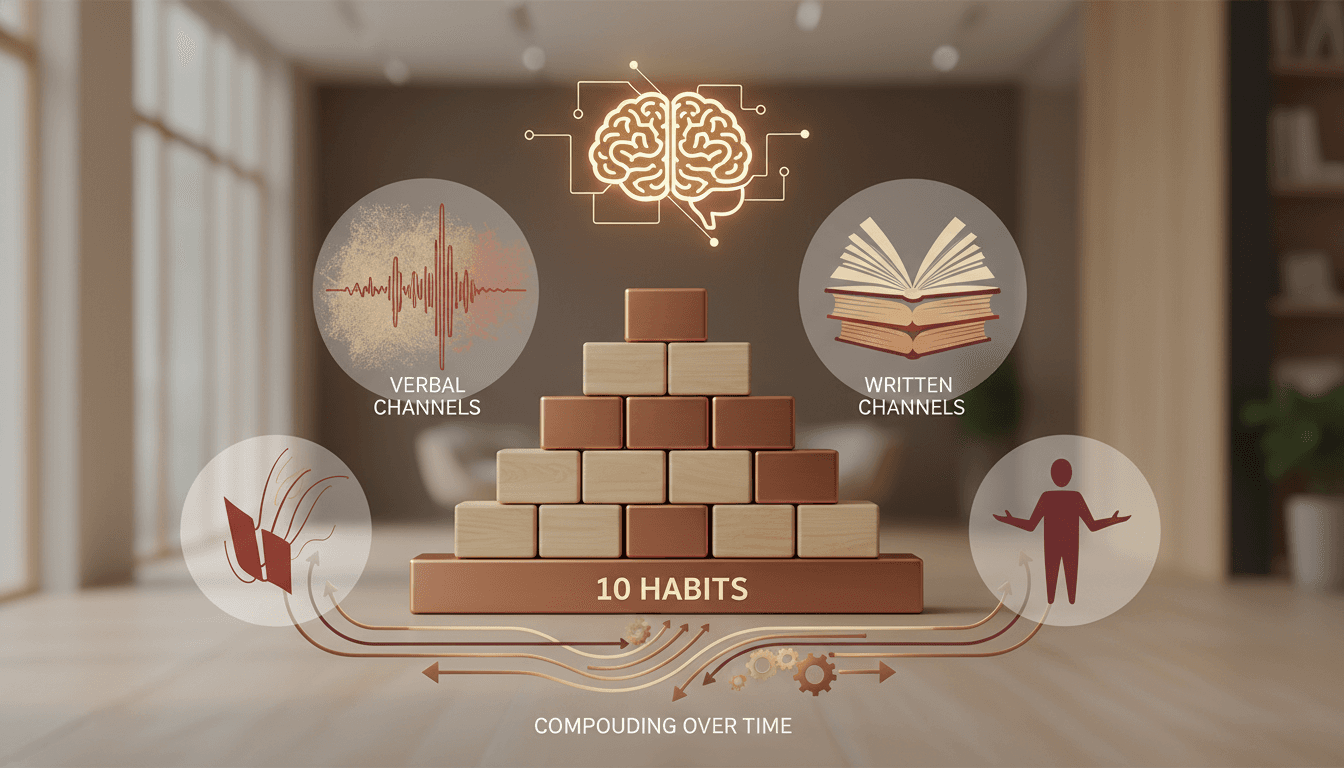
How to Communicate With Authority at Work: 10 Habits
To communicate with authority at work, build ten daily habits across verbal, written, and nonverbal channels: lead with your conclusion, eliminate hedging language, use strategic pauses, anchor your body language, control your vocal tone, write concisely, prepare a point of view before every meeting, ask high-value questions, set verbal boundaries, and follow through visibly. These small, repeatable actions compound over time to build a lasting reputation for credibility and leadership presence.