
Confident Communication at Work: 12 Before & After Examples

Confident communication at work means replacing vague, apologetic, or passive language with clear, direct, and authoritative phrasing. Below, you'll find 12 real-world before-and-after examples spanning emails, meetings, presentations, and negotiations. Each example shows the exact words to stop using and what to say instead—so you can sound credible, earn respect, and get heard without coming across as aggressive.
What Is Confident Communication at Work?
Confident communication at work is the ability to express ideas, requests, and opinions with clarity, directness, and composure in professional settings. It involves choosing language that conveys authority and competence—while remaining respectful—across emails, meetings, presentations, and one-on-one conversations.
It is not about being loud or dominating. It's about eliminating weak language patterns that signal uncertainty and replacing them with phrasing that earns trust and commands attention.
Research from the University of Wolverhampton found that communication competence is the single strongest predictor of workplace credibility, outranking technical skill and experience (Journal of Business Communication, 2019). In other words, how you say something shapes your professional reputation as much as what you know.
Why Your Word Choices Signal More Than You Think
The Psychology Behind Weak vs. Strong Language

Every sentence you speak or write at work sends a signal about your confidence level. Hedging phrases like "I just wanted to..." or "I'm not sure, but..." trigger what psychologists call low-power speech markers. A study published in the Journal of Language and Social Psychology (2014) found that speakers who used hedges and disclaimers were rated 25–35% less competent by listeners—even when the content of their message was identical to a confident speaker's.
Your brain processes these cues automatically. When a colleague says "I think maybe we should consider..." versus "I recommend we...", you instinctively assign different levels of authority to each speaker.
The Cost of Uncertain Communication
The stakes are real. According to a 2023 survey by Grammarly and The Harris Poll, poor communication costs U.S. businesses an estimated $1.2 trillion annually, with miscommunication and lack of clarity cited as the top contributors. On an individual level, professionals who communicate with uncertainty get interrupted more, receive fewer leadership opportunities, and are passed over for promotions.
If you've ever felt overlooked despite doing strong work, your language patterns—not your competence—may be the problem. Learning to sound more senior at work starts with recognizing these patterns.
The Before & After Framework
Each of the 12 examples below follows a simple structure:
- Before: The weak, uncertain, or undermining version
- After: The confident, credible alternative
- Why it works: A brief explanation of the psychological or linguistic shift
Use these as templates. Swap in your own context, and you'll notice an immediate difference in how people respond to you.
Examples 1–4: Confident Communication in Emails
Example 1: Making a Request
Before: "Hey, sorry to bother you! I was just wondering if you might possibly have a chance to send over the Q3 data when you get a moment? No rush at all!" After: "Hi Sarah, could you send the Q3 data by Thursday at noon? I need it to finalize the budget review. Thanks." Why it works: The "before" version stacks four uncertainty signals: an apology, "just," "might possibly," and "no rush." The "after" version is specific, includes a deadline, and states the reason. According to a study in Organizational Behavior and Human Decision Processes (2017), requests with clear rationale are 34% more likely to receive prompt action.For more on this, see our guide on how to sound confident in emails.
Example 2: Sharing an Update with Leadership
Before: "Just a quick update—I think we're sort of on track, but there might be a few issues that could maybe come up. I'll keep you posted!" After: "Project status: We're on track for the March 15 deadline. Two risks to flag—vendor delay on Phase 2 and a staffing gap in QA. I've outlined mitigation steps in the attached brief." Why it works: Leaders want precision, not vagueness. The confident version names specifics, quantifies the timeline, and demonstrates proactive problem-solving. This is exactly the kind of executive email writing that builds credibility fast.Example 3: Pushing Back on a Deadline
Before: "I'm not sure we can do that... I mean, it might be really tight? I don't want to say no, but it could be hard." After: "I want to deliver quality work on this. To meet Friday's deadline, I'd need to deprioritize the Henderson report. Would you like me to make that trade-off, or should we adjust the timeline to next Wednesday?" Why it works: Instead of vague resistance, the confident version frames the pushback as a professional trade-off. It gives the decision-maker options rather than complaints. This is a core skill in negotiating your workload without seeming lazy.Example 4: Responding to Criticism
Before: "Oh gosh, I'm so sorry. You're totally right. I messed that up. It won't happen again, I promise." After: "Thank you for the feedback. I see where the gap was in the client summary. I've already revised the document—here's the updated version. I've also added a review step to prevent this going forward." Why it works: Over-apologizing signals low status. The confident version acknowledges the issue, shows corrective action, and demonstrates a systems-level fix. It turns criticism into a credibility-building moment. Learn more in our guide on how to respond to criticism at work professionally.Examples 5–8: Confident Communication in Meetings
Example 5: Sharing an Idea
Before: "This might be a stupid idea, and I'm sure someone's already thought of it, but what if we maybe tried doing a customer survey or something?" After: "I'd like to propose we run a targeted customer survey before finalizing the product roadmap. It would give us data to validate our top three assumptions. Here's what I have in mind." Why it works: Self-deprecating disclaimers ("this might be stupid") tell the room to discount your idea before they've even heard it. The confident version leads with a clear proposal and a rationale. A 2022 study by Zenger/Folkman found that leaders who communicated with directness were rated 42% more effective by their teams.Say it once, and be taken seriously. The Authority Toolkit gives you 8 frameworks, the 7 shifts that make speech sound sure, and 100+ phrases for meetings and email, so the point lands the first time you make it. Get The Authority Toolkit — $27
Example 6: Disagreeing with a Colleague
Before: "I mean, I don't know... I kind of see it differently? But you probably know better than me." After: "I see it differently. The data from our pilot program suggests the opposite—retention actually dropped 12% with that approach. I'd recommend we look at the pilot results before deciding." Why it works: Confident disagreement is evidence-based, not emotional. The "after" version doesn't attack the person—it introduces data and suggests a process. This is the foundation of how to disagree professionally without burning bridges.Example 7: Speaking Up When You're Nervous
Before: [Silence. You wanted to say something but the moment passed.] After: "I'd like to add something here." (Pause.) "The timeline we're discussing doesn't account for the compliance review, which typically adds two weeks. I recommend we build that in now rather than scramble later." Why it works: The opening phrase—"I'd like to add something here"—is a verbal entry point. It claims space without asking permission. The pause after it gives you a moment to collect your thoughts and signals composure. If speaking up feels difficult, start with our framework on how to speak up in meetings when nervous.Example 8: Handling a Put-on-the-Spot Question
Before: "Oh, um, I don't know... I'd have to look into that. Sorry, I wasn't prepared for that question." After: "Good question. The short answer is that we're trending 8% above target. I'd like to pull the exact segment breakdown and follow up with you by end of day—I want to make sure the numbers are precise." Why it works: "Good question" buys you two seconds. Leading with what you do know—even a partial answer—demonstrates competence. Committing to a specific follow-up timeline shows reliability, not weakness. See more techniques in our guide on how to respond when put on the spot at work.Examples 9–10: Confident Communication in Presentations
Example 9: Opening a Presentation

Example 10: Handling Q&A After a Presentation
Before: "Hmm, that's a tough one. I'm not really sure. I think maybe... let me think... I guess we could...?" After: "That's an important consideration. Based on what we've seen in the Northeast region, the answer is yes—but with a caveat. The model only holds when customer acquisition cost stays below $120. I can share the full sensitivity analysis after this session." Why it works: The confident version acknowledges the question, provides a substantive answer with a qualifier, and offers a follow-up. It shows you're thinking at a strategic level. For a deeper dive, read our guide on how to handle Q&A after a presentation like a pro.Examples 11–12: Confident Communication in Negotiations
Example 11: Negotiating a Salary or Raise
Before: "I was kind of hoping, if it's not too much trouble, that maybe we could talk about my salary? I don't want to be greedy or anything, but I feel like maybe I deserve a little more?" After: "I'd like to discuss my compensation. Over the past year, I've led the product launch that generated $1.8M in new revenue, mentored three junior team members, and taken on the client success portfolio. Based on market data and my contributions, I'm requesting a salary adjustment to $115,000." Why it works: Confident negotiation is rooted in evidence, not emotion. The "after" version leads with accomplishments, cites a specific number, and uses "requesting" instead of "hoping." A 2023 report from PayScale found that 75% of employees who asked for a raise with documented evidence received one—compared to only 44% who asked without it.Example 12: Negotiating Project Scope
Before: "I guess we can try to do all of that... it's a lot, but we'll figure it out somehow." After: "I want to make sure we deliver excellent results. With the current team and timeline, we can execute Phase 1 and Phase 2 at a high standard. Adding Phase 3 would require either an extended deadline or two additional team members. Which approach works best for your priorities?" Why it works: Saying "yes" to everything isn't confidence—it's avoidance. The confident version protects quality, names the constraints clearly, and puts the decision back on the stakeholder. This is the kind of strategic communication covered in our guide on how to negotiate project scope professionally.How to Start Using These Examples Today
The 3-Day Replacement Method
Don't try to overhaul your communication overnight. Instead, use this method:
- Day 1: Pick one example from the list above that matches your biggest weak spot. Write the "after" version on a sticky note. Use it once that day.
- Day 2: Use it again, and add a second example. Notice how people respond differently.
- Day 3: Review your last five emails. Rewrite any sentence that contains "just," "sorry," "I think maybe," or "does that make sense?"
By the end of three days, you'll have built enough awareness to catch weak language before you hit send or open your mouth.
Track Your Progress
Keep a simple log. Each time you catch yourself using a weak phrase and replace it with a confident one, note it. Within two weeks, most professionals report that the confident versions start coming naturally. A study from the European Journal of Social Psychology (2009) found that new verbal habits take an average of 66 days to become automatic—but the payoff in professional credibility begins immediately.
Build a Confidence Communication Toolkit
These 12 examples are a starting point. The most effective communicators build a personal library of go-to phrases for recurring situations: status updates, disagreements, presentations, feedback conversations, and negotiations. When you have the language ready, confidence follows naturally. For a comprehensive approach, explore our guide on how to communicate with authority at work.
Frequently Asked Questions
What is confident communication at work?
Confident communication at work is the practice of expressing ideas, opinions, and requests with clarity, directness, and composure. It means using language that conveys competence and authority—without hedging, over-apologizing, or undermining your own message. It applies to emails, meetings, presentations, and every other professional interaction.
How can I sound more confident in meetings without being aggressive?
Focus on three shifts: replace hedging phrases ("I think maybe...") with direct statements ("I recommend..."), use evidence to support your points, and pause before speaking instead of rushing. Confident communication is assertive, not aggressive—it's about clarity and respect, not volume or dominance. See more in our guide on being more assertive in meetings without being aggressive.
Confident communication vs. aggressive communication: What's the difference?
Confident communication states your position clearly while respecting others' perspectives. It sounds like: "I see it differently—here's why." Aggressive communication dismisses or attacks others. It sounds like: "That's wrong and here's why you don't get it." The key difference is respect. Confident communicators invite dialogue; aggressive communicators shut it down.
What are the most common weak phrases to avoid at work?
The top offenders include: "I just wanted to...", "Sorry to bother you", "This might be a dumb idea, but...", "I'm not sure, but...", "Does that make sense?", and "I feel like maybe..." These phrases signal uncertainty and invite others to discount your message. Replace each with direct, specific alternatives like the examples in this article.
How long does it take to build confident communication habits?
Research from the European Journal of Social Psychology suggests new habits take an average of 66 days to become automatic. However, you'll notice a difference in how people respond to you within the first week of making deliberate language changes. Start with one or two swaps per day and build from there.
Can introverts communicate with confidence at work?
Absolutely. Confident communication isn't about being extroverted or talkative—it's about choosing precise, authoritative language when you do speak. Many introverts are naturally strong written communicators and excel in one-on-one conversations. The key is preparation and intentional language choices. Our guide on how to be more confident at work as an introvert covers this in depth.
Stop Sounding Uncertain in Everyday Conversations
8 communication frameworks, the 7 speech shifts with 30 before-and-after rewrites, 6 email templates, and 100+ phrases for speaking and writing with calm authority at work. PDF.
Get The Authority Toolkit — $27Related Articles
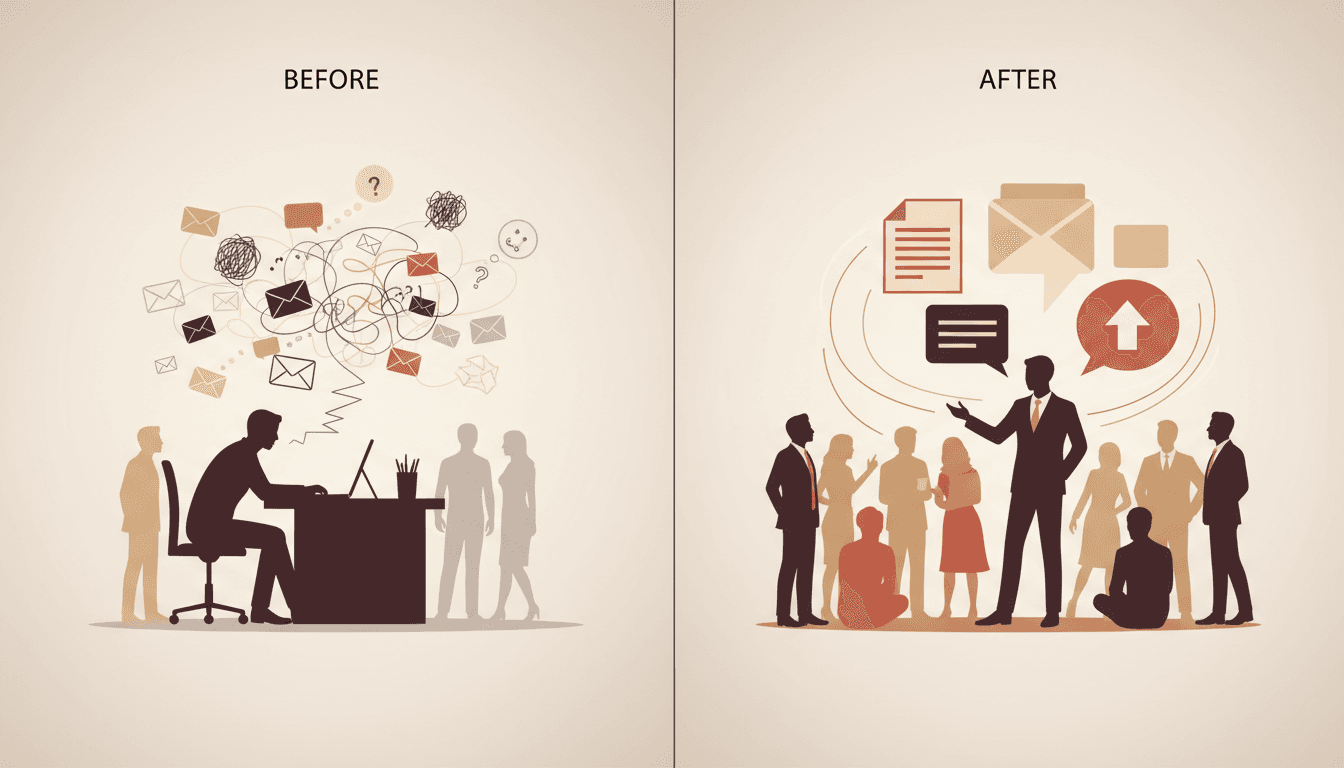
Confident Communication Examples for the Workplace (Before & After)
Confident communication in the workplace means replacing vague, apologetic, or hedging language with clear, direct, and purposeful phrasing — in emails, meetings, presentations, and one-on-one conversations. The difference between being overlooked and being respected often comes down to specific word choices. Below, you'll find more than 30 side-by-side before-and-after examples you can use immediately to sound more credible, assertive, and authoritative at work.

Stop Hedging Language at Work: Speak With Certainty
To stop hedging language at work, identify your most-used qualifier phrases — like "I just think maybe," "I could be wrong, but," and "sort of" — and replace them with direct, declarative alternatives. Start by auditing your speech and emails for one week, tracking every hedge word you use. Then practice specific replacement phrases daily until direct language becomes your default. Most professionals can dramatically reduce hedging within 30 days using a structured awareness-and-replacement meth
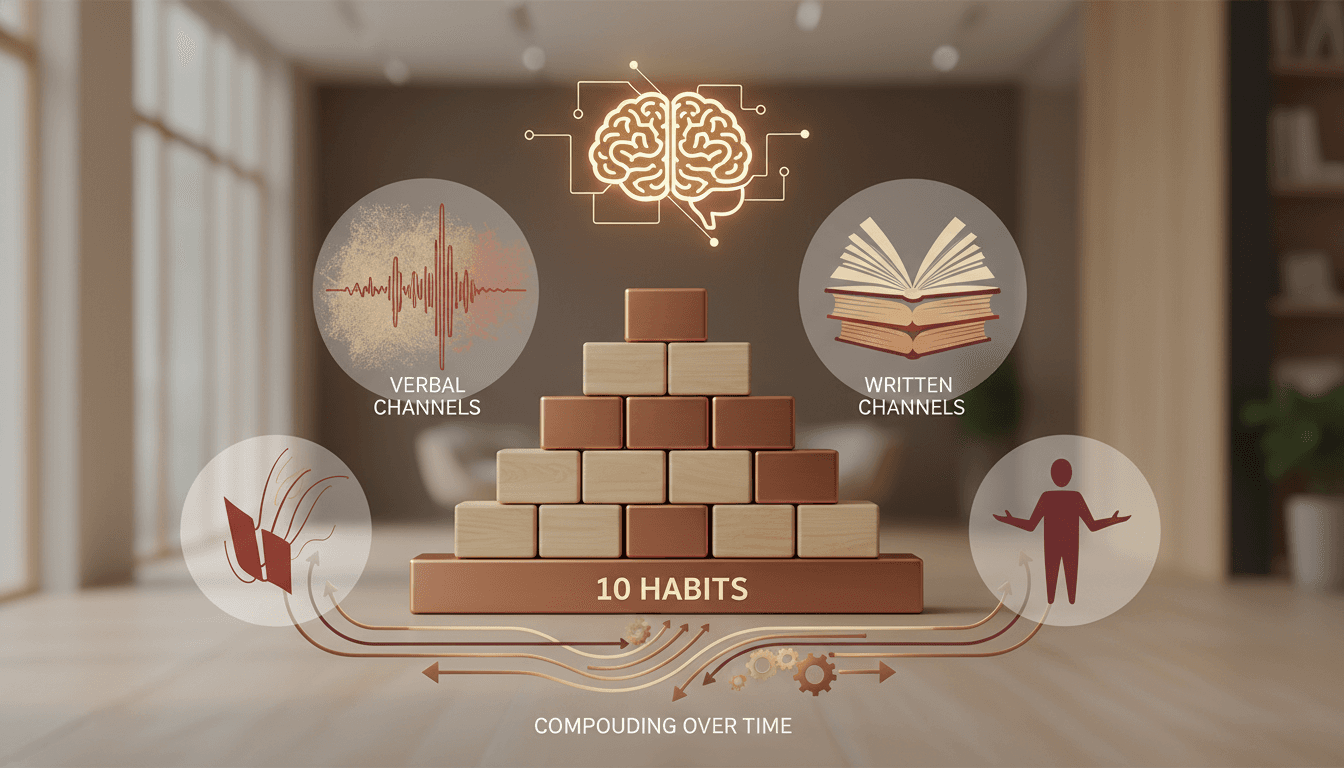
How to Communicate With Authority at Work: 10 Habits
To communicate with authority at work, build ten daily habits across verbal, written, and nonverbal channels: lead with your conclusion, eliminate hedging language, use strategic pauses, anchor your body language, control your vocal tone, write concisely, prepare a point of view before every meeting, ask high-value questions, set verbal boundaries, and follow through visibly. These small, repeatable actions compound over time to build a lasting reputation for credibility and leadership presence.