
Establish Authority at Work Without Being Arrogant: A Guide

What Is Workplace Authority (and How Is It Different from Arrogance)?
Workplace authority is the ability to influence decisions, shape direction, and earn trust based on your demonstrated competence, reliability, and judgment. It's the professional weight that makes people listen when you speak — not because of your title, but because of your track record.
Arrogance, by contrast, is the projection of superiority without the substance to back it up. It centers on ego rather than impact. The critical difference: authority invites people in, while arrogance pushes people away. Someone with genuine authority says, "Here's what the data shows and what I recommend." Someone operating from arrogance says, "I already know the answer — why are we even discussing this?"
According to a 2023 study published in the Journal of Applied Psychology, leaders perceived as confident but humble were rated 35% more effective by their teams than those perceived as confident but self-promoting. The distinction isn't subtle — it's career-defining.
For a deeper exploration of the building blocks, see our guide on leadership presence: definition, components, and how to build it.
The Authority-Arrogance Spectrum: Where Most Professionals Go Wrong
Why People Default to Arrogance Under Pressure
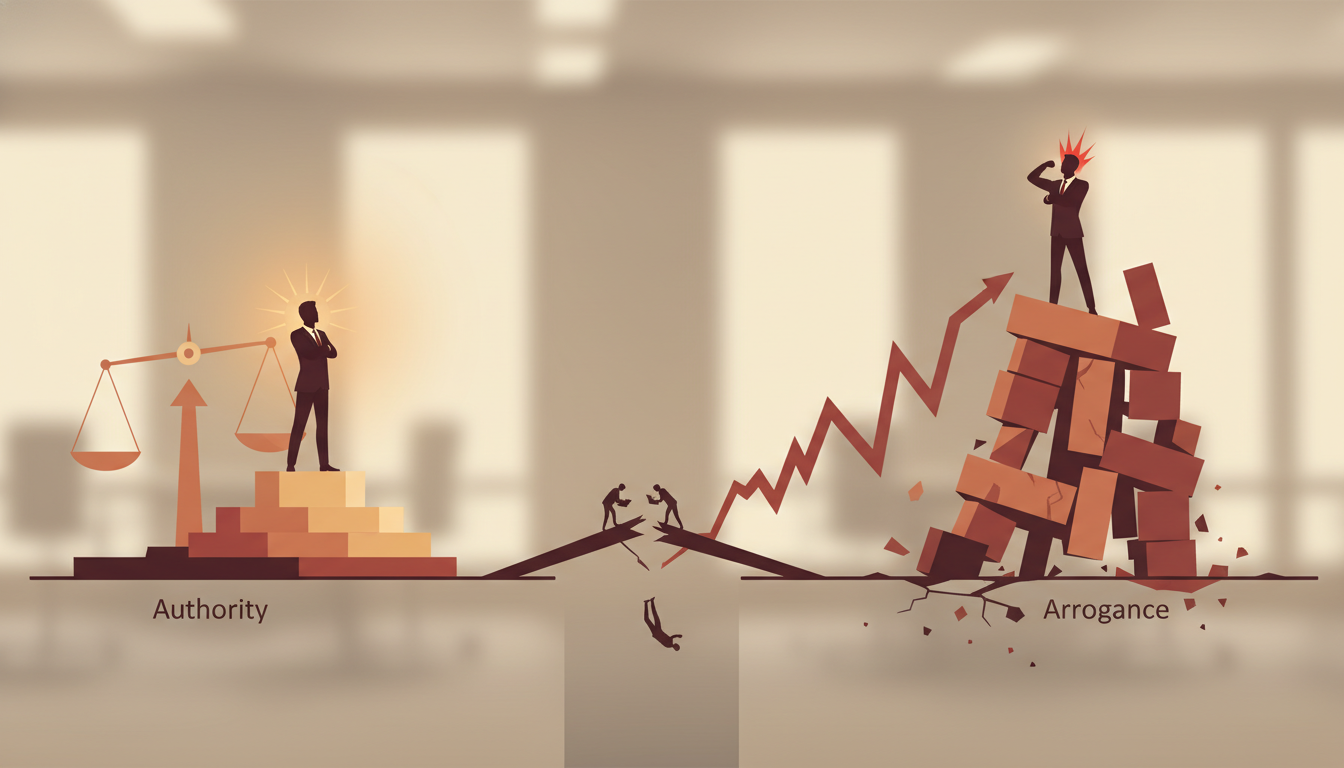
Most professionals don't intend to come across as arrogant. It happens when insecurity meets high stakes. You're in a meeting with senior leaders, you feel the need to prove yourself, and suddenly you're talking over colleagues, dismissing ideas too quickly, or name-dropping accomplishments.
This is what psychologists call "compensatory behavior" — overperforming confidence to mask uncertainty. The irony is that it undermines the very authority you're trying to build. Research from Harvard Business School shows that people who engage in self-promotion are perceived as 22% less competent by observers, even when the content of their claims is accurate (Scopelliti et al., 2015).
The Three Zones of Professional Presence
Think of your professional presence as existing on a spectrum with three zones:
- Under-assertive (Invisible): You defer constantly, hedge every statement, and avoid taking positions. People don't see you as a threat — but they also don't see you as a leader.
- Authoritative (The Sweet Spot): You state your perspective clearly, back it up with evidence, invite others' input, and hold your ground when challenged — without attacking.
- Arrogant (Overreach): You dominate conversations, dismiss dissent, claim credit broadly, and position yourself above peers rather than alongside them.
Most mid-career professionals oscillate between the first and third zones, skipping the middle entirely. If this resonates, our article on how to be more assertive at work without being rude offers a practical framework for finding that middle ground.
How to Self-Diagnose Your Current Position
Ask yourself three honest questions:
- After meetings, do colleagues seek your input — or avoid you? Authority attracts. Arrogance repels.
- When you share an idea, do you frame it as a contribution or a correction? "Here's another angle to consider" vs. "That's wrong — here's what we should actually do."
- Do you listen as much as you speak? A 2021 Zenger Folkman study of 4,000 leaders found that those rated highest in leadership effectiveness spent 60% of conversations listening and 40% speaking.
Five Behaviors That Build Authority Without Arrogance
1. Lead with Questions, Not Declarations
The most authoritative professionals in any room are often the ones asking the sharpest questions — not delivering the longest monologues. Strategic questions demonstrate that you understand the landscape well enough to know where the gaps are.
Instead of: "We need to pivot our Q3 strategy. The current approach isn't working." Try: "What's our confidence level that the current Q3 approach will hit the targets we committed to? And what would need to change if it won't?"The first version positions you as a critic. The second positions you as a strategic thinker. Both might lead to the same outcome, but the second earns you allies rather than enemies.
2. State Your Position, Then Open the Floor
Authority requires that you actually take a stand. The key is how you do it. Use what communication researchers call the "Assert and Invite" method:
- Assert: State your position clearly, with supporting evidence. No hedging, no apologies.
- Invite: Immediately open the floor for challenge or addition.
This approach signals confidence (you have a clear point of view) and humility (you genuinely want to stress-test it). For more on how executives use this kind of structured communication, read how executives communicate differently: 8 key patterns.
3. Give Credit Strategically and Generously
Nothing erodes authority faster than claiming credit that isn't fully yours. And nothing builds it faster than being the person who consistently highlights others' contributions.
A Glassdoor workplace survey found that 81% of employees say they're motivated to work harder when their boss shows appreciation for their work. When you are the one publicly acknowledging a colleague's insight or effort — especially in front of senior leaders — you demonstrate the security and generosity that define true authority.
Practical script: "I want to highlight something Maria identified in our analysis — it fundamentally changed how we approached this problem."This doesn't diminish you. It elevates you as someone who builds teams, not just personal brands.
4. Hold Your Ground Without Escalating
Authoritative professionals don't fold under pushback, but they also don't turn disagreements into battles. The framework here is "Acknowledge, Restate, Redirect":
- Acknowledge the other person's point genuinely.
- Restate your position with additional clarity or evidence.
- Redirect toward the shared goal.
5. Be Consistently Reliable, Not Occasionally Impressive
Arrogance often shows up as flashy, inconsistent performance — big wins followed by dropped balls. Authority is built on consistency. The professionals who command the most respect are the ones who deliver on every commitment, follow through on every promise, and show up prepared every time.
According to research from the Edelman Trust Barometer (2024), "competence" and "reliability" are the two highest-rated attributes for professional trust — outranking charisma, communication style, and even expertise. In other words, doing what you said you'd do, repeatedly, is the single most powerful authority-building behavior available to you.
Language Patterns That Signal Authority (Not Arrogance)
Words and Phrases to Eliminate

Certain language patterns undermine authority, while others inadvertently signal arrogance. Here are the most common culprits in each category:
Undermining phrases (too passive):- "I'm not sure if this is right, but…"
- "Sorry, I just wanted to add…"
- "This might be a dumb question…"
- "Obviously, the answer is…"
- "As I already explained…"
- "Anyone who's done this before knows…"
For a comprehensive list of language shifts, see how to stop undermining yourself at work: 12 hidden habits.
The Authority Language Framework
Replace both extremes with what we call "Grounded Language" — statements that are clear, direct, and inclusive:
| Instead of (Passive) | Instead of (Arrogant) | Use (Authoritative) |
|---|---|---|
| "I think maybe we should…" | "We need to…" | "I recommend we… based on [evidence]." |
| "Sorry to interrupt…" | "Let me stop you there." | "I'd like to build on that point." |
| "I could be wrong, but…" | "I'm right about this." | "The data supports [position]. Here's why." |
| "Does that make sense?" | "It's not that complicated." | "I want to make sure I've been clear." |
How to Deliver Hard Truths Without Burning Bridges
Authority sometimes requires saying things people don't want to hear. The key is to separate the message from the relationship. Use this three-part structure:
- Validate the context: "I understand why this direction felt right given the information we had."
- Present the reality: "The new data shows a different picture. Here's what's changed."
- Offer a path forward: "I'd suggest we adjust by doing X. Here's what that looks like."
This approach lets you be direct without being dismissive. For more on navigating these moments, check out how to disagree with your boss in a meeting respectfully.
Body Language and Presence: The Non-Verbal Authority Code
Posture and Space
Research from Columbia and Harvard universities (Carney, Cuddy, & Yap, 2010; updated by Cuddy et al., 2018) demonstrates that expansive, open postures are consistently associated with perceptions of confidence and competence. You don't need to dominate a room physically — you need to occupy your space fully.
Authority signals:- Sit upright with both feet on the floor
- Use open hand gestures at chest height
- Maintain steady (not aggressive) eye contact — aim for 60-70% of the time while speaking
- Avoid self-soothing gestures like touching your face or crossing your arms
- Leaning back with hands behind your head
- Pointing at people while speaking
- Taking up excessive physical space as a dominance display
- Refusing to make eye contact (signals contempt, not confidence)
Vocal Authority
Your voice carries as much authority as your words. The three vocal elements that signal authority without arrogance are:
- Pace: Speak 10-15% slower than your conversational speed. Rushing signals anxiety; deliberate pacing signals control.
- Downward inflection: End statements with a downward tone. Upward inflection ("uptalk") turns every statement into a question.
- Strategic pauses: Pause for 1-2 seconds before key points. This signals that what comes next matters — and that you're not afraid of silence.
For a deep dive into vocal techniques, our guide on how to speak with gravitas: 9 shifts that command respect covers each element with exercises.
Build the Presence That Earns Respect The Credibility Code includes a complete vocal authority module, body language audit, and daily practice system for building commanding presence — the kind that opens doors without pushing people away. Discover The Credibility Code
Positioning Strategies: Building Authority Over Time
Become the Person Who Synthesizes, Not Just Contributes
In meetings, most people either stay silent or add their own isolated point. Authoritative professionals do something different: they synthesize. They listen to the conversation, identify the through-line, and articulate it clearly.
Example: "It sounds like we're aligned on the problem — customer onboarding is too slow. Where we differ is whether the fix is a process change or a technology investment. Can we evaluate both against our Q4 budget constraints?"This positions you as the person who sees the whole board, not just your own piece. It's one of the most powerful authority-building moves available, and it requires zero self-promotion.
Build a Reputation Through Consistent Micro-Actions
Authority isn't built in a single moment. It's built through hundreds of small, consistent actions:
- Follow up on commitments within 24 hours. Every time.
- Send the summary email after meetings — the person who documents the discussion often shapes the narrative.
- Share relevant articles or data with colleagues before they ask. This positions you as someone who's always thinking ahead.
- Arrive prepared with a specific point of view for every meeting. Even if you don't share it, the preparation changes how you show up.
These micro-actions compound. Over six months, they transform how people perceive you — from "participant" to "leader." If you're looking for a structured approach to this kind of positioning, explore how to build authority in your career: a 5-step plan.
Manage Your Visibility Without Self-Promotion
One of the biggest fears around building authority is the concern about seeming self-promotional. The solution is to make your work visible through contribution, not announcement.
- Instead of saying "I closed the deal," say "The deal closed — here's what we learned that could help the team."
- Instead of listing your accomplishments in meetings, offer to present findings that benefit the group.
- Instead of broadcasting wins, document processes and share them as resources.
This approach ensures your competence is visible without ever feeling like you're bragging. The authority follows naturally.
Frequently Asked Questions
What is the difference between confidence and arrogance at work?
Confidence is grounded in competence and self-awareness — you know what you bring to the table and communicate it clearly. Arrogance is confidence without humility — it dismisses others' contributions and inflates your own. The practical test: confident professionals invite challenge and feedback; arrogant professionals shut it down. Confidence builds trust; arrogance erodes it. If colleagues feel comfortable pushing back on your ideas, you're likely landing on the right side.
How can I establish authority at work without a formal title?
Authority without a title comes from three things: expertise others rely on, consistent follow-through, and the ability to synthesize complex discussions into clear direction. Focus on becoming the person people consult before making decisions. Volunteer for cross-functional projects that increase your visibility. Document and share your knowledge. Title-based authority is borrowed; competence-based authority is earned and far more durable.
How do I know if I'm coming across as arrogant to colleagues?
Watch for these signals: colleagues stop offering ideas in your presence, you're excluded from informal discussions, people agree with you in meetings but don't follow through, or you receive feedback about being "intense" or "intimidating." The most reliable method is to ask a trusted peer directly: "Do I ever come across as dismissive or arrogant? I genuinely want to know." Their reaction to the question itself will tell you a lot.
Is it possible to be too humble at work?
Yes. Excessive humility can read as a lack of confidence or conviction, which undermines your credibility. If you consistently deflect compliments, refuse to share your perspective, or attribute all success to others while taking all blame yourself, you may be overcorrecting. Research from the University of North Carolina (2020) found that leaders who balanced humility with assertiveness were rated 28% more effective than those who leaned too far in either direction. The goal is calibrated confidence.
How do I build authority as a new leader without alienating the existing team?
Start by listening more than you speak for the first 30-60 days. Ask questions that show genuine curiosity about how things work and why. Make small, visible improvements before proposing large changes. Publicly acknowledge the team's existing strengths. When you do introduce change, frame it as building on what's already working rather than fixing what's broken. This earns trust before you spend it.
Authority vs. power at work — what's the real difference?
Power is positional — it comes from your role, title, or control over resources. Authority is personal — it comes from your credibility, expertise, and the trust others place in your judgment. You can have power without authority (a new executive no one respects yet) or authority without power (a senior individual contributor everyone consults). The most effective professionals build both, but authority is the foundation that makes power sustainable.
Be the Person Leadership Thinks Of First
The Credibility Code is a practical guide to the communication habits that get professionals noticed, trusted, and promoted.
Discover The Credibility CodeRelated Articles

Build Authority at Work Without Being Arrogant: A Guide
Building authority at work without being arrogant comes down to three core practices: signal competence through results (not self-promotion), elevate others while leading (collaborative authority), and maintain strategic visibility (so your work speaks before you do). True authority is granted by others based on trust, consistency, and demonstrated expertise—not claimed through dominance or ego. This guide gives you a complete framework for earning that authority while staying genuinely respecte

How to Present Yourself as a Leader Before Promotion
To present yourself as a leader before promotion, you need to shift from performing tasks to shaping outcomes. This means communicating with strategic clarity, making your contributions visible to decision-makers, taking ownership beyond your current role, and building credibility signals — like executive-level communication, composed body language, and a reputation for solving high-stakes problems — that make you the obvious choice when the opportunity arrives.

How to Position Yourself as an Expert at Work: 8 Moves
To position yourself as an expert at work, consistently share specialized knowledge, contribute insights before being asked, document your results, build a visible body of work, speak with authority in high-stakes moments, cultivate a strategic network, teach others what you know, and align your personal brand with a specific domain. These eight moves shift perception from "competent contributor" to "recognized authority."