
How to Develop Gravitas as a Leader: The Complete Method

Developing gravitas as a leader requires deliberate work across three dimensions: confidence (how you carry yourself), composure (how you respond under pressure), and substance (the depth behind your words). It is not an innate trait reserved for a few. You build gravitas by mastering structured thinking, controlling your emotional reactions, training your vocal delivery, and consistently demonstrating expertise. This article provides a complete, step-by-step method — including daily exercises, self-assessment questions, and real case studies — so you can develop genuine gravitas regardless of your natural personality.
What Is Gravitas in a Professional Context?
Gravitas is the quality that makes people stop, listen, and trust your judgment — even before you've proven yourself on a specific topic. It is the combination of intellectual weight, emotional steadiness, and authentic confidence that signals to others: this person is worth following.
Unlike charisma, which draws people in through energy and charm, gravitas earns respect through substance and composure. A leader with gravitas doesn't need to be the loudest voice in the room. They need to be the most grounded one.
In practical terms, gravitas shows up in three observable ways: the clarity of your thinking, the steadiness of your presence under pressure, and the consistency between what you say and what you do. When all three align, people experience you as credible, authoritative, and trustworthy.
For a deeper look at how gravitas differs from related concepts, see our breakdown of executive presence vs. confidence.
The Three Dimensions of Gravitas: A Framework
Most advice on gravitas is vague — "be more confident" or "command the room." That's not helpful. Research from the Center for Talent Innovation (now Coqual) found that gravitas is the single most important component of executive presence, cited by 67% of senior leaders surveyed. But what does it actually consist of?
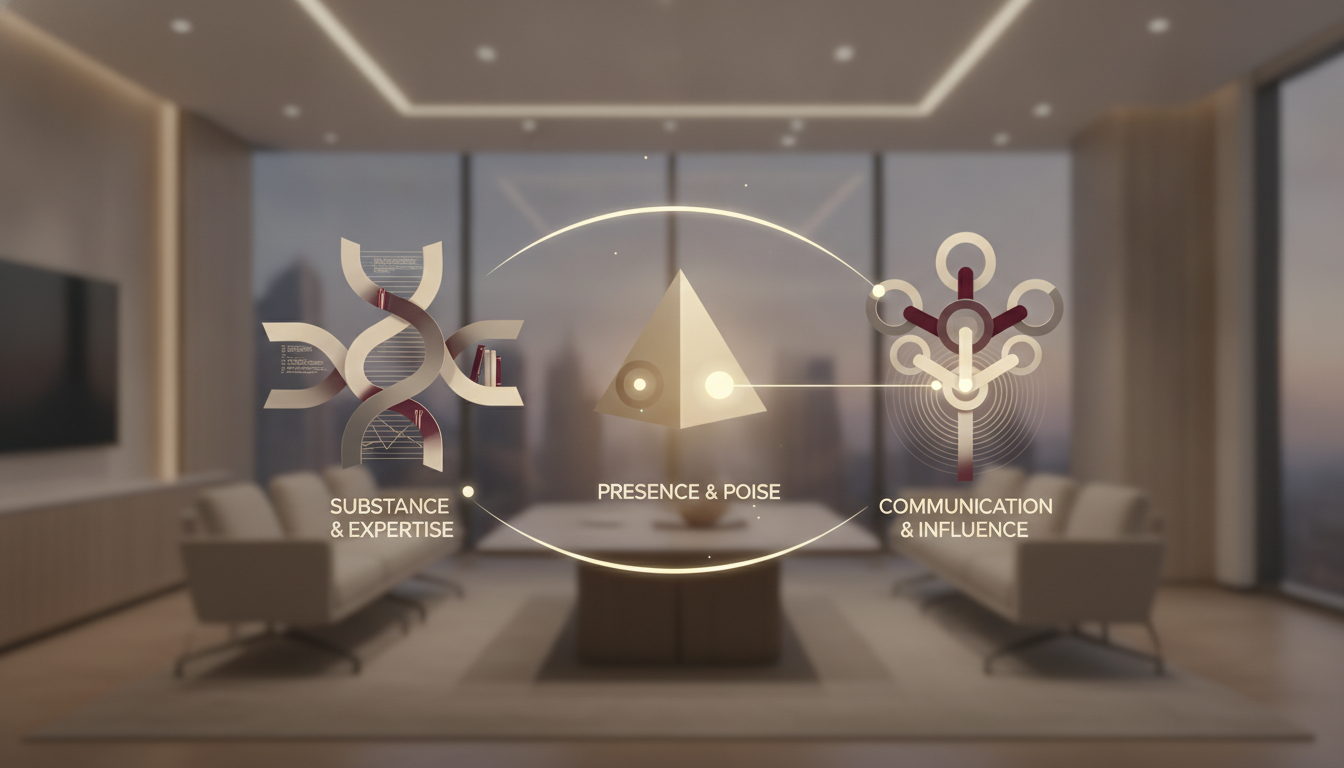
After analyzing how gravitas manifests in real workplace settings, we've identified three distinct dimensions. Developing all three is what separates leaders who are merely confident from those who carry genuine weight.
Dimension 1: Confidence — How You Carry Yourself
Confidence in the context of gravitas isn't bravado. It's the visible absence of self-doubt. It shows up in your posture, your willingness to hold silence, and your ability to state a position without hedging.
Leaders with this dimension don't preface their ideas with "This might be a dumb question, but..." or "I'm not sure if this is right, but..." They speak in declarative sentences. They make eye contact. They occupy space without apology.
What it looks like in practice: A director presenting quarterly results doesn't rush through bad numbers or apologize for them. She states the data clearly, explains the context, and outlines the path forward — all without flinching. The audience trusts her not because the numbers are good, but because she's not hiding from them.If you find yourself undermining your own points, our guide on how to stop undermining yourself at work identifies the eleven most common habits and how to break them.
Dimension 2: Composure — How You Respond Under Pressure
Composure is the dimension that separates leaders who seem authoritative from those who are authoritative. Anyone can project confidence when things are going well. Gravitas is tested when things go sideways.
A study published in the Harvard Business Review found that leaders who maintained emotional regulation during crises were rated 66% more effective by their teams than those who showed visible frustration or anxiety. Composure isn't about suppressing emotion — it's about choosing your response rather than reacting.
What it looks like in practice: A VP is blindsided during a board meeting with a question about a failed product launch. Instead of getting defensive or scrambling for data, he pauses, acknowledges the shortcoming directly, and says: "That's an important question. Here's what we know, here's what we don't, and here's what we're doing about it." The board walks away with more confidence in him, not less.Dimension 3: Substance — The Depth Behind Your Words
Gravitas without substance is performance. And people see through performance quickly.
Substance means you've done the thinking. You understand the broader context. You can connect your point to strategic priorities. You don't just share opinions — you share informed perspectives backed by evidence and experience.
According to a 2023 survey by Korn Ferry, 71% of C-suite executives said that "depth of knowledge and strategic thinking" was the primary factor that distinguished leaders with gravitas from those without it.
What it looks like in practice: A product manager doesn't just say "we should invest in mobile." She says: "Our mobile conversion rate is 40% below desktop, but mobile traffic has grown 28% year-over-year. If we close even half that conversion gap, we're looking at $2.3M in incremental revenue. Here's a phased approach." That's substance. That's gravitas.For a complete breakdown of building this kind of strategic communication, explore our guide on how to communicate like a senior leader.
The Gravitas Self-Assessment: Where Do You Stand?
Before you can develop gravitas, you need an honest picture of where you are now. Use these diagnostic questions across each dimension. Rate yourself 1 (rarely) to 5 (consistently) on each.
Confidence Self-Assessment
- Do I state my position clearly without excessive qualifiers?
- Can I hold eye contact comfortably during disagreements?
- Do I speak at a measured pace, or do I rush to fill silence?
- Am I comfortable saying "I don't know" without feeling diminished?
- Do I enter meetings with a clear point of view, or do I wait to see what others think first?
Composure Self-Assessment
- When challenged publicly, do I respond calmly or get defensive?
- Can I deliver bad news without over-apologizing or deflecting?
- Do I maintain my body language (open posture, steady voice) when stressed?
- When I make a mistake, do I address it directly or try to minimize it?
- In high-stakes conversations, do I pause before responding?
Substance Self-Assessment
- Can I connect my ideas to the organization's strategic priorities?
- Do I bring data or evidence to support my positions?
- When asked "why," can I explain my reasoning in a structured way?
- Do colleagues seek my perspective on complex problems?
- Can I simplify a complex topic without losing its meaning?
If your substance scores are low, the issue may not be knowledge — it may be how you structure and communicate what you know. Our guide on how to speak with authority at work covers eight daily practices that build this skill.
Daily Exercises to Build Each Dimension of Gravitas
Gravitas isn't built through a single workshop or book. It's built through daily, deliberate practice. Here are specific exercises for each dimension, designed to fit into your existing workday.

Exercises for Building Confidence
Exercise 1: The Declarative Sentence Drill (2 minutes/day)Before your first meeting each day, write down your key point in one declarative sentence. No qualifiers. No "I think" or "maybe." Just a clear statement of position. Example: "We should delay the launch by two weeks to resolve the onboarding issues." Practice saying it out loud before the meeting.
Exercise 2: The Silence HoldDuring one conversation per day, after making a point, deliberately pause for three full seconds before continuing. This trains you to be comfortable with silence — a hallmark of leaders with gravitas. Research from the University of Michigan found that speakers who paused for 2-3 seconds after key statements were perceived as 30% more credible than those who filled the silence.
Exercise 3: The Posture ResetSet three random alarms on your phone throughout the workday. When each alarm goes off, check your posture: feet flat, shoulders back, chin level. This physical reset reinforces the body language of confidence. For a deeper dive, see our guide on body language that conveys authority.
Exercises for Building Composure
Exercise 1: The Pressure Pause ProtocolWhen you receive a challenging question or criticism, train yourself to use this sequence: (1) Take one breath. (2) Acknowledge what was said. (3) Respond. This three-step pattern prevents reactive responses and gives you time to choose your words. Practice it in low-stakes situations first — a colleague's question, a minor disagreement — so it becomes automatic under real pressure.
Exercise 2: The Bad News RehearsalOnce a week, practice delivering a piece of uncomfortable information out loud. It could be a real update you need to share or a hypothetical scenario. Focus on stating the facts without softening language ("unfortunately," "I'm sorry but"), excessive context, or blame. Record yourself and listen back.
Exercise 3: The Post-Mortem JournalAfter any high-pressure interaction, spend two minutes writing: What happened? How did I react? What would the most composed version of me have done differently? This builds self-awareness, which is the foundation of composure.
Exercises for Building Substance
Exercise 1: The "So What?" TestBefore sharing any idea in a meeting, ask yourself: "So what? Why does this matter to the business?" If you can't answer that in one sentence, you're not ready to share it. This forces you to connect every contribution to strategic value.
Exercise 2: The Three-Layer PreparationFor any important meeting, prepare at three levels: (1) The data — what are the facts? (2) The analysis — what do the facts mean? (3) The recommendation — what should we do? Most people stop at layer one. Leaders with gravitas always reach layer three.
Exercise 3: The Weekly Deep ReadSpend 30 minutes each week reading one article, report, or analysis outside your immediate function. This builds the cross-functional knowledge that gives your contributions breadth and context — a key ingredient of substance.
Case Studies: Leaders Who Developed Gravitas Without Natural Charisma
One of the most damaging myths about gravitas is that it requires charisma. It doesn't. Some of the most respected leaders in business history built their authority through quiet substance, consistent composure, and steady confidence — not through force of personality.
Case Study 1: The Quiet CFO
Maria was promoted to CFO of a mid-size technology company at 38. She was introverted, soft-spoken, and self-conscious about being the youngest member of the executive team. In her first board meeting, she over-prepared with 47 slides and spoke quickly, trying to prove she belonged.
The feedback was polite but clear: the board wanted fewer slides and more judgment.
Maria changed her approach. She adopted the Three-Layer Preparation method, arriving at each meeting with three key points, each supported by one data point and one clear recommendation. She trained herself to speak more slowly, using the Silence Hold exercise. Within six months, the board chair described her as "the most credible voice in the room."
Maria didn't become more charismatic. She became more grounded. That's gravitas.
If you relate to Maria's experience, our guide on leadership presence without charisma offers a complete framework for quiet leaders.
Case Study 2: The Promoted Manager
David was a high-performing engineering manager who was promoted to director. He was technically brilliant but had a habit of getting visibly frustrated when his ideas were challenged. In cross-functional meetings, his defensive reactions undermined his credibility — even when his ideas were right.
David's development focused almost entirely on the composure dimension. He used the Pressure Pause Protocol in every meeting for 90 days. He kept a Post-Mortem Journal. He practiced the Bad News Rehearsal with a coach.
The transformation wasn't dramatic or sudden. But over three months, his peers and senior leaders began describing him differently. Instead of "smart but reactive," he became "thoughtful and steady." His ideas didn't change. His delivery did.
A 2022 study by DDI (Development Dimensions International) found that leaders who improved their emotional regulation skills saw a 25% increase in their leadership effectiveness ratings within one year. David's experience mirrors this finding precisely.
Case Study 3: The Career Changer
Priya transitioned from academia to a corporate strategy role at 42. She had deep analytical skills but no corporate credibility. Her colleagues didn't question her intelligence — they questioned her relevance.
Priya built gravitas through the substance dimension. She used the Weekly Deep Read exercise to learn the company's industry inside and out. She adopted the "So What?" Test before every contribution, ensuring her academic rigor was translated into business impact. She also worked on her confidence by eliminating hedging language from her vocabulary.
Within her first year, she was invited to present at the company's annual strategy offsite — a role typically reserved for tenured executives. Her gravitas came not from years of corporate experience, but from the disciplined way she prepared, communicated, and carried herself.
Build the Authority That Gets You Noticed Whether you're a quiet leader, a new executive, or a career changer, The Credibility Code provides the frameworks, scripts, and daily practices you need to develop genuine gravitas. Discover The Credibility Code
The 30-Day Gravitas Development Plan
Knowing what to do is not enough. You need a structured timeline. Here's a phased plan to develop gravitas over 30 days.
Week 1: Awareness (Days 1-7)
Complete the self-assessment above. Identify your weakest dimension. For this week, focus only on observation: notice how you show up in meetings, how you respond to pressure, and where your substance gaps are. Keep a daily journal of one observation per day. Don't try to change anything yet — just notice.
Week 2: Foundation (Days 8-14)
Begin the daily exercises for your weakest dimension. Practice one exercise per day, rotating through the three exercises for that dimension. At the end of each day, rate your execution on a 1-5 scale. The goal isn't perfection — it's consistency.
Week 3: Expansion (Days 15-21)
Add exercises from your second-weakest dimension while maintaining the first. You should now be practicing two exercises per day — one from each dimension. Start applying these skills in real meetings, beginning with lower-stakes settings.
Week 4: Integration (Days 22-30)
Practice all three dimensions simultaneously. Choose one high-stakes interaction per week where you deliberately apply all three: enter with a clear, confident point of view (confidence), manage your reactions if challenged (composure), and ground your contributions in data and strategic context (substance).
At the end of 30 days, retake the self-assessment. You should see measurable improvement in at least two dimensions.
For a complementary 30-day system, see our executive presence self-improvement plan.
Common Gravitas Killers (And How to Fix Them)
Even leaders who understand gravitas intellectually can sabotage it through unconscious habits. Here are the five most common gravitas killers and their fixes.
Killer 1: Over-Explaining
When you explain too much, you signal uncertainty. Leaders with gravitas make their point and stop. Fix: Use the "headline first, details on request" rule. State your conclusion, then wait. If people want more detail, they'll ask.
Killer 2: Reactive Body Language
Eye-rolling, sighing, crossing arms, looking at your phone — these micro-behaviors destroy gravitas instantly. Fix: Record yourself in a meeting (with permission) and watch it back. You'll be surprised by what you see. Awareness alone eliminates most of these habits.
Killer 3: Apologetic Language
"Sorry, but I just wanted to say..." strips your words of weight before you've even made your point. A study by the University of Waterloo found that unnecessary apologies in professional settings reduced the speaker's perceived competence by up to 22%. Fix: Replace "sorry" with direct statements. Instead of "Sorry to interrupt," say "I want to add something here."
Killer 4: Inconsistency
Gravitas requires consistency. If you're composed on Monday and explosive on Thursday, people won't trust your steadiness. Fix: Use the Post-Mortem Journal to track your patterns. Identify your triggers — specific people, topics, or situations that cause you to lose composure — and develop pre-planned responses for each.
Killer 5: Lack of Preparation
Nothing kills gravitas faster than being caught without substance. If you show up to meetings without a point of view, you're training people to see you as a passive participant, not a leader. Fix: Spend 10 minutes before every meeting answering three questions: What's my point of view? What data supports it? What's my recommendation?
For more on eliminating language habits that undermine your authority, read our guide on words that make you sound less confident at work.
Frequently Asked Questions
What is gravitas in leadership?
Gravitas in leadership is the quality of being taken seriously because of the weight and substance behind your words and actions. It combines three elements: confidence (how you carry yourself), composure (how you respond under pressure), and substance (the depth of your thinking). Unlike charisma, gravitas doesn't require extroversion — it requires consistency, preparation, and emotional steadiness. Leaders with gravitas are trusted, listened to, and respected even in difficult situations.
How long does it take to develop gravitas?
Most professionals see noticeable improvement within 30 to 90 days of deliberate practice. The confidence and composure dimensions can shift within weeks through daily exercises like the Silence Hold and Pressure Pause Protocol. The substance dimension takes longer because it requires building deeper knowledge and strategic thinking habits. However, the most significant factor is consistency — practicing daily, even for just 10 minutes, produces faster results than occasional intensive effort.
Gravitas vs. charisma: what's the difference?
Charisma draws people in through energy, warmth, and personal magnetism. Gravitas earns respect through substance, composure, and steady confidence. Charismatic leaders are liked; leaders with gravitas are trusted. You can have both, but they're independent qualities. Many highly effective leaders — think Warren Buffett or Angela Merkel — have significant gravitas with relatively low charisma. Gravitas is more learnable and more durable than charisma in professional settings.
Can introverts develop gravitas?
Absolutely. In fact, introverts often have a natural advantage in two of the three gravitas dimensions: composure (introverts tend to be less reactive) and substance (introverts tend to think deeply before speaking). The confidence dimension may require more deliberate work, specifically around speaking up, holding space, and projecting physical presence. But gravitas fundamentally rewards depth over volume — which plays to introverted strengths.
How do you show gravitas in meetings?
Show gravitas in meetings by doing three things: (1) Arrive with a clear, prepared point of view — not just questions or reactions. (2) Speak in declarative sentences without hedging language like "I think maybe" or "this might be wrong, but." (3) When challenged, pause before responding rather than getting defensive. These three behaviors — preparation, clarity, and composure — are the most visible markers of gravitas in any meeting setting.
Can you develop gravitas without being in a senior role?
Yes. Gravitas is not tied to title or tenure. You can demonstrate it at any level by consistently showing up prepared, speaking with clarity and conviction, and maintaining composure under pressure. In fact, developing gravitas before you reach a senior role is one of the most effective ways to get promoted into one. Senior leaders notice when someone at a lower level communicates with unusual substance and steadiness — it signals readiness for greater responsibility.
Build Presence People Notice Before You Say a Word
The Credibility Code gives you the specific verbal and nonverbal habits that make people treat you as the senior person in the room.
Discover The Credibility CodeRelated Articles

How to Build Executive Presence: A 5-Pillar Framework
Executive presence is built on five core pillars: gravitas, communication, appearance, emotional intelligence, and decisiveness. To develop it, you need to cultivate the weight behind your words, speak with clarity and conviction, project a polished image, read the room with precision, and make confident decisions under pressure. Executive presence isn't a personality trait you're born with—it's a skill set you build through deliberate daily practice across each of these pillars.

How to Communicate With Gravitas at Work: 7 Pillars
To communicate with gravitas at work, master seven interconnected pillars: composure under pressure, economy of language, conviction in delivery, emotional regulation, strategic thinking signals, commanding physical presence, and moral authority. Gravitas isn't about being the loudest person in the room—it's about being the most grounded. When you speak with gravitas, people stop multitasking and listen. These seven pillars give you a repeatable framework to build that weight into every conversa

How to Build Executive Presence: A Complete Roadmap
Executive presence is the combination of gravitas, communication skill, and professional appearance that signals leadership readiness. To build executive presence, start by developing your gravitas through decisive action and emotional composure. Then sharpen your communication by speaking concisely, structuring your thoughts before speaking, and eliminating hedging language. Finally, align your appearance and body language with the authority you want to project. The 90-day roadmap below walks y