
How to Stop Undermining Yourself at Work: 11 Hidden Habits
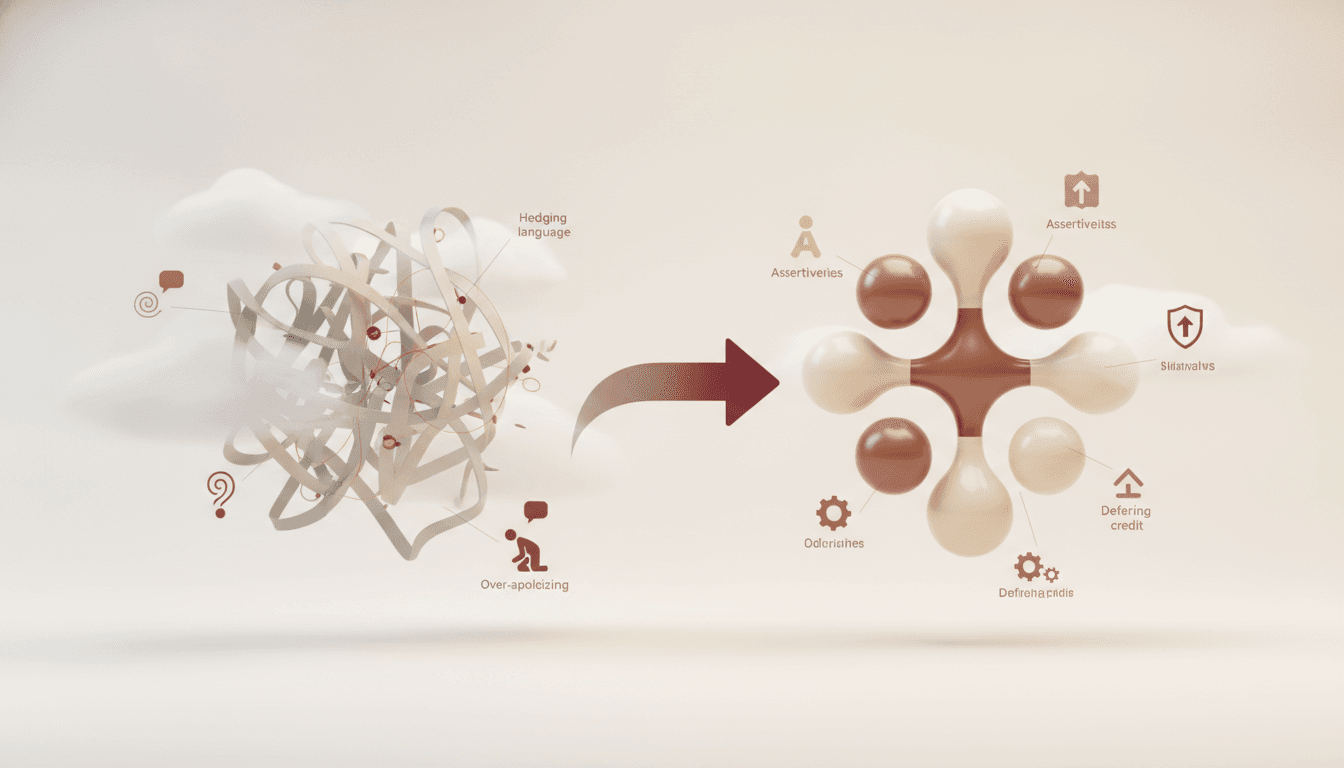
You stop undermining yourself at work by identifying and replacing the subtle communication habits that silently erode your credibility. The most common self-undermining behaviors include hedging your language ("I just think maybe..."), over-apologizing, using upspeak, deferring credit, and shrinking your physical presence. Each habit sends an unintentional signal that you lack conviction—even when your ideas are strong. Below, you'll find all 11 hidden habits with specific before-and-after replacements you can use immediately.
What Does "Undermining Yourself at Work" Mean?
Undermining yourself at work is the pattern of unconscious communication habits—verbal, written, and physical—that diminish your perceived competence, authority, and credibility in professional settings. Unlike external undermining by colleagues or managers, self-undermining is self-inflicted and often invisible to the person doing it.
These habits don't reflect a lack of skill or intelligence. They reflect a gap between your actual expertise and how you present it. A 2023 study by the National Bureau of Economic Research found that how confidently professionals communicate their ideas is a stronger predictor of influence than the quality of the ideas themselves. That means your delivery isn't just packaging—it is part of the message.
Why Smart Professionals Undermine Themselves (Without Realizing It)
The Socialization Factor

Most self-undermining habits aren't character flaws. They're learned behaviors. Many professionals—especially women, introverts, and first-generation professionals—were socialized to prioritize politeness, deference, and consensus over directness. These social scripts served a purpose in certain contexts, but they backfire in environments where authority and decisiveness are currency.
According to research published in Personnel Psychology (2019), employees who used tentative language in meetings were rated 36% lower on leadership potential by their managers—regardless of the substance of their contributions. The habit of softening your message to avoid seeming "too much" can quietly cap your career trajectory.
The Competence-Confidence Gap
There's a well-documented pattern in workplace psychology: the more competent you are, the more likely you are to second-guess yourself. This is related to the Dunning-Kruger effect, where high performers tend to underestimate their abilities while lower performers overestimate theirs.
The result? You hedge, qualify, and minimize—not because you lack knowledge, but because you're aware of complexity. The problem is that your audience doesn't hear nuance. They hear uncertainty. If you've ever felt like people don't take you seriously at work, this gap is likely a contributing factor.
The Feedback Vacuum
Most professionals never receive direct feedback about these habits. No manager pulls you aside and says, "You said 'sorry' four times in that meeting and it made you seem unsure." These behaviors fly under the radar precisely because they're small. But small, repeated signals compound into a reputation.
The 11 Hidden Habits That Undermine Your Credibility
Habit 1: Hedging Your Language
Hedging is the use of qualifiers that weaken your statements before anyone can evaluate them. Words like "just," "kind of," "sort of," "maybe," and "I think" signal that even you aren't fully behind your own point.
Before: "I just think maybe we should kind of consider a different approach." After: "I recommend we consider a different approach. Here's why."The fix isn't about being aggressive. It's about stopping hedging language and speaking with certainty. Remove the qualifiers and let your idea stand on its own merits.
Habit 2: Over-Apologizing
Apologizing when you've made a genuine mistake is professional. Apologizing for existing, having an opinion, or asking a question is self-undermining. A study by researchers at Harvard Business School (2020) found that unnecessary apologies—those unrelated to an actual offense—reduced the apologizer's perceived competence by 22%.
Before: "Sorry, but I have a question about the timeline." After: "I have a question about the timeline." Before: "Sorry to bother you, but could I get your input?" After: "I'd value your input on this."For a deeper dive into this pattern, see our guide on how to stop over-apologizing at work and what to say instead.
Habit 3: Upspeak (Turning Statements into Questions)
Upspeak is the vocal pattern of raising your pitch at the end of a declarative sentence, making it sound like a question. When you say "We should launch in Q3?" instead of "We should launch in Q3," you're implicitly asking for permission to hold your own opinion.
Before: "The data supports expanding into the Southeast market?" (rising inflection) After: "The data supports expanding into the Southeast market." (downward inflection, period)This is one of the most impactful vocal shifts you can make to sound confident in meetings. Record yourself in your next call and listen for it—most people are surprised by how often they do it.
Habit 4: Deferring Credit
When someone compliments your work and you respond with "Oh, it was a team effort" or "I just got lucky," you're training people to attribute your results to luck or others. Acknowledging your team is important, but reflexively deflecting personal credit erodes your professional brand.
Before: "Oh, it was nothing. Anyone could have done it." After: "Thank you. I put a lot of thought into the approach, and the team executed it well."This habit is closely related to the challenge of advocating for yourself at work without bragging.
Habit 5: Asking Permission to Speak
Phrases like "Can I say something?" or "Would it be okay if I added a point?" frame your contribution as optional and interruptible. You don't need permission to contribute in a meeting you were invited to attend.
Before: "Can I jump in here for a second?" After: "I want to add an important point to this." (Then add it.)Know exactly what to say next time. The Pushback Playbook has 50 word-for-word scripts for moments like this one: what they say, what you say, why it works, and what to do if they push back. Get The Pushback Playbook — $27
Habit 6: Minimizing Your Expertise
This shows up when you preface contributions with disclaimers like "I'm no expert, but..." or "This might be a dumb question..." These pre-apologies prime your audience to view what follows as less valuable.
Before: "I'm not sure if this is right, but I was thinking we could restructure the workflow." After: "Based on my experience with similar projects, I recommend restructuring the workflow."A 2021 study in the Journal of Experimental Social Psychology found that speakers who used disclaimers before sharing expertise were rated as 34% less credible than those who presented the same information without qualifiers—even when listeners were told both speakers had identical credentials.
Habit 7: Shrinking Your Physical Presence
Self-undermining isn't only verbal. Crossing your arms, hunching your shoulders, avoiding eye contact, sitting in the back of the room, and making yourself physically smaller all communicate subordination. Social psychologist Amy Cuddy's research at Harvard demonstrated that expansive postures increase feelings of confidence and are perceived as more authoritative by observers.
Before: Sitting at the edge of the table, arms crossed, looking down at notes. After: Sitting at the table, shoulders back, hands visible, making eye contact with speakers.For a complete breakdown of physical authority signals, explore our guide on body language that conveys authority.
Habit 8: Failing to Take Up Conversational Space
This habit manifests as speaking too quickly, using as few words as possible, or trailing off at the end of sentences. You rush through your point as if you're borrowing time that doesn't belong to you.
Before: "So yeah, I looked at the numbers and they seem fine, so... yeah." (spoken rapidly, trailing off) After: "I reviewed the numbers. Revenue is tracking 12% above forecast. I recommend we reallocate the surplus to the Q4 campaign." (measured pace, clear endpoint)The fix involves both speaking concisely and giving your words room to land. Pauses aren't empty space—they're power.
Habit 9: Laughing to Soften Serious Points
Nervous laughter after making a strong point or delivering critical feedback is a common self-undermining behavior. It signals to your audience that you're uncomfortable with your own authority, which gives them permission to dismiss what you've said.
Before: "We need to push the deadline back by two weeks, haha." After: "We need to push the deadline back by two weeks. Here's the revised plan."Notice the difference. The first version undercuts urgency. The second commands attention.
Habit 10: Waiting for the "Perfect" Moment to Speak
If you consistently wait for a natural pause that never comes, you're not being polite—you're being invisible. In fast-paced meetings, the "perfect" moment to contribute doesn't exist. People who are perceived as leaders interject strategically, not disruptively.
Before: (Thinking: "I'll wait until they finish this point...") — Meeting ends. You said nothing. After: "I want to build on that point before we move on." (Then speak.)If this resonates, you'll find actionable strategies in our post on being overlooked in meetings.
Habit 11: Writing Emails That Undermine Your Authority
Self-undermining in writing is especially damaging because it's permanent and shareable. Phrases like "Just checking in," "Sorry for the follow-up," "I could be wrong, but," and "No worries if not" all dilute your professional authority in writing.
Before: "Hi! Just wanted to check in on this. No worries if you haven't had a chance to look at it yet! Sorry for the follow-up 😊" After: "Following up on the proposal I sent Thursday. I'd like to finalize the plan by Friday. When can I expect your feedback?"For a complete email transformation, see our guide on how to sound authoritative in emails.
How to Audit Yourself for Self-Undermining Habits
The 3-Day Communication Audit

You can't fix what you can't see. Spend three days actively monitoring your communication using this framework:
Day 1 — Verbal audit. Record (or have a trusted colleague observe) two meetings. Count instances of hedging, upspeak, over-apologizing, nervous laughter, and permission-seeking. Don't try to change anything yet—just observe. Day 2 — Written audit. Review your last 20 sent emails. Highlight every instance of unnecessary apologies, minimizing language, and softening phrases. Tally them. Day 3 — Physical audit. Pay attention to your posture, eye contact, and spatial behavior in meetings. Where do you sit? How much space do you take up? Do you make eye contact when making a point?The Accountability Framework
After your audit, pick your top three habits to address. Research from University College London (2009) found that it takes an average of 66 days to form a new habit. Use this structure:
- Identify the trigger. When does the habit appear? (e.g., "I hedge when speaking to senior leaders.")
- Script the replacement. Write the exact words you'll use instead.
- Practice in low-stakes settings first. Use the replacement in one-on-one conversations before deploying it in high-visibility meetings.
- Track daily. Keep a simple tally of catches and corrections.
The Mindset Shift: From Politeness to Clarity
Directness Is Not Rudeness
The most common objection to eliminating self-undermining habits is: "But I don't want to seem arrogant or rude." This concern conflates directness with aggression. They're not the same.
Directness means saying what you mean without unnecessary qualifiers. Aggression means disregarding others' perspectives. You can be direct and respectful. You can be clear and kind. In fact, direct communication is often more respectful because it doesn't waste people's time or obscure your meaning.
For a deeper exploration of this balance, read our guide on building authority at work without being arrogant.
Reframing Confidence as Service
Here's a reframe that helps many professionals: when you communicate with clarity and conviction, you're not serving your ego—you're serving your audience. Your colleagues, clients, and leaders need to quickly understand your position so they can make decisions. Every hedge, disclaimer, and apology you add is friction that slows that process down.
Confidence in communication is an act of professional generosity. It makes you easier to understand, easier to trust, and easier to follow.
Frequently Asked Questions
How do I stop undermining myself at work if it's a lifelong habit?
Start with awareness, not perfection. Conduct a 3-day communication audit to identify your top patterns, then focus on replacing one habit at a time. Research shows new habits take approximately 66 days to solidify. Script your replacement phrases, practice in low-stakes conversations first, and track your progress daily. Small, consistent changes compound into a fundamentally different communication style.
What's the difference between being humble and undermining yourself?
Humility is accurately representing your abilities and acknowledging others' contributions. Self-undermining is inaccurately diminishing your abilities and deflecting credit you've earned. Humble communicators say, "The team did excellent work, and I'm proud of the strategy I developed." Self-undermining communicators say, "Oh, it was nothing—I just got lucky." The difference is accuracy, not volume.
Can self-undermining habits actually hurt my career advancement?
Yes. Research published in Personnel Psychology (2019) found that professionals who used tentative, hedging language were rated 36% lower on leadership potential by managers. Since promotion decisions are heavily influenced by perceived confidence and executive presence, self-undermining habits can create an invisible ceiling—even when your performance metrics are strong.
How do I stop undermining myself in emails specifically?
Audit your last 20 sent emails for patterns: unnecessary apologies ("Sorry for the follow-up"), softening phrases ("Just checking in"), permission-seeking ("Would it be okay if..."), and excessive exclamation points or emojis in professional contexts. Replace each with a direct alternative. "Sorry for the follow-up" becomes "Following up on my previous message." For detailed before-and-after examples, see our guide on sounding confident in emails.
Is self-undermining the same as imposter syndrome?
They're related but distinct. Imposter syndrome is an internal feeling—the belief that you're less competent than others perceive you to be. Self-undermining is the external behavior—the communication habits that make others perceive you as less competent. You can experience imposter syndrome without self-undermining (by managing your outward communication), and you can self-undermine without imposter syndrome (through ingrained habits rather than beliefs).
How long does it take to stop undermining yourself at work?
Most professionals see noticeable changes within 2-4 weeks of focused practice. However, fully replacing deeply ingrained habits typically takes 8-12 weeks of consistent effort. The key is targeting one or two habits at a time rather than trying to overhaul your entire communication style overnight. Progress isn't linear—expect setbacks, especially in high-pressure situations.
Never Be Caught Without the Right Words Again
50 word-for-word scripts for being talked down to, interrupted, dismissed, and put on the spot at work, plus five worksheets. PDF, 50 pages.
Get The Pushback Playbook — $27Related Articles

How to Stop Undermining Yourself at Work: 10 Fixes
To stop undermining yourself at work, identify and replace the specific communication habits that erode your credibility—like qualifying language ("I just think…"), excessive apologizing, vocal uptick, delayed responses, and chronic deference. Each habit has a concrete fix: swap hedging phrases for direct statements, replace apologies with acknowledgments, and practice assertive body language. The ten fixes below give you exact replacement scripts so you can project confidence and authority star

How to Stop Undermining Yourself at Work: 12 Hidden Habits
You stop undermining yourself at work by identifying and replacing the subtle communication habits that silently erode your credibility. The most damaging self-sabotage isn't dramatic—it's the hedging language, upspeak, chronic over-apologizing, praise deflection, and over-explaining that signal uncertainty to colleagues and leaders. By swapping these 12 hidden habits for specific authority-building alternatives, you project confidence and earn the professional respect your expertise deserves.

How to Handle Being Talked Down to at Work Professionally
To handle being talked down to at work, stay calm and address the behavior directly using neutral, assertive language. Name the specific behavior without attacking the person by saying something like, "I'd appreciate it if we could discuss this as equals—I have relevant expertise here." Set clear boundaries, document patterns of condescension, and escalate to HR if the behavior continues. The goal is to protect your credibility and professional standing without matching their tone or becoming re