
Build Authority at Work Without Being Arrogant: A Guide

Building authority at work without being arrogant comes down to three core practices: signal competence through results (not self-promotion), elevate others while leading (collaborative authority), and maintain strategic visibility (so your work speaks before you do). True authority is granted by others based on trust, consistency, and demonstrated expertise—not claimed through dominance or ego. This guide gives you a complete framework for earning that authority while staying genuinely respected.
What Is Workplace Authority (and Why It's Not About Ego)
Workplace authority is the earned ability to influence decisions, shape direction, and command trust—without relying on formal power or self-promotion. It's the professional credibility that makes people seek your input, defer to your judgment, and follow your lead voluntarily.
Authority and arrogance look similar on the surface but produce opposite results. Authority draws people in. Arrogance pushes them away. The difference lies in where the focus lands: authoritative professionals focus on the work, the team, and the outcome. Arrogant ones focus on themselves.
According to a 2023 study published in the Journal of Applied Psychology, leaders perceived as both competent and humble received 22% higher performance ratings from their teams than leaders perceived as competent but self-promoting. The data is clear—humility doesn't weaken authority. It amplifies it.
Understanding this distinction is the first step toward building professional credibility that lasts.
The Authority-Arrogance Spectrum: Where Most Professionals Go Wrong
Why Competent People Get Labeled as Arrogant
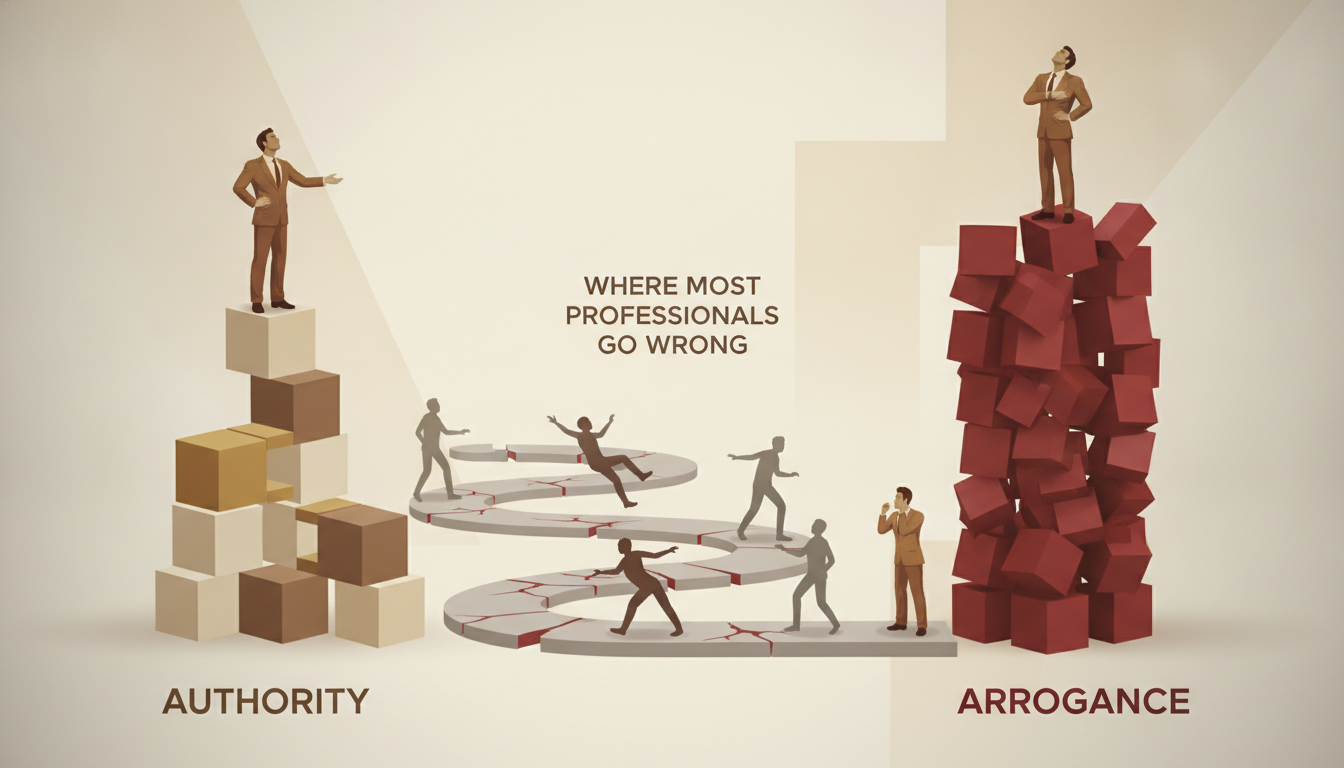
Here's the uncomfortable truth: many professionals who get called "arrogant" aren't actually egotistical. They're simply signaling competence in ways that feel threatening to others.
Common triggers include:
- Speaking with certainty when others are hedging
- Offering unsolicited expertise in meetings where norms favor consensus
- Moving quickly in cultures that value deliberation
- Being direct in environments that prize diplomacy
The issue isn't confidence itself—it's contextual mismatch. You're reading the room wrong, not being wrong. A 2022 Harvard Business Review analysis found that professionals who adapted their communication style to organizational culture were 31% more likely to be perceived as authoritative rather than aggressive.
Why Holding Back Doesn't Work Either
The opposite mistake is just as costly. Many professionals—especially women and introverts—overcorrect by shrinking. They soften every statement, defer excessively, and avoid visibility entirely.
This creates a different problem: you become invisible. Research from McKinsey's 2023 Women in the Workplace report showed that women who self-advocated at the same rate as their male peers were promoted 1.5x faster, with no increase in negative perception when they used collaborative framing.
The sweet spot isn't louder or quieter. It's strategically calibrated. If you've struggled with this balance, our guide on how to advocate for yourself at work without bragging breaks down the specific language patterns that work.
The "Earned Authority" Mindset
Arrogance assumes authority. Earned authority demonstrates it.
Shift your internal narrative from "I need people to know I'm smart" to "I need to consistently create value that people can see." This isn't about hiding your light. It's about letting your results generate the light while you stay focused on the work.
Professionals with earned authority share three traits:
- They prepare more than they perform. Their contributions are substantive, not performative.
- They credit others genuinely. Not as a tactic—because they actually notice contributions.
- They welcome challenge. They don't need to be right. They need the team to get it right.
Five Competence Signals That Build Authority Without Arrogance
Signal 1: Demonstrate Pattern Recognition
The fastest way to build authority is to see what others miss—and name it clearly.
In your next strategy meeting, try this framework:
The Pattern Bridge Statement: "I'm noticing a pattern across [X, Y, Z] that might be worth exploring. It seems like [observation]. What's your read on that?"Example: "I'm noticing a pattern across our last three product launches—we're consistently underestimating onboarding time by about 40%. It seems like our timeline models aren't accounting for the support team ramp-up. What's your read on that?"
This accomplishes three things: it shows analytical depth, it invites collaboration, and it positions you as someone who thinks systemically. You've demonstrated authority without making a single claim about yourself.
For more on how senior leaders structure their thinking this way, explore how executives structure their thinking before speaking.
Signal 2: Ask Questions That Reframe the Conversation
Authoritative professionals don't just answer questions—they ask better ones. A well-placed question can redirect an entire meeting and position you as the strategic thinker in the room.
High-authority question patterns:- The Upstream Question: "Before we solve this, what's causing it to recur?"
- The Stakeholder Question: "Who else will this decision affect that we haven't consulted?"
- The Assumption Question: "What are we assuming is true here that might not be?"
These questions signal that you're thinking at a higher level without claiming superiority. They also create genuine value for the group, which is why people start looking to you for direction.
Signal 3: Deliver Concise, Structured Contributions
Nothing signals authority like clarity. Nothing signals insecurity like rambling.
Use the PREP framework for meeting contributions:
- Point: State your position in one sentence
- Reason: Give the primary reason
- Evidence: Offer one data point or example
- Point: Restate your position
Example: "I recommend we delay the launch by two weeks. [Point] Our beta testing showed a 15% error rate on the checkout flow. [Reason] That's three times our acceptable threshold based on last quarter's standards. [Evidence] A two-week delay protects both revenue and customer trust. [Point]"
This takes 20 seconds. It sounds authoritative. And it doesn't contain a single self-referencing claim. For a deeper dive into speaking with this kind of precision, see our guide on how to speak concisely in meetings.
Signal 4: Show Your Work (Strategically)
There's a difference between bragging and making your contributions visible. Bragging says, "Look how great I am." Strategic visibility says, "Here's what happened, here's what we learned, and here's what it means for us going forward."
The Visibility Framework:| Instead of... | Try... |
|---|---|
| "I closed the biggest deal this quarter" | "The approach we tested on the Morrison account yielded 40% faster close—here's the playbook so the team can replicate it" |
| "I fixed the process" | "We identified a bottleneck in the approval chain. Here's the before-and-after data and the change we made" |
| "I was right about the market shift" | "The market data from Q3 confirmed what several of us suspected. Here's how we can position for Q4" |
Notice the pattern: shift from "I" to "we," from self-praise to shared learning, and from claiming credit to creating value. A Gallup 2023 workplace study found that managers who shared credit with their teams saw 28% higher engagement scores than those who took individual credit.
Signal 5: Be Consistently Reliable, Not Occasionally Brilliant
Authority is built through consistency, not occasional brilliance. The professional who delivers solid work every single time earns more authority than the one who occasionally produces something spectacular but is unpredictable.
This means:
- Follow through on every commitment, no matter how small
- Communicate proactively when timelines shift
- Prepare thoroughly for every meeting, not just the important ones
- Respond reliably to requests within a consistent timeframe
According to a 2022 study from the Center for Creative Leadership, "reliability" was rated as the #1 trait that built credibility with senior leaders—ahead of intelligence, charisma, and strategic thinking.
Strategic Visibility: Being Seen Without Being Self-Promotional
Choose Your Authority Domain

You can't be the authority on everything. Trying to be makes you look arrogant. Pick one or two domains where you want to be the go-to person, and invest deeply.
The Authority Domain Selection Criteria:- Organizational need: Is this area important to leadership right now?
- Genuine expertise: Do you have real depth here (or can you build it)?
- Low competition: Are others already owning this space?
- Career alignment: Does this position you for where you want to go?
Once you've chosen your domain, become the person who shares relevant insights, curates resources, and connects people. This is how you position yourself as an expert at work without ever having to say "I'm the expert."
Use the "Contribution, Not Credit" Communication Style
Every time you communicate about your work, run it through this filter: Am I highlighting a contribution to the team's goals, or am I claiming personal credit?
Contribution-focused language patterns:- "The data from our pilot suggests..."
- "One thing that worked well in this approach was..."
- "Building on what [colleague] started, we were able to..."
- "Here's a resource that might help the team with..."
This approach works because it positions you as a generous expert rather than a self-serving one. People remember who helped them succeed far more than who told them about their own success.
Build Authority Through Teaching
Teaching is the ultimate authority signal that never reads as arrogant. When you teach, you're simultaneously demonstrating expertise and serving others.
Practical ways to teach at work:
- Offer to run a 15-minute knowledge share at a team meeting
- Write a one-page "lessons learned" brief after a project
- Mentor a junior colleague and let the relationship speak for itself
- Create a resource guide for a common challenge your team faces
A 2023 LinkedIn Workplace Learning Report found that employees who regularly shared knowledge with colleagues were 3.5x more likely to be identified as "high-potential" by their managers. Teaching doesn't diminish your authority—it compounds it.
For a broader system of authority-building moves, see our complete guide on how to build authority in your career.
Collaborative Leadership: Authority That Elevates Everyone
The "First to Listen, Last to Speak" Principle
One of the most powerful authority moves is counterintuitive: speak last.
When you let others share their perspectives first, you gain three advantages:
- You gather more information before committing to a position
- You signal that you value others' input (the opposite of arrogance)
- You get the final word, which carries disproportionate weight in group decisions
This doesn't mean being passive. It means being strategically patient. When you do speak, synthesize what you've heard, add your perspective, and propose a direction. This is what leadership presence in meetings actually looks like.
Disagree Without Diminishing
Authoritative professionals disagree frequently—but they do it in ways that respect the other person's thinking.
The Respectful Disagreement Framework:- Acknowledge the logic: "I can see why that approach makes sense, especially given [X]."
- Introduce your concern: "The thing I'm wrestling with is [specific concern]."
- Offer an alternative: "What if we tried [alternative] to address both [their priority] and [your concern]?"
- Invite dialogue: "What am I missing in that thinking?"
This framework lets you hold a strong position while remaining genuinely open. It's the hallmark of what researchers call "intellectual humility"—and it's one of the strongest predictors of leadership effectiveness.
Build the Kind of Authority People Follow Willingly. The Credibility Code gives you the exact frameworks, scripts, and daily practices to establish yourself as a trusted authority—without ego, without self-promotion, and without pretending to be someone you're not. Discover The Credibility Code
Give Credit Publicly, Take Responsibility Privately
This single habit separates authoritative leaders from arrogant ones more than any other.
In practice:- In meetings: "Priya's analysis was what unlocked this. She identified the variable we were all missing."
- In emails: "Thanks to the ops team for turning this around under a tight deadline."
- When things go wrong: "I should have caught that earlier. Here's what I'm doing to fix it."
When you consistently elevate others' contributions and own your mistakes, you build a reputation that no amount of self-promotion could match. People will advocate for your authority because you've invested in theirs.
Body Language and Vocal Presence: The Non-Verbal Authority Code
Physical Presence That Commands Without Intimidating
Your body communicates authority before you say a word. The key is projecting calm confidence rather than aggressive dominance.
Authority body language cues:- Steady eye contact (not staring—the 70/30 rule: maintain eye contact 70% of the time while speaking)
- Open posture with uncrossed arms and visible hands
- Deliberate gestures rather than fidgeting or excessive hand movement
- Stillness when listening—don't shift, check your phone, or look around the room
- Taking up appropriate space without sprawling or invading others' space
For a complete breakdown, see our guide on body language that conveys authority.
Vocal Authority Without Vocal Dominance
How you sound matters as much as what you say. Authoritative voices share specific traits:
- Downward inflection at the end of statements (upward inflection sounds uncertain)
- Moderate pace—not rushed (signals anxiety) or excessively slow (signals condescension)
- Strategic pauses before key points, which signal confidence and give your words weight
- Consistent volume—loud enough to be heard clearly, not so loud that it feels aggressive
A study from Quantified Communications found that executives who used deliberate pausing and downward inflection were rated 32% more credible by audiences than those who spoke quickly with upward inflection—even when delivering identical content.
The goal isn't to perform authority. It's to remove the vocal habits that accidentally undermine it. Our guide on how to develop a commanding voice at work walks through daily vocal exercises that build this naturally.
Frequently Asked Questions
How do I build authority at work as a new employee?
Start by listening more than you speak for the first 30-60 days. Ask thoughtful questions that show you're learning the context. Deliver on small commitments with total reliability. Then, once you understand the culture and key challenges, begin sharing insights from your unique perspective. Authority as a new hire comes from demonstrating that you're both humble enough to learn and capable enough to contribute. See our full guide on building credibility when new to a role.
What's the difference between authority and arrogance at work?
Authority is granted by others based on demonstrated competence, reliability, and character. Arrogance is claimed by yourself based on self-perception. Authority focuses outward—on the team, the work, and the outcome. Arrogance focuses inward—on recognition, status, and being right. The simplest test: authoritative people make others feel capable. Arrogant people make others feel small.
Can introverts build authority at work?
Absolutely. Introverts often build stronger authority because their contributions tend to be more thoughtful and well-prepared. The key is choosing high-leverage moments to contribute rather than trying to speak in every discussion. Written communication, one-on-one conversations, and prepared meeting contributions are all authority-building channels where introverts naturally excel. Our guide on building presence as a quiet leader covers this in depth.
How do I build authority without a leadership title?
Focus on three things: become the most reliable person on your team, develop deep expertise in one valuable area, and consistently help others succeed. Authority without a title comes from influence, not position. When people voluntarily seek your input, defer to your judgment, or recommend you for opportunities—you have authority regardless of your title. Learn more in our guide on how to influence without formal authority.
How do I recover authority after being perceived as arrogant?
Start by genuinely listening to the feedback without defensiveness. Then make visible changes: ask more questions, credit others more explicitly, and actively seek input before making decisions. Consistency over 60-90 days will shift perception. The key is not to announce that you've changed—just change. People will notice. A single conversation where you say "I've been reflecting on how I show up, and I want to do better" can accelerate the reset significantly.
Authority vs. confidence at work—what's the difference?
Confidence is an internal state—your belief in your own abilities. Authority is an external perception—others' belief in your abilities. You can be confident without having authority (new to a role, haven't proven yourself yet) and you can have authority without feeling confident (experienced professional dealing with imposter syndrome). The goal is to align both: build genuine competence, let it show through your work, and allow your confidence to grow from evidence rather than wishful thinking.
Be the Person Leadership Thinks Of First
The Credibility Code is a practical guide to the communication habits that get professionals noticed, trusted, and promoted.
Discover The Credibility CodeRelated Articles

Establish Authority at Work Without Being Arrogant: A Guide
To establish authority at work without being arrogant, focus on competence-driven credibility rather than ego-driven dominance. This means leading with expertise, asking powerful questions, giving credit generously, speaking with precision, and demonstrating consistent reliability. Authority built on value — not volume — earns lasting respect. The professionals who command the most influence are rarely the loudest; they're the ones others consistently turn to for clarity, direction, and sound ju

Build Career Authority Without Being Self-Promotional
You can build career authority without being self-promotional by shifting your focus from talking about yourself to consistently delivering visible value. The most credible professionals don't announce their expertise — they demonstrate it through strategic question-asking, contribution framing, knowledge sharing, and solving problems others avoid. Authority built this way feels earned rather than claimed, which makes it far more durable and respected than any self-promotion ever could.

How to Position Yourself as an Expert at Work: 8 Moves
To position yourself as an expert at work, consistently share specialized knowledge, contribute insights before being asked, document your results, build a visible body of work, speak with authority in high-stakes moments, cultivate a strategic network, teach others what you know, and align your personal brand with a specific domain. These eight moves shift perception from "competent contributor" to "recognized authority."