
How to Speak Up in Meetings When Nervous: 7 Strategies

What Is Meeting Anxiety?
Meeting anxiety is the physiological and psychological stress response triggered by the prospect of speaking in a group professional setting. It often manifests as a racing heart, shallow breathing, mental blanking, and an overwhelming urge to stay silent—even when you have valuable insights to share.
Meeting anxiety is not a character flaw or a sign of incompetence. It's a well-documented phenomenon rooted in social evaluation threat—the brain's fear of being judged by peers and authority figures. According to the National Institute of Mental Health, approximately 73% of the population experiences some degree of glossophobia, or fear of public speaking, which extends directly into workplace meeting environments.
Understanding this distinction matters: the goal isn't to eliminate nervousness entirely. It's to build systems that let you contribute despite it. That's what separates professionals who get overlooked from those who build authority at work without a title.
Why Speaking Up in Meetings Feels So Hard
The Neuroscience Behind Meeting Nerves
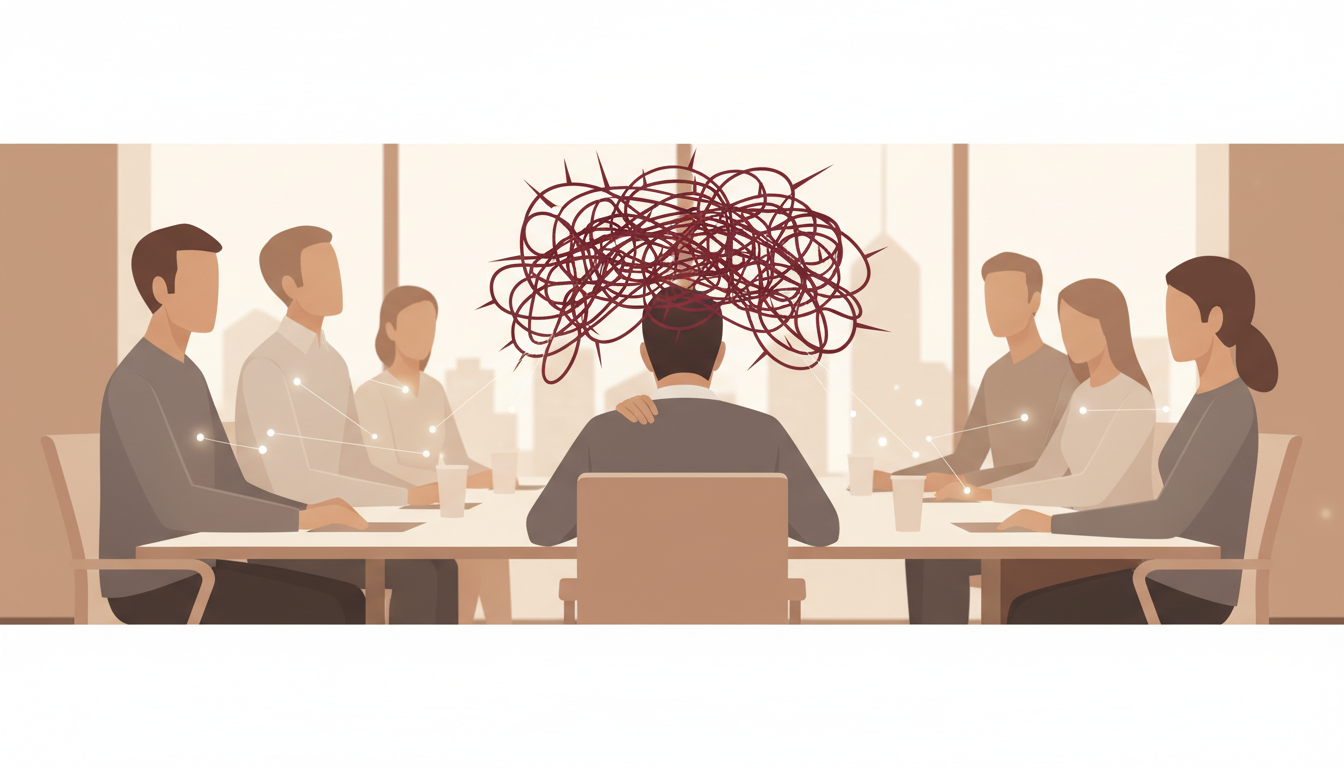
When you anticipate speaking in a meeting, your amygdala—the brain's threat detection center—activates a fight-or-flight response. Your body floods with cortisol and adrenaline. Blood moves away from your prefrontal cortex (where clear thinking happens) and toward your limbs (where running away happens).
This is why you can rehearse a brilliant point in your head, then freeze the moment it's your turn to speak. A 2019 study published in NeuroImage found that social evaluation anxiety significantly reduces activity in the brain regions responsible for verbal fluency and working memory. In other words, your brain is literally working against you in those moments.
The Visibility-Credibility Gap
Staying silent in meetings creates a compounding problem. Research from Yale School of Management found that people who speak up in group settings are consistently rated as more competent—even when their contributions aren't objectively better than those of quieter colleagues. Over time, silence erodes your perceived expertise.
This creates what we call the visibility-credibility gap: you may be the most knowledgeable person in the room, but if no one hears your perspective, that knowledge doesn't translate into career capital. If you've ever felt overlooked despite doing excellent work, this gap is likely the reason. It's a pattern we explore in depth in our guide on why people don't take you seriously at work and how to fix it.
The Perfectionism Trap
Many nervous speakers stay silent because they're waiting for the "perfect" moment or the "perfect" point. They mentally draft and redraft their contribution until the conversation has moved on. This perfectionism is a defense mechanism—if you never speak, you can never be wrong.
But meetings don't reward perfection. They reward participation. A Harvard Business Review study found that employees who contribute regularly in meetings are 40% more likely to be rated as high-potential by their managers, regardless of the quality of every individual comment.
7 Proven Strategies to Speak Up in Meetings When Nervous
Strategy 1: The Pre-Meeting Preparation Ritual
Walking into a meeting without preparation is like walking onto a stage without a script. You're relying entirely on improvisation while your nervous system is working against you.
The 10-Minute Prep Framework:- Review the agenda and identify two to three points where you have relevant knowledge or an opinion.
- Write down one specific contribution for each point—a question, a data point, an observation, or a recommendation.
- Rehearse your strongest point out loud at least twice. Hearing your own voice say the words reduces the novelty shock when you say them in the room.
- Identify your "first move"—the single, low-risk contribution you'll make in the first five minutes.
For example, if you're attending a quarterly planning meeting, you might prepare: "I noticed our customer churn rate dropped 12% after we implemented the new onboarding flow. I think that's worth factoring into our Q3 resource allocation." That's specific, data-backed, and takes ten seconds to deliver.
This approach is part of the broader communication system we cover in how to communicate with confidence at work as a daily system.
Strategy 2: Use Low-Risk Entry Points
Not every meeting contribution needs to be a groundbreaking insight. In fact, the most effective way to break through meeting anxiety is to start with low-stakes contributions and build momentum.
The Contribution Ladder (from lowest to highest risk):- Level 1: Agree with someone else's point and add a brief reason. ("I agree with Sarah's point—we saw similar results on our team last quarter.")
- Level 2: Ask a clarifying question. ("Can you walk us through how that timeline accounts for the vendor delay?")
- Level 3: Share a relevant data point or observation. ("One thing worth noting—our support tickets on this feature increased 30% last month.")
- Level 4: Offer a recommendation or alternative perspective. ("I'd suggest we pilot this with the Southeast region first, since they have the shortest implementation timeline.")
- Level 5: Challenge an assumption or push back respectfully. ("I see the logic, but I'm concerned we're underestimating the compliance review timeline.")
Start at Level 1 or 2 in every meeting. Once you've spoken once, the psychological barrier drops dramatically. A study from the University of Texas at Austin found that participants who made an early, low-stakes contribution in group discussions were 67% more likely to make substantive contributions later in the same session.
Know exactly what to say next time. The Pushback Playbook has 50 word-for-word scripts for moments like this one: what they say, what you say, why it works, and what to do if they push back. Get The Pushback Playbook — $27
Strategy 3: The 4-7-8 Breathing Reset
Physical anxiety symptoms—shaking hands, tight throat, racing heart—make it nearly impossible to sound confident even when your content is strong. You need a physiological tool, not just a psychological one.
The 4-7-8 Technique (adapted for meetings):- Inhale quietly through your nose for 4 seconds.
- Hold your breath for 7 seconds.
- Exhale slowly through your mouth for 8 seconds.
- Repeat two to three times.
Do this in the two minutes before the meeting starts, or during a transition between agenda items. The extended exhale activates your parasympathetic nervous system, directly counteracting the fight-or-flight response.
This isn't just anecdotal. Research published in Frontiers in Psychology (2017) demonstrated that controlled breathing techniques reduced self-reported anxiety by up to 44% in participants facing social performance situations. For more techniques on managing the physical symptoms of nervousness, see our guide on how to stop sounding nervous when speaking.
Strategy 4: Reframe Nervousness as Engagement
The internal narrative "I'm nervous" and the internal narrative "I'm engaged and invested" produce nearly identical physiological responses—elevated heart rate, heightened alertness, increased energy. The difference is interpretation.
The Reframing Script:Instead of: "My heart is racing. I'm going to sound stupid."
Try: "My body is preparing me to contribute. This energy means I care about this topic."
Harvard Business School professor Alison Wood Brooks tested this approach in a landmark 2014 study. Participants who reframed anxiety as excitement performed significantly better in public speaking tasks than those who tried to calm down. The key insight: trying to suppress nervousness backfires. Redirecting it works.
In practice, this means telling yourself before a meeting: "I'm energized about this discussion" rather than "I need to calm down." It's a small linguistic shift with outsized impact on your delivery and presence—a principle central to how to sound confident in a meeting even when you're not.
Strategy 5: Claim Your Space with Body Language
Your body communicates before your mouth does. When you're nervous, your body instinctively shrinks—shoulders round, arms cross, eyes drop. This signals uncertainty to the room and reinforces your internal anxiety.
The Meeting Presence Checklist:- Sit at the table, not against the wall. Physical proximity to the center of the discussion signals belonging.
- Place both forearms on the table. This open posture projects engagement and authority.
- Make eye contact with the speaker before you contribute. This signals you're about to add to the conversation and naturally creates a pause for you to enter.
- Use a deliberate hand gesture when making your point. Research from the University of Chicago found that speakers who use purposeful hand gestures are perceived as 28% more credible than those who keep their hands still.
These aren't power poses or theatrical tricks. They're practical adjustments that change how others perceive you and how you perceive yourself. For a deeper exploration, see our guide on body language for leadership presence.
Strategy 6: Use the "Anchor and Add" Technique
One of the biggest fears nervous speakers have is that their contribution will seem disconnected or irrelevant. The "Anchor and Add" technique eliminates this fear by structurally tying your point to something already on the table.
The Formula:"Building on [person's name]'s point about [specific topic], I'd add that [your contribution]."
Examples in action:- "Building on Marcus's point about the timeline, I'd add that our engineering team flagged a dependency that could shift the launch by two weeks."
- "Building on what the client shared about their budget constraints, I'd add that we have a phased approach that could address their top priority within their current allocation."
This technique works for three reasons: it shows you're listening, it validates another person's contribution (which builds social capital), and it provides a natural bridge into your point without requiring you to "start from scratch." It's one of the professional communication frameworks leaders use daily.
Strategy 7: Set a Contribution Commitment
Vague intentions ("I'll try to speak up more") almost never work. Specific commitments do.
The Meeting Contribution Contract:Before each meeting, commit to a specific, measurable contribution goal:
- "I will make at least one comment in the first ten minutes."
- "I will ask one question during this meeting."
- "I will share my team's update without reading from my notes."
Write it down. Put it at the top of your meeting notes. After the meeting, assess: did you meet your commitment?
This approach leverages implementation intentions—a concept from psychology researcher Peter Gollwitzer, whose studies show that people who set specific "when-then" plans are two to three times more likely to follow through than those who set general goals. Over weeks and months, this practice builds a track record of participation that rewires your brain's association with meetings from "threat" to "routine."
How to Build a Long-Term Meeting Confidence Practice
Track Your Progress with a Contribution Log

After each meeting, spend 60 seconds recording: what you said, how it landed, and what you'd do differently. This creates a feedback loop that most professionals never build.
Over time, you'll notice patterns—certain meeting formats feel easier, certain topics give you more confidence, certain preparation methods work better. This data transforms meeting confidence from a vague aspiration into a measurable skill you're actively developing.
Expand Your Comfort Zone Gradually
Don't leap from silent observer to keynote speaker. Use a progressive exposure approach:
- Week 1-2: Make one low-risk contribution per meeting (Level 1-2 on the Contribution Ladder).
- Week 3-4: Make one substantive contribution per meeting (Level 3-4).
- Week 5-6: Volunteer to present a brief update or lead a segment.
- Week 7-8: Offer a recommendation or respectfully challenge an idea.
This gradual escalation is how professionals build leadership presence quietly, without being loud. Each step builds neural pathways that make the next step feel less threatening.
Find an Accountability Partner
Tell one trusted colleague about your goal to speak up more. Ask them to notice when you contribute and give you honest feedback afterward. Social accountability dramatically increases follow-through—and having an ally in the room reduces the feeling of isolation that fuels anxiety.
Common Mistakes That Keep You Silent
Waiting for Permission to Speak
In many meetings, there's no formal invitation to contribute. If you're waiting for someone to call on you, you may wait forever. Practice entering conversations during natural pauses rather than waiting for a gap that may never come. If you struggle with this in senior settings, our guide on how to speak up in meetings with senior leaders offers specific scripts.
Over-Apologizing When You Do Speak
Starting with "Sorry, this might be a dumb question" or "I'm not sure if this is relevant, but..." immediately undermines your credibility. Replace these hedges with direct openers: "One thing worth considering..." or "I have a question about..." For more on this pattern, see how to stop undermining yourself at work.
Trying to Eliminate Nervousness Entirely
The goal isn't zero anxiety. It's functional confidence—the ability to contribute effectively while nervous. Every seasoned executive still feels nerves before high-stakes meetings. The difference is they have systems to perform despite those nerves, not in the absence of them.
Frequently Asked Questions
How do I speak up in meetings when I'm nervous?
Start with a pre-meeting preparation ritual: review the agenda, prepare two to three specific talking points, and commit to making one low-risk contribution in the first five minutes. Use controlled breathing to manage physical symptoms and reframe your nervousness as engagement rather than fear. Build momentum with small contributions before attempting larger ones.
What causes meeting anxiety at work?
Meeting anxiety stems from social evaluation threat—your brain's fear of being judged by colleagues and authority figures. This triggers a fight-or-flight response that impairs verbal fluency and working memory. Contributing factors include perfectionism, past negative experiences, power dynamics with senior leaders, and lack of preparation.
Meeting anxiety vs. social anxiety: what's the difference?
Meeting anxiety is specific to professional group settings and typically centers on performance concerns—fear of sounding unintelligent or being judged by colleagues. Social anxiety disorder is a broader clinical condition affecting multiple social situations and daily functioning. Meeting anxiety can often be managed with preparation and behavioral strategies, while social anxiety disorder may require professional therapeutic support.
How long does it take to overcome fear of speaking up in meetings?
Most professionals see noticeable improvement within four to six weeks of consistent practice using structured strategies like the Contribution Ladder and preparation rituals. Full confidence typically develops over three to six months. The key is progressive exposure—starting with low-risk contributions and gradually increasing complexity, rather than attempting dramatic overnight change.
Can introverts be confident speakers in meetings?
Absolutely. Introversion is about energy preferences, not communication ability. Introverts often excel in meetings when they prepare in advance and use structured contribution methods like the "Anchor and Add" technique. Many of the most credible meeting contributors are introverts who leverage preparation and strategic timing. For more, read our guide on how to build confidence in meetings even as an introvert.
What should I say first in a meeting when I'm nervous?
The easiest first contribution is agreeing with a colleague and adding brief context: "I agree with [name]'s point—we saw similar results on our team." Alternatively, ask a clarifying question about something already discussed. Both options are low-risk, show engagement, and break the psychological barrier of silence so that subsequent contributions feel easier.
Never Be Caught Without the Right Words Again
50 word-for-word scripts for being talked down to, interrupted, dismissed, and put on the spot at work, plus five worksheets. PDF, 50 pages.
Get The Pushback Playbook — $27Related Articles

How to Handle Being Interrupted in Meetings Professionally
When you're interrupted in a meeting, pause briefly, maintain open body language, and use a calm redirect phrase such as "I'd like to finish my point" or "Let me complete this thought." The key is responding without escalating—combining assertive language with composed delivery signals confidence and commands respect. Chronic interrupters can be managed through proactive strategies like pre-framing your contributions, building alliances, and addressing the pattern directly in private.

Assertive Communication at Work: 15 Before & After Examples
Assertive communication at work means expressing your ideas, needs, and boundaries clearly and respectfully — without being passive or aggressive. Here are 15 real-world before-and-after examples: Instead of saying "Sorry, I just think maybe we could…" say "I recommend we take a different approach. Here's why." Instead of staying silent when your idea is taken, say "I appreciate you building on the point I raised earlier — let me expand on it." These examples, and 13 more below, cover meetings,

How to Speak Up in Meetings as a Woman: 9 Proven Tactics
To speak up in meetings as a woman, prepare one key point in advance, use the first five minutes to establish your voice, anchor contributions in data, and employ strategic language that resists interruption. Build alliances with colleagues who will amplify your ideas and practice vocal authority techniques that project calm confidence. The goal isn't to change who you are—it's to ensure the room hears what you already bring.