
Leadership Presence in Difficult Conversations: A Method

What Is Leadership Presence in Difficult Conversations?
Leadership presence in difficult conversations is the combination of emotional steadiness, verbal precision, and physical composure that allows you to stay credible and authoritative when a conversation becomes tense, adversarial, or emotionally charged. It's not about winning arguments—it's about holding your ground while keeping the relationship and your reputation intact.
Unlike general leadership presence, which applies broadly across meetings, presentations, and daily interactions, presence in difficult conversations requires a specific set of skills tuned to high-emotion environments. The stakes are higher, the margin for error is thinner, and the consequences of losing composure are immediate.
A 2023 study by the Center for Creative Leadership found that 91% of employees say how their leader handles conflict directly impacts their trust in that leader. That single statistic tells you everything: difficult conversations aren't just about the issue at hand—they're auditions for your credibility.
The Emotional Regulation Foundation
Before you can manage a difficult conversation, you have to manage yourself. Emotional regulation isn't about suppressing emotion. It's about creating enough internal space to choose your response rather than react.

The 90-Second Neurological Reset
Neuroscientist Dr. Jill Bolte Taylor's research shows that the chemical process of an emotional reaction—the cortisol and adrenaline surge—lasts approximately 90 seconds. After that, any continued emotional flooding is being sustained by your own thinking, not your biology.
This means your first job in a difficult conversation is to buy yourself 90 seconds. Here's how:
- Pause before responding. Take a deliberate breath. Take a sip of water. Say, "Let me think about that for a moment." The pause itself signals authority, not weakness.
- Ground physically. Press your feet flat into the floor. Feel the chair beneath you. This activates your parasympathetic nervous system and interrupts the fight-or-flight loop.
- Name the emotion internally. Research from UCLA's Matthew Lieberman shows that simply labeling an emotion ("I'm feeling defensive right now") reduces amygdala activation by up to 50%. You don't say this out loud—you say it to yourself.
Pre-Conversation Priming
The best leaders don't walk into difficult conversations cold. They prime their emotional state beforehand.
Spend five minutes before the conversation doing what psychologists call "cognitive reappraisal." Instead of telling yourself, "This is going to be terrible," reframe: "This conversation is an opportunity to demonstrate that I can handle hard things." According to a 2019 study published in Frontiers in Psychology, cognitive reappraisal reduces emotional reactivity by 30-40% compared to suppression strategies.
Write down three things you want the other person to feel after the conversation: heard, respected, and clear on next steps. This shifts your brain from self-protection mode to leadership mode. For a deeper dive into managing your emotional state under pressure, see our guide on how to communicate without being emotional at work.
The Composure Anchor Technique
Choose a physical anchor—a specific gesture or posture—that you associate with calm authority. It might be steepling your fingers, placing both hands flat on the table, or sitting back slightly in your chair.
Practice using this anchor in low-stakes situations first: routine meetings, casual conversations, phone calls. Over time, your nervous system will associate this physical position with a calm state. When you deploy it in a difficult conversation, it triggers that same calm automatically. This is a form of classical conditioning, and elite athletes and military leaders use it routinely.
Strategic Framing: How to Structure Your Message
What you say in a difficult conversation matters far less than how you frame it. Framing determines whether the other person hears a threat or an invitation—and whether you come across as credible or combative.
The ARC Framework for Difficult Messages
Use the ARC Framework to structure any difficult message:
- Acknowledge the situation or the other person's perspective first. This isn't agreement—it's recognition. "I understand this project timeline is important to your team, and I know you've invested significant effort."
- Redirect to the core issue using a bridge phrase. "What I want to make sure we address is..." or "The concern I need to raise is..."
- Commit to a path forward. End with a clear, specific next step. "Here's what I propose we do from here."
This structure works because it satisfies the other person's need to feel heard before you introduce tension. Research from Harvard's Program on Negotiation shows that people are 40% more likely to accept difficult feedback when they feel their perspective was acknowledged first.
Framing vs. Blurting: The Credibility Difference
Consider two versions of the same message:
Blurting: "Your team's numbers are wrong, and we can't move forward with this plan." Framing: "I've been reviewing the projections, and I've found some discrepancies that could create risk if we move forward as planned. I want to walk through them with you so we can make the strongest decision together."Both deliver the same information. But the framed version preserves the relationship, positions you as collaborative rather than adversarial, and—critically—makes you sound like a leader rather than a critic. If you want to sharpen how you structure your thoughts before speaking, our guide on how to present ideas without rambling covers this in detail.
The "Shared Interest" Anchor
Before any difficult conversation, identify the shared interest between you and the other person. There is always one—even in adversarial situations.
Maybe you both want the project to succeed. Maybe you both want to avoid looking bad in front of the board. Maybe you both want to keep a high-performing team member.
Open with this shared interest: "We both want this launch to go well. That's why I want to address something that could put it at risk." This immediately positions the conversation as collaborative rather than combative, and it makes it much harder for the other person to become defensive.
Body Language Under Pressure: What Your Physiology Communicates
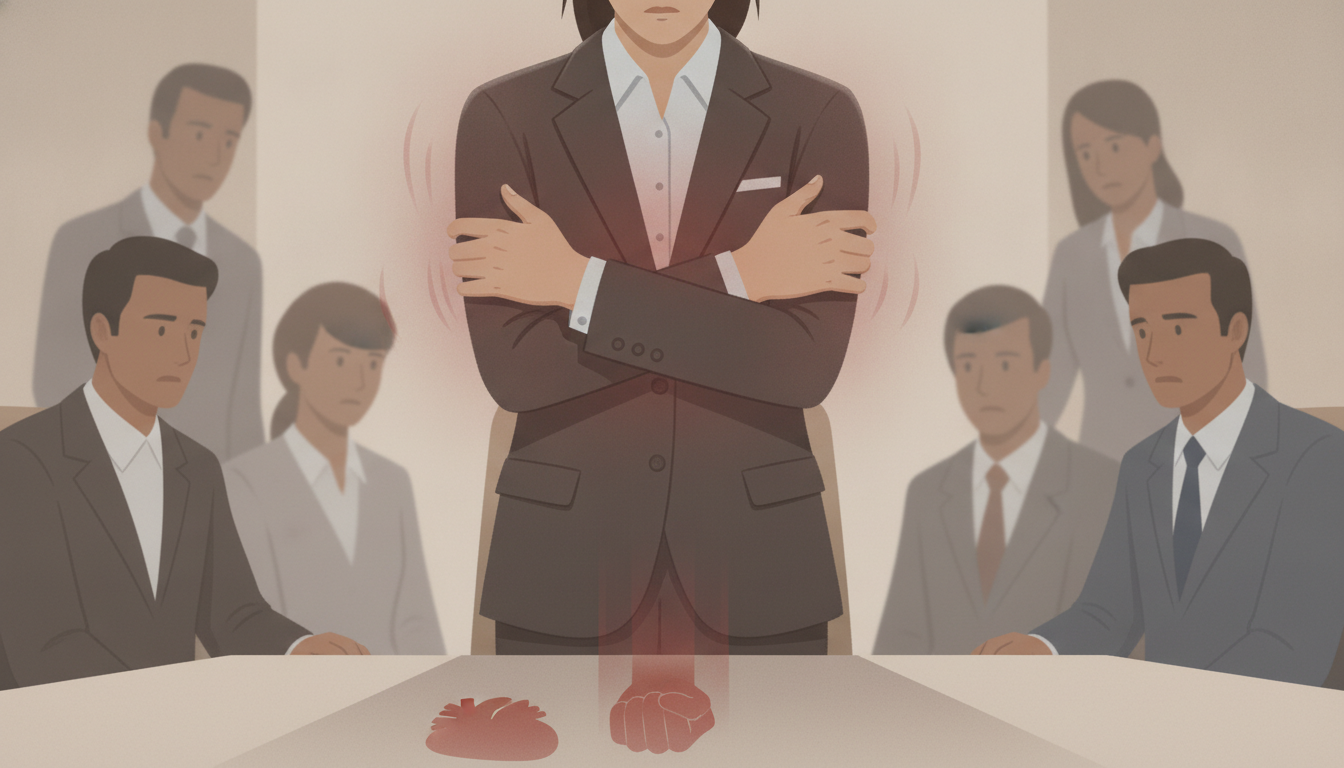
According to research by Albert Mehrabian (often cited but widely misunderstood), nonverbal cues don't carry "93% of communication" in all contexts—but in emotionally charged conversations where words and tone conflict, body language becomes the tiebreaker. People will believe what they see over what they hear.
The Three Body Language Anchors for Difficult Conversations
In tense moments, most people unconsciously shrink: they cross their arms, break eye contact, shift in their seat, or lean away. These signals broadcast anxiety and undermine every word you say. For a comprehensive look at authority-signaling body language, see our guide on body language that conveys authority.
Instead, focus on three physical anchors:
- Stillness. Reduce unnecessary movement. Don't fidget, tap, or shift. Stillness signals confidence and control. A 2020 study in the Journal of Nonverbal Behavior found that leaders who displayed physical stillness during conflict were rated 28% more trustworthy by observers.
- Open torso. Keep your chest and shoulders open. Don't cross your arms or hunch forward. An open torso signals that you're not threatened—even if you are.
- Deliberate eye contact. Maintain steady (not staring) eye contact, especially when making your key point. Look away naturally when listening, but lock in when delivering your message.
The Vocal Dimension: Speed, Pitch, and Pauses
Your voice changes under stress. It speeds up. The pitch rises. You fill silences with filler words. Every one of these signals tells the other person you're rattled.
Counter this deliberately:
- Slow down by 20%. Whatever speed feels natural in the moment, it's too fast. Consciously drop your pace.
- Lower your pitch slightly. Not artificially—just bring it down from wherever stress has pushed it. A lower pitch signals authority and calm.
- Use pauses as punctuation. After making a key point, pause for two full seconds. This gives your words weight and signals that you're not rushing to fill space out of discomfort.
Managing the Other Person's Physiology
Here's an advanced move: you can influence the other person's emotional state through your own body language. This is called "limbic resonance"—the neurological tendency for humans to mirror the emotional states of people around them.
If you remain physically calm, speak slowly, and maintain open posture, the other person's nervous system will begin to downregulate. You become the thermostat in the room, not the thermometer. This is one of the most powerful—and least discussed—leadership presence skills.
De-Escalation Language That Preserves Authority
The biggest fear most professionals have about difficult conversations isn't the conflict itself—it's that they'll either lose their composure or back down and lose credibility. The right language patterns solve both problems.
Five Phrases That De-Escalate Without Surrendering
Memorize these. Practice them until they're automatic:
- "Help me understand your perspective on this." — This buys you time, signals respect, and often reveals information you didn't have.
- "I hear what you're saying. Here's where I see it differently." — Acknowledges without agreeing. The word "differently" is neutral; "wrong" or "but" would be adversarial.
- "Let's separate the issue from the emotion for a moment." — This is a power move. It names the dynamic without blaming anyone and repositions the conversation as problem-solving.
- "I'm committed to finding a solution here. What I can't do is [state your boundary]." — This combines flexibility with firmness. It shows willingness to collaborate while drawing a clear line.
- "I want to make sure we both walk out of this conversation with a clear path forward." — This reframes the conversation as a shared project rather than a contest.
What Not to Say: Language That Escalates
Certain phrases—even well-intentioned ones—reliably escalate tension:
- "Calm down." — This has never calmed anyone down in the history of human communication. It implies the other person is irrational.
- "With all due respect..." — This phrase signals that disrespect is incoming. Everyone knows it.
- "You always..." or "You never..." — Absolute language triggers defensiveness because it's almost always inaccurate.
- "That's not my problem." — Even if it's true, this phrase destroys collaboration instantly.
Replace these with the de-escalation phrases above. For more scripts you can use in tense workplace situations, explore our resource on communicating with confidence in conflict at work.
The Broken Record Technique (Updated for Leaders)
When someone is pushing back aggressively and trying to get you to concede a point you shouldn't concede, use a technique adapted from assertiveness training: calmly repeat your position using slightly different words each time, without escalating.
Example:- Them: "We need the budget approved by Friday, no exceptions."
- You: "I understand the urgency. I'm not able to approve it until I've reviewed the risk analysis."
- Them: "This has already been vetted. Just sign off."
- You: "I hear you, and I know this feels urgent. My responsibility is to review the risk analysis before I can approve it."
- Them: "You're holding up the entire project."
- You: "I don't want to hold anything up. And I need to see the risk analysis to move forward responsibly."
Notice: no escalation, no new arguments, no defensiveness. Just calm, repeated clarity. This is what assertive communication at work without creating conflict looks like in practice.
Putting the Method Together: A Real-World Scenario
Let's walk through a complete example using all four pillars.
The Scenario
You're a senior manager. Your VP has publicly committed to a product launch timeline that your team cannot meet without cutting critical quality steps. You need to push back—but the VP is your boss, has a short temper, and has already told the board the date is locked.
Before the Conversation (Emotional Regulation)
- You do a five-minute cognitive reappraisal: "This conversation is my chance to protect my team and demonstrate strategic thinking."
- You identify the shared interest: "We both want this launch to succeed and reflect well on the division."
- You write down three outcomes you want the VP to feel: heard, respected, and confident that you're solving the problem—not creating one.
Opening the Conversation (Strategic Framing)
"Thanks for making time. I know this launch is a top priority for both of us, and I want to make sure we set it up for the strongest possible outcome." (Shared interest anchor.)
"I've been running the numbers with my team, and I've found a gap between the current timeline and the quality benchmarks we need to hit. I want to walk you through what I'm seeing so we can decide together how to handle it." (ARC: Acknowledge, Redirect, Commit.)
During the Conversation (Body Language + De-Escalation)
When the VP pushes back—"We've already committed to this date"—you maintain stillness, keep your posture open, and respond at a measured pace:
"I understand the commitment, and I respect it. Here's where I see the risk..." (De-escalation phrase #2.)
If the VP escalates: "Let's separate the timeline pressure from the quality question for a moment. If we look at the quality benchmarks alone, here's what the data shows." (De-escalation phrase #3.)
Closing the Conversation
"I want to make sure we both walk out of this with a clear path forward. Here are two options I've prepared that protect the launch date as much as possible while managing the quality risk. Can I walk you through them?" (De-escalation phrase #5 + ARC Commit.)
This is leadership presence in action. Not aggressive. Not passive. Strategically composed.
Ready to Build This Skill Systematically? The Credibility Code gives you the complete system—frameworks, scripts, body language techniques, and daily exercises—for showing up with authority in every conversation, especially the hard ones. Discover The Credibility Code
Common Mistakes That Destroy Presence in Difficult Conversations
Even skilled communicators make predictable errors under pressure. According to a 2022 survey by VitalSmarts (now Crucial Learning), 72% of employees say they've witnessed a leader lose credibility during a single poorly handled difficult conversation. Here are the most common mistakes:
Over-Preparing Your Script
Paradoxically, memorizing exactly what you'll say makes you less present. When the conversation deviates from your script—and it always does—you freeze or become rigid. Instead, prepare your framework (ARC), your key points, and your de-escalation phrases. Then trust yourself to be responsive in the moment.
Confusing Aggression with Authority
Raising your voice, interrupting, or using sharp language might feel powerful in the moment. But observers consistently rate aggressive communicators as less credible than calm ones. A 2021 study in Leadership Quarterly found that leaders who maintained vocal calm during disagreements were rated 34% more competent by their teams than those who raised their voices.
True authority is quiet. It doesn't need volume.
Apologizing for Having a Position
Phrases like "I'm sorry, but I just feel like..." or "This might be wrong, but..." undermine your message before you've even delivered it. You can be respectful without being apologetic. State your position clearly and let the quality of your reasoning speak for itself. If hedging language is a habit you're working to break, our guide on how to stop sounding uncertain at work offers specific fixes.
Failing to Close
Many leaders handle the difficult part well but then let the conversation trail off without a clear resolution. Always close with a specific next step: "So we've agreed that I'll send the revised timeline by Thursday, and we'll reconvene Friday morning. Does that work?"
Frequently Asked Questions
How do you maintain leadership presence when someone is yelling at you?
Focus on physical stillness and slow your breathing. Do not match their volume or pace. Maintain eye contact and wait for a natural pause, then speak at half their speed: "I can see this is important to you. I want to address it properly. Can we take this point by point?" Your calm becomes the dominant energy in the room. If the behavior continues, it's appropriate to say, "I want to continue this conversation, and I need us to have it at a volume where we can both think clearly."
What is the difference between leadership presence and conflict avoidance?
Leadership presence in difficult conversations means engaging directly with the tension while maintaining composure and authority. Conflict avoidance means sidestepping the issue entirely—changing the subject, agreeing prematurely, or postponing indefinitely. Presence requires you to stay in the discomfort and lead through it. Avoidance removes you from it. The outcome of presence is resolution and increased credibility; the outcome of avoidance is unresolved issues and decreased trust.
How can introverts maintain leadership presence in difficult conversations?
Introverts often have a natural advantage in difficult conversations: they tend to listen more carefully, pause before responding, and avoid impulsive reactions. The key is to leverage these strengths rather than trying to match extroverted energy. Prepare your key points in advance, use the ARC framework to structure your message, and remember that silence and stillness signal authority. For more strategies, see our guide on building leadership presence as an introvert.
How do you prepare for a difficult conversation with a senior leader?
Start by clarifying your objective: what specific outcome do you need? Then identify the shared interest between you and the senior leader. Prepare your message using the ARC framework. Anticipate their two or three most likely objections and prepare brief, data-backed responses. Practice your opening sentence out loud until it feels natural. Finally, do a five-minute emotional regulation exercise—cognitive reappraisal and physical grounding—immediately before the meeting.
Can you develop leadership presence in difficult conversations, or is it innate?
It is entirely learnable. Research from the Center for Creative Leadership shows that leadership presence is a set of behaviors, not a personality trait. The professionals who appear most natural in difficult conversations have simply practiced specific techniques—emotional regulation, strategic framing, deliberate body language, and de-escalation language—until those techniques became automatic. Like any skill, it improves with deliberate, repeated practice.
How do you recover if you lose your composure during a difficult conversation?
Acknowledge it briefly and reset. Say something like, "I got ahead of myself there. Let me restate that." Then take a breath, return to your physical anchor, and continue with your framework. A 2023 study in Organizational Behavior and Human Decision Processes found that leaders who acknowledged a composure slip and recovered gracefully were rated as more authentic—and no less competent—than those who never slipped at all. The recovery is what people remember.
Build Presence People Notice Before You Say a Word
The Credibility Code gives you the specific verbal and nonverbal habits that make people treat you as the senior person in the room.
Discover The Credibility CodeRelated Articles

Leadership Communication in Difficult Conversations
Leadership communication during difficult conversations is the ability to deliver hard truths, navigate conflict, and address sensitive workplace issues while maintaining your authority, composure, and the respect of everyone involved. It requires a combination of emotional regulation, strategic word choice, structured delivery, and genuine empathy — skills that separate respected leaders from those who either avoid tough talks altogether or handle them so poorly they damage trust. This article

Body Language for Leadership Presence: A Complete Guide
Body language for leadership presence is the intentional use of nonverbal cues—posture, eye contact, gestures, facial expressions, and spatial positioning—to project authority, confidence, and credibility in professional settings. Research from UCLA professor Albert Mehrabian found that up to 55% of communication impact comes from nonverbal signals. This guide gives you a complete framework for mastering the physical cues that make people listen, trust, and follow your lead in meetings, presenta

Leadership Presence in Meetings: 8 Habits That Command
Leadership presence in meetings comes down to eight specific habits: arriving with intentional energy, claiming physical space confidently, speaking with strategic timing, using deliberate vocal authority, holding attention through structured contributions, managing silence as a power tool, redirecting conversations with purpose, and closing discussions with decisive clarity. These habits are learnable, repeatable, and separate leaders who command respect from those who merely attend.