
Communication Skills for New Managers: 9 Essential Shifts

The transition from individual contributor to manager is one of the most disorienting shifts in any career — not because the work gets harder, but because the communication rules completely change. What made you successful as a peer (deep expertise, heads-down execution, collaborative brainstorming) can actually undermine you as a leader. New managers need to master nine critical communication shifts: moving from sharing opinions to giving direction, from receiving feedback to delivering it, from peer-level banter to authority with former colleagues, from reporting status to communicating strategy, from avoiding conflict to addressing it directly, from informal updates to structured one-on-ones, from individual advocacy to team advocacy, from reactive communication to proactive transparency, and from proving competence to projecting confidence. These shifts don't require a personality change — they require deliberate communication recalibration.
What Are Communication Skills for New Managers?
Communication skills for new managers are the specific verbal, written, and interpersonal competencies required when transitioning from an individual contributor role into a people-leadership position. Unlike general communication skills, these focus on the unique challenges of directing work, delivering feedback, managing up to senior leaders, and establishing credibility with people who may have been your peers yesterday.
These skills go beyond "being a good communicator." They involve a fundamental identity shift in how you use language, when you speak, and what you choose to communicate — all of which signal whether your team, your peers, and your leadership see you as a credible manager or someone still operating like an individual contributor.
Why the Transition Breaks Most Communicators
The Identity Gap Between Doing and Leading

Here's what nobody tells you in your first week as a manager: the communication habits that earned you the promotion will actively work against you in the new role.
As an individual contributor, you built credibility by having the best answer in the room. You spoke up to demonstrate expertise. You sent detailed emails to show thoroughness. You collaborated as an equal.
Now, every one of those instincts needs recalibration. A 2023 study by DDI's Global Leadership Forecast found that only 40% of leaders rated the quality of their organization's leadership as high — and communication gaps during the transition were cited as a primary factor. The shift isn't about communicating more. It's about communicating differently.
Why "Just Be Yourself" Is Bad Advice
Well-meaning mentors often tell new managers to "just be yourself." But your old self was an individual contributor. The new role demands a new communication identity — one that balances warmth with authority, clarity with empathy, and directness with diplomacy.
This doesn't mean being fake. It means being intentional. The managers who struggle most are those who refuse to adapt, clinging to peer-level communication patterns while wondering why their team doesn't follow their direction. If you're working on developing your leadership voice, this identity shift is where it starts.
Shift 1: From Sharing Opinions to Giving Clear Direction
The Difference Between Suggesting and Directing
As a peer, you might say: "I think we should probably consider moving the deadline up — what does everyone think?"
As a manager, that ambiguity creates confusion. Your team doesn't know if you're brainstorming or making a decision. The shift sounds like this: "We're moving the deadline to Thursday. Here's why, and here's what I need from each of you."
Notice the structure: decision, rationale, action. This isn't being bossy — it's being clear. According to research from Gallup, only 50% of employees strongly agree that they know what's expected of them at work. That number drops further when managers hedge their direction with unnecessary qualifiers.
How to Give Direction Without Micromanaging
The fear most new managers have is that giving clear direction will make them a micromanager. But micromanaging is about controlling how people do the work. Directing is about clarifying what needs to happen and why.
Use this framework:
- State the outcome: "I need the client proposal finalized by Wednesday."
- Explain the why: "The client has a board meeting Friday and needs time to review."
- Define the boundaries: "Use the template from last quarter, but adjust the pricing section."
- Leave the how: "You know the client better than I do — structure it the way that makes sense to you."
This approach gives your team clarity and autonomy simultaneously. It's the hallmark of communicating with authority at work without overstepping.
Shift 2: From Receiving Feedback to Delivering It
Why New Managers Avoid Feedback (and the Cost)
Most new managers delay difficult feedback conversations for weeks — sometimes months. A study by Zenger Folkman found that 44% of managers reported that giving negative feedback is stressful or difficult, and many avoid it entirely.
The cost is enormous. Small performance issues compound. Team members feel blindsided during formal reviews. Resentment builds among high performers who watch underperformance go unaddressed.
The SBI Framework for Manager Feedback
Use the Situation-Behavior-Impact (SBI) model developed by the Center for Creative Leadership:
- Situation: "In yesterday's client call..."
- Behavior: "...you interrupted the client twice while they were explaining their concerns."
- Impact: "...which made it harder for us to fully understand their objections, and the client seemed frustrated."
Then add a forward-looking question: "How do you want to handle that differently next time?"
This structure removes personal judgment from the equation. You're not saying "you're a bad listener." You're describing a specific behavior and its observable impact. It's direct without being destructive.
For more on navigating these conversations, explore our guide on leadership communication in difficult conversations.
Shift 3: From Peer Banter to Authority with Former Colleagues
This is the shift that causes the most anxiety. Yesterday you were grabbing lunch together and complaining about deadlines. Today you're responsible for their performance reviews.
The key is not to pretend the friendship doesn't exist — it's to add a new layer of professional clarity on top of it.
What to say in the first week:"I value our relationship, and that's not going to change. What will change is that I now have responsibilities to the team and to leadership that might sometimes mean I can't be as casual about certain things. I'd rather be upfront about that than let it get awkward."
This conversation — had proactively, not reactively — sets the tone. It's honest, respectful, and establishes boundaries without creating distance. If you're navigating this specific challenge, our article on how to establish authority in a new leadership role provides a deeper framework.
Say it once, and be taken seriously. The Authority Toolkit gives you 8 frameworks, the 7 shifts that make speech sound sure, and 100+ phrases for meetings and email, so the point lands the first time you make it. Get The Authority Toolkit — $27
Shift 4: From Reporting Status to Communicating Strategy
Stop Narrating Tasks — Start Framing Decisions
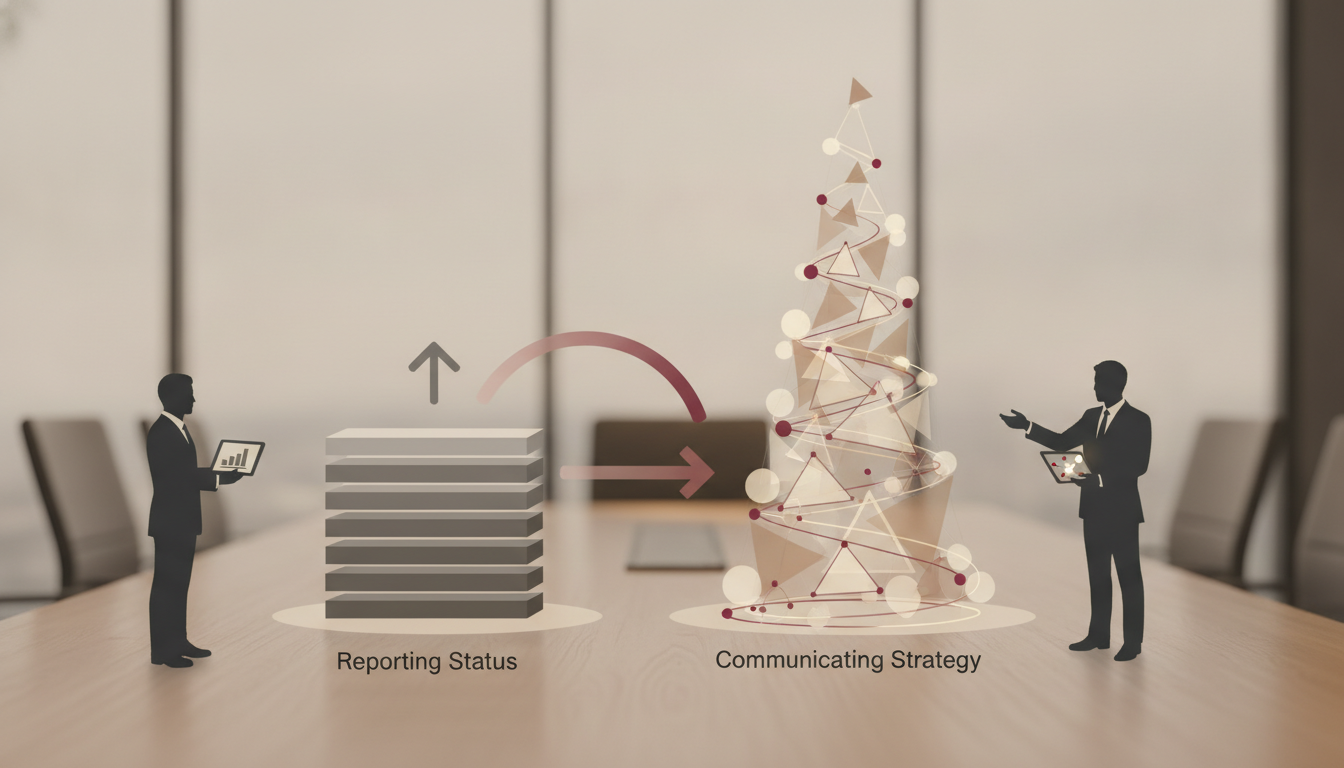
Individual contributors report what they did. Managers communicate why it matters and what it means for the broader picture.
Compare these two updates to a VP:
Individual contributor style: "We completed the user testing phase. We found 14 bugs, and the team is working through them. We should be done by next Friday." Manager style: "User testing revealed 14 issues — three are critical and could affect launch. I've prioritized those three for resolution this week, and the remaining items won't impact the timeline. We're on track for the Friday release, but I'll flag it immediately if that changes."The second version demonstrates judgment, prioritization, and proactive risk communication. This is the shift from doing work to communicating like a senior leader.
The "So What" Test for Every Communication
Before you send an email, give an update, or speak in a meeting, ask yourself: So what?
Your team completed a project milestone — so what does that mean for the timeline? A team member is underperforming — so what's your plan? Revenue is up 12% — so what's driving it and can you replicate it?
According to Harvard Business Review, executives spend an average of 23 hours per week in meetings. They don't have time for information without interpretation. When you add the "so what," you're communicating at the level they expect.
Shift 5: From Avoiding Conflict to Addressing It Directly
Why Conflict Avoidance Destroys New Manager Credibility
Nothing erodes a new manager's authority faster than visible conflict avoidance. When you sidestep a disagreement between team members, ignore a missed deadline, or let a disrespectful comment slide, your entire team notices — and recalibrates how seriously they take your leadership.
A CPP Inc. study found that U.S. employees spend approximately 2.8 hours per week dealing with conflict, costing companies an estimated $359 billion annually in paid hours. Much of this waste comes from unresolved conflicts that fester because managers won't address them.
The Direct-but-Diplomatic Script
Here's a framework for addressing conflict without escalation:
- Name what you've observed (not what you've assumed): "I've noticed tension between you and Sarah during our sprint reviews."
- Ask for their perspective: "What's your experience of those interactions?"
- State your expectation: "I need our team meetings to be spaces where everyone can contribute without friction."
- Collaborate on a path forward: "What would help make that happen?"
This approach is direct without being aggressive. It shows you're paying attention, you have standards, and you're willing to help — but you're not willing to ignore the problem. For more on this, see our guide on assertive communication at work without creating conflict.
Shift 6: From Informal Updates to Structured One-on-Ones
Why Casual Check-ins Don't Replace Real Conversations
Many new managers mistake hallway conversations and Slack messages for meaningful communication. "I talk to my team all the time," they say. But those interactions are transactional — they're about tasks, not development, alignment, or trust.
Structured one-on-ones are where real management communication happens. Gallup research shows that employees whose managers hold regular one-on-one meetings are nearly three times more likely to be engaged at work.
A One-on-One Framework for New Managers
Use this 30-minute structure:
- First 10 minutes — Their agenda: "What's on your mind?" Let them lead. This builds trust and surfaces issues you wouldn't otherwise hear.
- Middle 10 minutes — Your agenda: Address performance, share context from leadership, give feedback, or discuss development.
- Final 10 minutes — Forward-looking: "What do you need from me this week?" or "What's one thing that would make your work easier?"
Keep brief notes. Follow up on commitments. This consistency — showing up, listening, acting — is what builds your credibility faster than any grand leadership gesture.
Shift 7: From Individual Advocacy to Team Advocacy
Your Job Is Now to Make Others Visible
As an individual contributor, you advocated for yourself — your ideas, your accomplishments, your career growth. As a manager, your primary advocacy role shifts to your team.
This means:
- Giving credit publicly and specifically: "This was Maya's insight — she identified the pattern in the data that changed our approach."
- Fighting for resources on their behalf in leadership meetings.
- Shielding them from unnecessary organizational noise so they can focus.
- Championing their promotions and development opportunities.
This shift feels counterintuitive. You might worry that making others visible makes you invisible. The opposite is true. Leaders who develop strong teams are the ones who get promoted. Your ability to build credibility with a new team directly correlates with your willingness to put their success before your ego.
Shift 8: From Reactive Communication to Proactive Transparency
Get Ahead of the Information Vacuum
When you don't communicate proactively, your team fills the silence with assumptions — and those assumptions are almost always worse than reality.
New managers often wait until they have "all the information" before communicating. But in management, you rarely have complete information. The shift is learning to communicate what you do know, what you don't know, and when you expect to know more.
Example: "I know there are rumors about the restructuring. Here's what I can tell you: our team is not being eliminated. I don't yet have details on how reporting lines might change, but I expect to know more after Thursday's leadership meeting. I'll share everything I can as soon as I have it."This kind of proactive transparency — even when the message is "I don't know yet" — builds trust exponentially faster than silence. It's a core principle of how to communicate change as a leader with authority.
Shift 9: From Proving Competence to Projecting Confidence
You Don't Need to Be the Smartest Person in the Room Anymore
This might be the hardest shift of all. As an individual contributor, your value was your expertise. As a manager, your value is your judgment, your ability to make decisions with incomplete information, and your capacity to create clarity for others.
That means you can stop trying to prove you know everything. In fact, saying "I don't know, but I'll find out" or "Sarah is the expert on this — let's get her input" actually increases your credibility rather than diminishing it.
According to a study published in the Journal of Applied Psychology, leaders who admitted uncertainty while demonstrating clear decision-making processes were rated as more trustworthy by their teams than those who projected false certainty.
How to Project Confidence When You're Still Learning
Three daily practices:
- Speak in statements, not questions: "Here's the plan" instead of "Do you think maybe we should...?"
- Eliminate hedging language: Drop "just," "kind of," "I might be wrong, but..." from your vocabulary. Our guide on how to stop sounding unsure when speaking at work has specific before-and-after examples.
- Own your decisions: Even when you're uncertain, commit to a direction. "Based on what we know today, we're going with Option A. If new information changes the picture, we'll adapt."
This isn't arrogance. It's the kind of leadership presence that makes your team feel safe and focused rather than anxious and directionless.
Frequently Asked Questions
How long does it take to develop strong communication skills as a new manager?
Most new managers begin feeling comfortable with the core communication shifts within three to six months, but true fluency takes 12 to 18 months of deliberate practice. The key is focusing on one or two shifts at a time rather than trying to overhaul everything at once. Start with the shifts that address your most immediate pain points — typically giving direction and delivering feedback — then layer in the others progressively.
What is the biggest communication mistake new managers make?
The single biggest mistake is continuing to communicate like a peer instead of a leader. This shows up as hedging direction with unnecessary qualifiers ("Maybe we should..."), avoiding feedback conversations, and over-explaining decisions to seek consensus rather than alignment. These habits signal to your team and your leadership that you haven't fully stepped into the role, which undermines your credibility before you've had a chance to build it.
Communication skills for new managers vs. senior leaders: what's different?
New manager communication focuses on establishing baseline authority, building trust with a direct team, and mastering feedback and direction. Senior leader communication emphasizes strategic framing, cross-functional influence, executive presence, and communicating vision across larger groups. The fundamentals are the same — clarity, confidence, and intentionality — but the scope and stakes expand significantly. Our article on executive vs. regular communication differences explores this in depth.
How do I communicate authority with people who used to be my peers?
Have a direct, early conversation acknowledging the shift. Be honest: "Our relationship matters to me, and I want to be transparent that my responsibilities have changed." Then demonstrate authority through consistency — follow through on commitments, hold everyone to the same standards, and make decisions clearly. Avoid overcompensating by being either too rigid or too casual. Authority with former peers is built through fairness and reliability, not through pulling rank.
How should new managers communicate with their own boss?
Shift from reporting activities to communicating outcomes, risks, and decisions. Your boss doesn't need to know everything you did this week — they need to know what matters, what's at risk, and where you need their input. Use a brief structure: "Here's where we stand, here's what I'm concerned about, here's what I need from you." This demonstrates strategic thinking and executive-level communication that positions you as a capable leader rather than someone who still needs hand-holding.
Can introverted new managers communicate with authority effectively?
Absolutely. Authority in management communication comes from clarity, consistency, and follow-through — not volume or charisma. Introverted managers often excel at one-on-one conversations, thoughtful written communication, and listening deeply before responding. These are enormous strengths. The key is ensuring you also communicate visibly in group settings — even briefly — so your team and leadership see you leading. Our guide on building presence as a quiet leader offers specific strategies.
Stop Sounding Uncertain in Everyday Conversations
8 communication frameworks, the 7 speech shifts with 30 before-and-after rewrites, 6 email templates, and 100+ phrases for speaking and writing with calm authority at work. PDF.
Get The Authority Toolkit — $27Related Articles

How to Communicate With Authority at Work: 10 Habits
To communicate with authority at work, build ten daily habits across verbal, written, and nonverbal channels: lead with your conclusion, eliminate hedging language, use strategic pauses, anchor your body language, control your vocal tone, write concisely, prepare a point of view before every meeting, ask high-value questions, set verbal boundaries, and follow through visibly. These small, repeatable actions compound over time to build a lasting reputation for credibility and leadership presence.

Confident Communication for Managers: 10 Daily Techniques
Confident communication techniques for managers include using direct language without hedging, leading with conclusions before context, pausing instead of filling silence, naming decisions with ownership ("I've decided" vs. "I think maybe"), and matching body language to your message. These techniques work in four core management scenarios: giving direction, delivering feedback, running meetings, and communicating upward. The best part? Each takes less than two minutes to practice daily and comp

How to Sound Confident on Phone Calls: 9 Pro Tips
To sound confident on phone calls, focus on three core areas: vocal delivery, strategic preparation, and active conversation control. Lower your pitch slightly, slow your speaking pace by 10–15%, and eliminate filler words like "um" and "so." Prepare key talking points before every call, stand while speaking to project more energy, and use deliberate pauses instead of rushing to fill silence. These techniques work for client calls, virtual meetings, and internal conversations alike.