
How to Be More Assertive in Workplace Conversations

Being more assertive in workplace conversations starts with understanding the difference between assertiveness and aggression—then practicing specific language patterns that communicate confidence without hostility. Assertiveness means stating your needs, boundaries, and opinions clearly while respecting others. It requires replacing passive habits like hedging and over-apologizing with direct, composed language. The good news: assertiveness is a skill you can build through daily practice, not a personality trait you're born with.
What Is Assertive Communication in the Workplace?
Assertive communication is the ability to express your thoughts, needs, and boundaries directly, honestly, and respectfully—without undermining yourself or disrespecting others. It sits in the healthy middle ground between passive communication (where you suppress your needs) and aggressive communication (where you override everyone else's).In a workplace context, assertive communication looks like stating your position in a meeting without apologizing for having one, pushing back on an unreasonable deadline without becoming combative, or asking for what you deserve in a negotiation without hedging every sentence. According to research published in the Journal of Occupational Health Psychology, employees who communicate assertively report 28% higher job satisfaction and significantly lower levels of workplace stress than those who default to passive or aggressive styles.
Assertive communicators aren't louder. They're clearer. And that clarity is what earns respect.
The Four Communication Styles: Where Assertiveness Fits
Before you can become more assertive, you need to honestly identify where you currently fall on the communication spectrum. Most professionals default to one of four styles—often without realizing it.

Passive Communication: The "It's Fine" Default
Passive communicators avoid conflict at all costs. They agree to projects they don't have bandwidth for, stay silent when their ideas are dismissed, and use phrases like "I'm sorry, but..." or "This might be a dumb question..." They prioritize being liked over being heard.
Workplace example: Your manager assigns you a third project this week. You say, "Sure, I can make it work," even though you know the quality of your other deliverables will suffer. You leave the conversation frustrated—not at your manager, but at yourself.Passive communication feels safe in the moment, but it erodes your credibility over time. If you find yourself consistently overlooked, our guide on why people don't take you seriously at work explores the deeper patterns behind this dynamic.
Aggressive Communication: The Bulldozer Approach
Aggressive communicators dominate conversations, interrupt frequently, and prioritize winning over collaborating. They use "you" statements ("You never listen"), raise their voice, and often dismiss others' perspectives outright.
Workplace example: In a team meeting, a colleague suggests an approach you disagree with. You respond, "That's not going to work. We already tried something like that and it was a waste of time." The room goes quiet. You got your point across—but you also shut down collaboration.Passive-Aggressive Communication: The Hidden Sting
Passive-aggressive communicators express frustration indirectly—through sarcasm, the silent treatment, backhanded compliments, or deliberate procrastination. They avoid direct confrontation but make their displeasure known through subtext.
Workplace example: A colleague takes credit for your work in a presentation. Instead of addressing it directly, you send a group email the next day "clarifying" your contributions, CC'ing the entire department. The message is technically professional, but the intent is unmistakable.Assertive Communication: The Credibility Builder
Assertive communicators state their position clearly, use "I" statements, maintain calm body language, and invite dialogue. They don't bulldoze—but they don't shrink, either.
Workplace example: That same colleague takes credit for your work. You approach them privately: "I noticed the presentation attributed the client analysis to the team generally. I led that analysis and I'd like that reflected in the project documentation. Can we align on that?" Direct. Calm. Specific.A 2023 study from the Center for Creative Leadership found that leaders rated highest in assertiveness were 2.5 times more likely to be rated as "highly effective" by their direct reports compared to leaders who scored low in assertiveness.
A Practical Framework for Assertive Workplace Conversations
Knowing what assertiveness looks like is one thing. Doing it under pressure—when your heart rate spikes and your instinct is to either retreat or attack—is another. This framework gives you a repeatable structure for any workplace conversation.
The CLEAR Method for Assertive Responses
Use the CLEAR method whenever you need to assert yourself in real time:
- C – Center yourself. Take one breath before responding. This prevents reactive, emotional replies. Even a two-second pause signals composure and authority.
- L – Lead with facts. Start with what's observable and objective, not with emotions or assumptions. "The deadline was moved up by three days" is a fact. "You're always changing things at the last minute" is an accusation.
- E – Express your position. Use "I" statements to own your perspective. "I'm concerned this timeline doesn't allow for quality review" is assertive. "You're setting us up to fail" is aggressive.
- A – Ask for what you need. Be specific. Don't hint. "I need two additional days to deliver this at the standard we agreed on" is far more effective than "I just think we might need more time, maybe?"
- R – Respect the response. Assertiveness isn't about getting your way every time. It's about being heard. Listen to the other person's reply. Negotiate if needed. Hold your ground on what matters most.
This framework aligns closely with the professional communication frameworks leaders use daily—structured approaches that remove guesswork from high-stakes interactions.
Replacing Passive Language Patterns
Assertiveness often comes down to word choice. Here are specific swaps you can make immediately:
| Instead of (Passive) | Say (Assertive) |
|---|---|
| "Sorry, but I think maybe..." | "My recommendation is..." |
| "I'm not sure this is right, but..." | "Based on the data, here's what I see." |
| "Would it be okay if I..." | "I'd like to..." |
| "I just wanted to check in about..." | "I'm following up on..." |
| "Does that make sense?" | "What questions do you have?" |
| "I feel like maybe we should..." | "I recommend we..." |
These aren't cosmetic changes. Research from the University of Texas at Austin found that professionals who eliminated hedging language ("just," "kind of," "I think maybe") from their workplace communication were perceived as 35% more competent by peers—without any change in the actual content of their ideas.
For a deeper dive into these language shifts, see our guide on how to stop undermining yourself at work.
Know exactly what to say next time. The Pushback Playbook has 50 word-for-word scripts for moments like this one: what they say, what you say, why it works, and what to do if they push back. Get The Pushback Playbook — $27
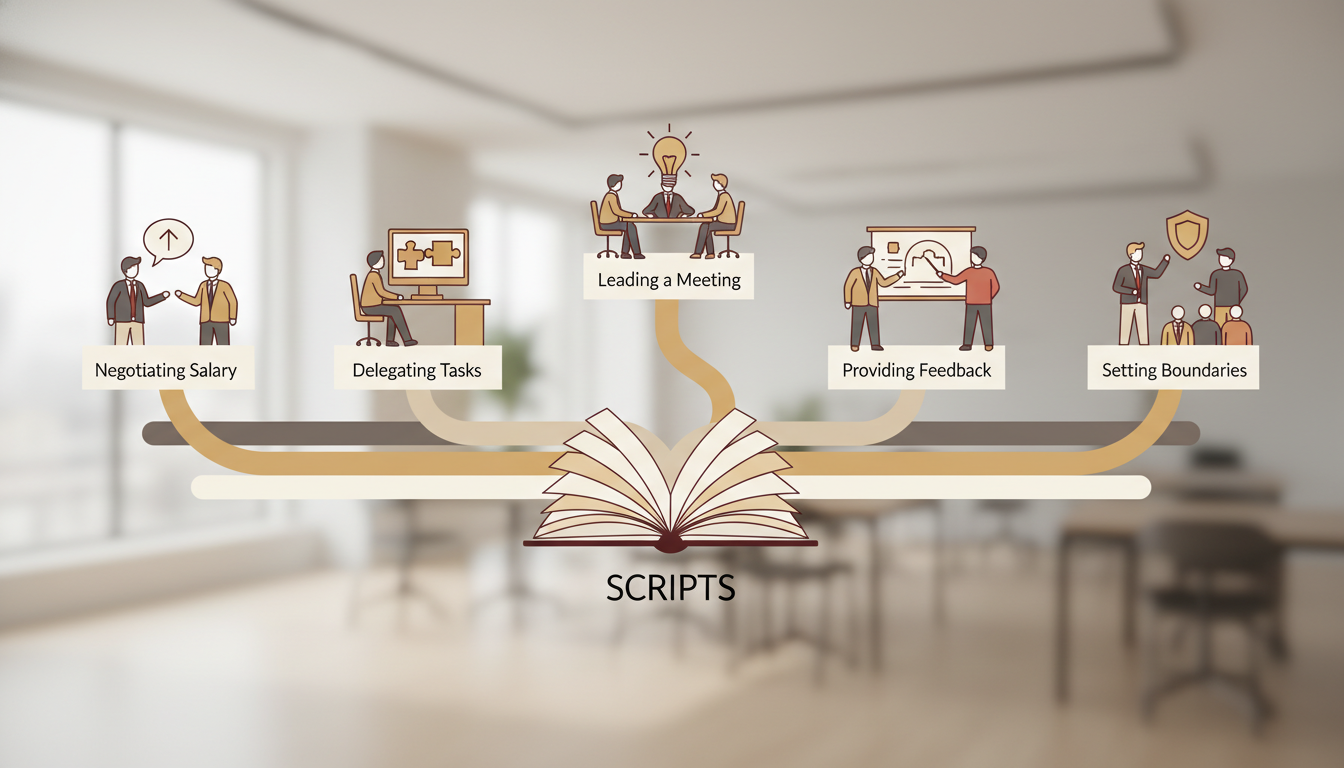
Scripts for 5 Common Workplace Scenarios
Theory is useful. Scripts you can adapt and use tomorrow morning are better. Here are assertive responses for five situations most professionals face regularly.
Scenario 1: Pushing Back on an Unreasonable Deadline
The situation: Your VP drops a Friday deadline on a project that realistically needs two weeks. Passive response: "Okay, I'll try my best." (Then you work 14-hour days and deliver something mediocre.) Aggressive response: "There's no way that's happening. That timeline is completely unrealistic." Assertive response: "I want to deliver this at the quality level this project deserves. To do that, I need until [specific date]. If the Friday deadline is firm, I'd like to discuss which components to prioritize so we're aligned on scope." Why it works: You've stated your need, offered a solution, and invited collaboration—without apologizing or attacking.Scenario 2: Being Interrupted or Talked Over in a Meeting
The situation: You're mid-sentence in a team meeting and a colleague cuts in with their own point. Assertive response: "I'd like to finish my point—then I want to hear yours." (Maintain eye contact. Keep your voice steady, not louder.)If the interruption has already derailed the conversation: "I want to circle back to what I was saying before. [Restate your point.]"
For a complete toolkit on this specific challenge, read our guide on how to handle being talked over in meetings.
Scenario 3: Declining Additional Work Without Damaging Relationships
The situation: A colleague asks you to take on a task that isn't your responsibility—and you're already at capacity. Assertive response: "I appreciate you thinking of me for this. Right now, I'm focused on [Project A] and [Project B], which are my priorities this quarter. I'm not able to take this on and give it the attention it needs. Have you considered [alternative person or solution]?" Why it works: You validated the request, explained your reasoning without over-justifying, and offered a redirect.Scenario 4: Addressing a Colleague Who Takes Credit for Your Work
Assertive response (private conversation): "In yesterday's presentation, the competitive analysis was presented as a team effort. I want to make sure my individual contribution is documented accurately, since I led that research independently. Can we correct the attribution in the follow-up notes?"This is specific, non-accusatory, and action-oriented. You're not questioning their character—you're correcting a factual record.
Scenario 5: Negotiating Salary or a Raise
The situation: Your annual review is coming up and you want to advocate for a raise. Assertive response: "Based on my contributions this year—specifically [result 1], [result 2], and [result 3]—I'd like to discuss adjusting my compensation to reflect the value I'm delivering. I've researched market rates for this role, and I'm targeting a salary of [specific number]."According to a PayScale survey, 70% of employees who negotiated their salary received some form of increase—yet only 37% of workers ever ask. Assertiveness in compensation conversations has a measurable financial impact. For a complete negotiation approach, explore our guide on how to negotiate when you feel nervous.
Building Assertiveness as a Daily Habit
Assertiveness isn't a switch you flip. It's a muscle you strengthen through consistent, low-stakes practice before you need it in high-stakes moments.
Start with Low-Risk Situations
Don't debut your assertive communication in a board meeting. Start where the stakes are low:
- Order at a restaurant without saying "sorry." Instead of "Sorry, could I maybe get the check?" say "I'd like the check, please."
- State a preference in a team lunch decision. Instead of "I'm fine with whatever," say "I'd prefer Thai food. What does everyone else think?"
- Send one email today without hedging language. Remove every "just," "I think," and "sorry to bother you."
These micro-practices rewire your default communication patterns. Within weeks, assertive language starts feeling natural rather than forced.
The 30-Second Assertiveness Audit
At the end of each workday, spend 30 seconds reviewing one conversation. Ask yourself:
- Did I say what I actually meant?
- Did I hedge, over-apologize, or minimize my point?
- Was there a moment I stayed silent when I had something valuable to add?
Don't judge yourself—just notice. Awareness is the first step to change. Over time, you'll start catching passive patterns in the moment, not just in hindsight.
This kind of daily self-assessment is part of what we outline in our guide on building a confident communication style.
Managing the Fear of Being "Too Much"
One of the biggest barriers to assertiveness—especially for women and people from marginalized backgrounds—is the fear of being perceived as aggressive, difficult, or "too much." This fear is real, and it's rooted in genuine social dynamics.
Here's the reframe: assertiveness protects relationships; passivity erodes them. When you consistently suppress your needs, resentment builds. When you consistently override others' needs, trust collapses. Assertiveness is the only communication style that sustains healthy professional relationships long-term.
A 2022 Harvard Business Review analysis found that teams led by assertive (not aggressive) communicators had 19% higher psychological safety scores—meaning people felt more comfortable speaking up, not less, when their leader modeled clear, respectful directness.
Assertiveness and Body Language: The Unspoken Signal
Your words can be perfectly assertive, but if your body language contradicts them, people will believe your body. Nonverbal communication accounts for a significant portion of how your message is received.
Three Non-Negotiable Body Language Shifts
1. Steady eye contact. When making an assertive statement, maintain eye contact for 3-5 seconds at a time. Looking away, looking down, or darting your eyes signals uncertainty—even if your words are confident. 2. Grounded posture. Stand or sit with both feet flat on the floor. Avoid crossing your arms (defensive), fidgeting (nervous), or leaning back excessively (disengaged). Take up the space you're entitled to. 3. Controlled vocal pace. Assertive speakers don't rush. When you speed up, you signal anxiety. When you slow down slightly—especially on key points—you signal authority. Pause after making an important statement. Let it land.According to research by Albert Mehrabian, widely cited in communication studies, up to 55% of emotional meaning in face-to-face communication comes from body language, with 38% from vocal tone and only 7% from the actual words. While these specific percentages are debated and context-dependent, the broader principle holds: how you say something matters as much as what you say.
For a comprehensive guide to nonverbal authority, see our post on body language for leadership presence.
Frequently Asked Questions
What is the difference between assertive and aggressive communication at work?
Assertive communication expresses your needs while respecting others' perspectives. Aggressive communication prioritizes your needs at others' expense. The key distinction is intent and delivery: assertive communicators use "I" statements, maintain a calm tone, and invite dialogue. Aggressive communicators use "you" accusations, raise their voice, and shut down conversation. Assertiveness builds trust; aggression destroys it.
How can I be more assertive at work without being rude?
Focus on three principles: be specific about what you need (not vague or emotional), use neutral language that describes facts rather than assigns blame, and always leave room for the other person to respond. Saying "I need this report by Thursday to meet our client deadline" isn't rude—it's clear. Rudeness comes from contempt, not from clarity. For a full framework, explore our guide on being assertive at work without being aggressive.
Can introverts be assertive communicators?
Absolutely. Assertiveness has nothing to do with being extroverted or loud. Introverts often excel at assertive communication because they tend to think before speaking, choose words carefully, and listen actively—all hallmarks of assertive style. The challenge for introverts is usually initiating the conversation, not the content of it. Start with written communication like emails, where you can draft and refine your assertive language before hitting send.
How long does it take to become more assertive at work?
Most professionals notice meaningful shifts within 2-4 weeks of deliberate practice. You won't transform overnight, but replacing one passive language pattern per week creates compounding change. Within 90 days of consistent effort—using frameworks like the CLEAR method and daily self-audits—assertive communication starts becoming your default rather than a conscious effort.
What should I do if my assertiveness is met with pushback or hostility?
Stay the course. Pushback often comes from people who benefited from your previous passivity. Maintain your calm, restate your position without escalating, and avoid retreating into old patterns. If someone responds aggressively to your reasonable assertiveness, that reveals their communication problem—not yours. Document interactions if needed, and seek support from HR or a trusted mentor if the hostility persists.
How do I practice assertiveness in virtual meetings and remote work?
Virtual settings require extra intentional effort because body language cues are limited. Keep your camera on and position yourself at eye level. Use the chat function to signal you want to speak ("I'd like to add something here"). Unmute and speak within the first 10 minutes of any meeting to establish your presence early. In written channels like Slack or email, apply the same language swaps—remove hedging, state your position clearly, and make direct requests.
Featured image alt text: Professional confidently speaking up in a workplace meeting, demonstrating assertive communication with composed body language and direct eye contact.
Never Be Caught Without the Right Words Again
50 word-for-word scripts for being talked down to, interrupted, dismissed, and put on the spot at work, plus five worksheets. PDF, 50 pages.
Get The Pushback Playbook — $27Related Articles

How to Handle Being Talked Down to at Work Professionally
To handle being talked down to at work, stay calm and address the behavior directly using neutral, assertive language. Name the specific behavior without attacking the person by saying something like, "I'd appreciate it if we could discuss this as equals—I have relevant expertise here." Set clear boundaries, document patterns of condescension, and escalate to HR if the behavior continues. The goal is to protect your credibility and professional standing without matching their tone or becoming re

How to Stop Being Passive at Work: 10 Daily Shifts
To stop being passive at work, replace habits like deferring decisions, over-qualifying your statements, and avoiding conflict with assertive alternatives. The key is making small, daily shifts: state your opinion before asking for others', eliminate hedging language from emails, volunteer to lead rather than follow, and address disagreements directly instead of staying silent. These micro-changes compound into a confident, credible professional presence that earns respect and accelerates your c
Be More Assertive at Work Without Being Rude: A Framework
Being more assertive at work without being rude comes down to one principle: advocate for your position while respecting the other person's. The framework that makes this practical is the ACR Method—Acknowledge, Communicate, Reinforce. First, acknowledge the other person's perspective. Then, communicate your position with clear, direct language. Finally, reinforce the relationship by proposing a path forward. This approach lets you hold your ground, set boundaries, and speak up—without damaging