
How to Build Gravitas as a Young Leader: A Practical Guide

Building gravitas as a young leader requires deliberate mastery of four pillars: vocal authority, physical composure, strategic communication, and emotional steadiness. You don't need decades of experience to command a room. By controlling your vocal delivery, choosing words with precision, maintaining composed body language, and demonstrating strategic thinking, you can project the weight and credibility that earn respect from even the most seasoned colleagues. This guide gives you a concrete, actionable framework to do exactly that.
What Is Gravitas in Leadership?
Gravitas is the quality that makes people stop, listen, and take you seriously. It's a combination of calm authority, intellectual depth, and emotional composure that signals to others: this person's words carry weight.
In a leadership context, gravitas isn't about being loud, domineering, or the most senior person in the room. It's about presence — the ability to hold attention, inspire confidence, and influence decisions even when you lack formal authority or years of tenure. For a deeper exploration, see our guide on gravitas in leadership and how to develop it.
Gravitas is especially critical for young leaders because it bridges the gap between your actual competence and how others perceive that competence. Without it, brilliant ideas get ignored. With it, the same ideas reshape strategy.
Why Gravitas Is the #1 Challenge for Young Leaders
The Perception Gap Is Real

Here's the uncomfortable truth: people make snap judgments about your credibility based on how you look, sound, and carry yourself — often before you've finished your first sentence. A study published in the Journal of Experimental Social Psychology found that listeners form impressions of a speaker's competence within 500 milliseconds of hearing their voice (McAleer, Todorov, & Belin, 2014). For young leaders, this means the deck is stacked before you even present your argument.
When you're visibly younger than your peers, colleagues may unconsciously default to assumptions — that you lack experience, that your ideas are untested, or that you need to "earn your stripes" before being taken seriously. This isn't fair, but it's predictable. And it's solvable.
Competence Alone Won't Close the Gap
Many young professionals believe that if they just work harder, deliver better results, and know more than everyone else, respect will follow. Research tells a different story. A 2012 study from the Center for Talent Innovation found that executive presence — which includes gravitas as its largest component — accounts for 26% of what it takes to get promoted. Technical skills and results matter, but they aren't enough on their own.
If you've ever felt overlooked despite doing excellent work, the issue likely isn't your competence. It's how you're communicating that competence. Our article on why people don't take you seriously at work breaks down the most common reasons this happens.
The Double Bind of Youth
Young leaders face a unique tension. Push too hard for authority and you're seen as arrogant or "trying too hard." Stay quiet and deferential, and you're invisible. Gravitas is the middle path — it projects confidence without aggression, authority without ego, and substance without showboating.
Pillar 1: Command Your Voice
Your voice is the single most powerful tool for building gravitas. It's the first thing people assess, and it shapes every impression that follows.
Lower Your Pitch, Slow Your Pace
When we're nervous or eager to prove ourselves, our vocal pitch rises and our pace accelerates. Both undermine gravitas. Research from Quantified Communications found that speakers who used a lower pitch and slower rate of speech were rated as 38% more persuasive and significantly more competent by listeners.
Here's a practical technique: The 3-Second Anchor. Before you begin speaking in any meeting, take a silent breath and let your shoulders drop. Start your first sentence one full beat later than feels natural. This forces your voice into a lower register and signals composure.
Practice this daily. Before phone calls, before meetings, before presentations. Within two weeks, it becomes automatic. For a complete vocal training approach, explore our guide on how to develop a commanding voice at work.
Eliminate Upspeak and Filler Words
Upspeak — ending statements with a rising intonation as if asking a question — instantly erodes gravitas. So do filler words like "um," "like," "sort of," and "just."
Try this exercise: Record yourself in a low-stakes meeting or practice conversation. Listen back and count every filler word and upspeak instance. Most people are shocked — the average speaker uses 5-8 filler words per minute without realizing it.Replace fillers with silence. A two-second pause where you'd normally say "um" doesn't just sound more polished — it sounds powerful. Our deep dive on how to stop using filler words in professional speaking provides a step-by-step method.
Use the "Land the Plane" Technique
Young leaders often over-explain, hedging their points with qualifiers and caveats. Gravitas requires you to make your point and stop talking.
The framework: State your position in one sentence. Support it with one piece of evidence or reasoning. Then stop. Resist the urge to keep talking. Here's what this looks like: Instead of: "I was thinking, and this might not be the best idea, but maybe we could consider shifting the launch to Q2? I mean, the data sort of suggests that might work better, but I'm not sure..." Try: "I recommend we shift the launch to Q2. Our customer acquisition data shows a 40% higher conversion rate in that window." Then silence.The silence after your statement is where gravitas lives.
Pillar 2: Master Your Physical Presence
Body language communicates more than words. Research by Albert Mehrabian — though often oversimplified — established that nonverbal cues significantly influence how messages are received, particularly when there's incongruence between what someone says and how they say it. For young leaders, your body must reinforce your words, not contradict them.
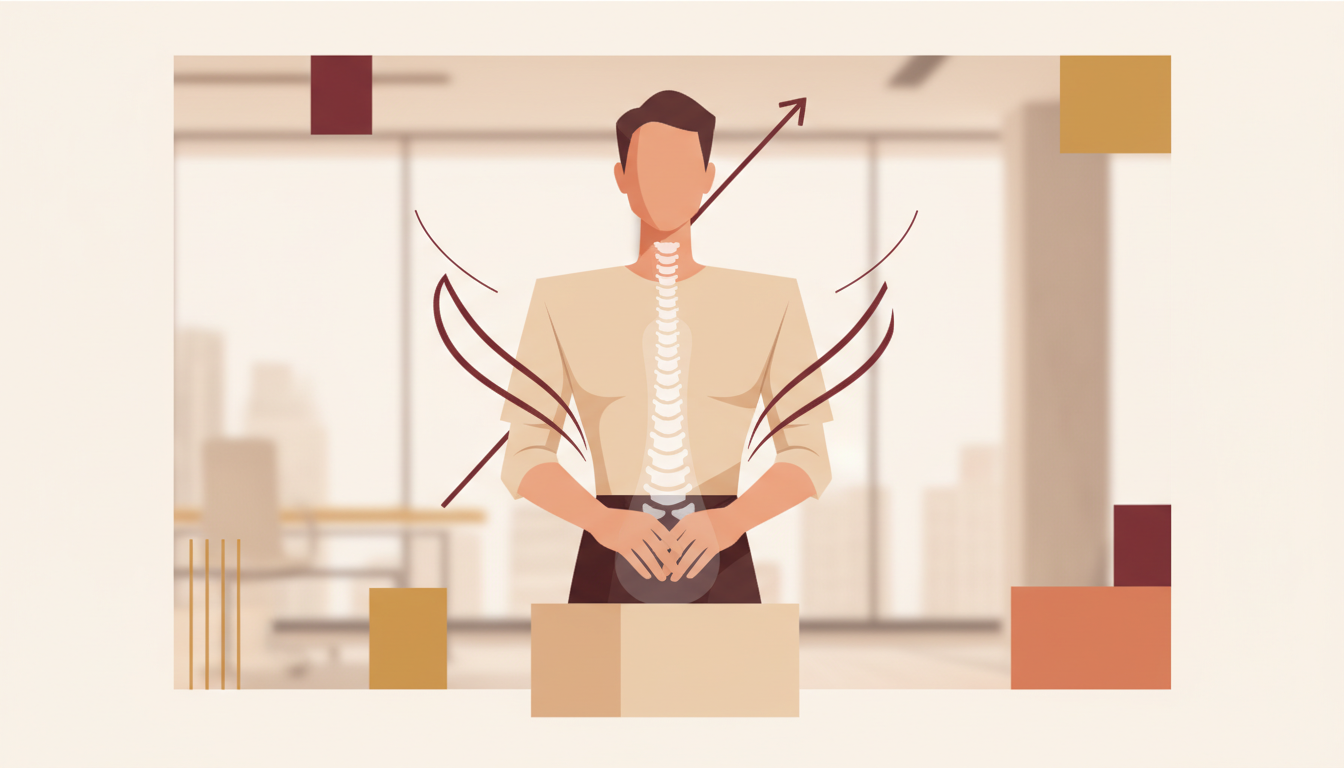
The Stillness Principle
Gravitas and fidgeting cannot coexist. Leaders with gravitas are physically still. They don't shift their weight, touch their face, or fidget with pens. Stillness signals that you are in control — of yourself and of the moment.
Practice this: In your next meeting, plant both feet flat on the floor. Rest your hands on the table or in your lap. When you speak, use deliberate gestures — then return to stillness. Notice how different this feels compared to your normal habits.This is particularly important in high-stakes settings. Our guide on confident body language for public speaking covers eight specific shifts that project authority from the moment you enter a room.
Strategic Eye Contact
Young leaders often break eye contact too quickly, especially when challenged. This reads as uncertainty. The fix is simple: hold eye contact for a full sentence before naturally shifting your gaze.
In group settings, use the "triangle method" — make eye contact with one person for a complete thought, then shift to another. This creates the impression of commanding the entire room rather than talking to the table. When challenged by a senior colleague, maintain steady eye contact while they speak. Nod once, slowly, to signal you're absorbing their point. Then pause before responding. This sequence — listen, nod, pause, respond — is the physical signature of gravitas.Take Up Space (Appropriately)
This isn't about power posing or dominating. It's about not shrinking. Young leaders, especially in rooms full of senior executives, unconsciously make themselves smaller — hunching, pulling elbows in, sitting at the edge of their chair.
Instead: sit back in your chair fully. Rest your arm on the armrest or table. When standing, place your feet shoulder-width apart. These subtle adjustments signal that you belong in the room — because you do.
Pillar 3: Communicate Like a Strategist
Gravitas isn't just about how you speak — it's about what you say. Young leaders often default to tactical, detail-heavy communication when what earns gravitas is strategic, big-picture thinking.
The "So What?" Filter
Before you speak in any meeting, run your comment through the "So What?" filter. Ask yourself: Does this add strategic value, or am I just showing that I did the work?
Senior leaders don't want to hear about the 47 data points you analyzed. They want to hear the insight those data points revealed and what should be done about it. According to a Harvard Business Review analysis, executives consistently rank "the ability to distill complex information into clear recommendations" as a top-three leadership communication skill.
Example scenario: You've analyzed customer churn data for the past quarter. Tactical response (low gravitas): "I looked at the churn numbers and found that segment A had 12% churn, segment B had 8%, and segment C had 15%. I used three different models to analyze this..." Strategic response (high gravitas): "Our highest-value customer segment is churning at nearly double the rate of others. I recommend we reallocate 20% of our retention budget to address this before it impacts Q3 revenue."For more on this shift, see our article on how to sound more strategic at work.
Lead with Recommendations, Not Analysis
This is a gravitas accelerator. Instead of walking people through your process, lead with your conclusion. This is how senior leaders communicate, and adopting this pattern signals that you think at their level.
Use this structure:- Recommendation — "Here's what I recommend."
- Rationale — "Here's why, in one to two sentences."
- Evidence — "Here's the key data point that supports this."
- Ask — "Here's what I need from this group to move forward."
This structure works in meetings, emails, and presentations. It's the fastest way to sound more senior at work.
Speak in Frameworks
People with gravitas don't ramble. They organize their thinking into clear structures that are easy to follow. When someone asks your opinion, don't stream-of-consciousness your way through an answer.
Instead, try: "I see three factors at play here. First... Second... Third..." or "There are two ways to look at this. The short-term view is... The long-term view is..."
This signals structured thinking and intellectual command — two core components of gravitas.
Pillar 4: Build Emotional Composure Under Pressure
Nothing destroys gravitas faster than losing your composure. And nothing builds it faster than staying calm when everyone else is rattled.
The Pause-and-Redirect Method
When you're challenged, criticized, or put on the spot, your body's stress response kicks in. Your heart rate spikes, your voice tightens, and you feel the urge to defend yourself immediately. Resist it.
Instead, use this sequence:- Pause — Take a full breath before responding. Two seconds of silence feels like an eternity to you but reads as confidence to everyone else.
- Acknowledge — "That's a fair point" or "I appreciate you raising that."
- Redirect — Steer back to your core message. "Here's how I see it..." or "The key question is..."
This method works in every high-pressure scenario — from tough Q&A sessions to difficult conversations with senior leaders. It's the composure that separates leaders from everyone else.
Develop a "Challenge Response" Library
Young leaders often struggle with gravitas in the moment because they're caught off guard. The solution: prepare for predictable challenges.
Before any important meeting, ask yourself: What's the hardest question someone could ask me? What's the most likely pushback? Then rehearse your responses — not word-for-word scripts, but key phrases and structures.
Common challenges young leaders face and gravitas-preserving responses:- "You don't have enough experience for this." → "What I bring is a fresh perspective backed by data. Let me walk you through what the numbers show."
- "We've tried this before and it didn't work." → "I've looked at why it didn't work last time. Three things have changed since then that make this viable now."
- "You're too junior to lead this." → "I understand the concern. Here's the plan I've built and the results I've already delivered on similar scope."
For a complete framework on maintaining poise in these moments, see our guide on how to communicate with poise under pressure.
Control Your Emotional Leakage
"Emotional leakage" is when your internal state — frustration, anxiety, self-doubt — shows up in your face, voice, or body language without your permission. Young leaders are especially susceptible because they're often navigating unfamiliar high-stakes situations.
The fix is awareness. Identify your personal leakage patterns. Do you clench your jaw when frustrated? Does your voice get higher when you're anxious? Do you talk faster when you feel challenged? Once you know your patterns, you can catch them in real time and correct.A daily practice: spend 60 seconds before each meeting doing a "body scan." Notice where you're holding tension. Release it. Set an intention for how you want to show up — calm, grounded, steady. This small ritual compounds over time into genuine emotional mastery.
Build Unshakable Professional Presence The Credibility Code provides the complete system for developing gravitas, authority, and commanding communication — specifically designed for professionals ready to lead at the next level. Discover The Credibility Code
Putting It All Together: The 30-Day Gravitas Plan
Theory without practice changes nothing. Here's a concrete 30-day plan to build gravitas as a young leader:
Week 1: Voice and Language
- Record yourself in two meetings and review for filler words, upspeak, and pace
- Practice the 3-Second Anchor before every conversation
- Run every meeting comment through the "So What?" filter
- Replace one hedging phrase per day ("I think maybe..." → "I recommend...")
Week 2: Physical Presence
- Practice stillness in every meeting — feet planted, hands steady
- Hold eye contact for one full sentence longer than feels comfortable
- Sit fully back in your chair in every meeting
- Do a 60-second body scan before each meeting
Week 3: Strategic Communication
- Lead with recommendations in every email and meeting contribution
- Use the "First... Second... Third..." framework at least once per day
- Prepare a "Challenge Response" for your most important meeting each week
- Practice the Pause-and-Redirect method in one real conversation
Week 4: Integration and Refinement
- Ask a trusted colleague for honest feedback on your presence
- Record a practice presentation and evaluate against all four pillars
- Identify your top two emotional leakage patterns and practice correcting them
- Set three specific gravitas goals for the next quarter
This plan isn't theoretical. Each action is small enough to execute daily but powerful enough to create visible change. According to research published in the European Journal of Social Psychology, it takes an average of 66 days for a new behavior to become automatic (Lally et al., 2010). Starting this 30-day plan gets you past the halfway point.
Frequently Asked Questions
Can you develop gravitas, or is it something you're born with?
Gravitas is absolutely a learnable skill. While some people may have natural tendencies toward composure or vocal depth, every component of gravitas — vocal authority, physical presence, strategic communication, and emotional steadiness — can be developed through deliberate practice. The 30-day plan outlined above provides a structured path. Most professionals see noticeable improvement within two to three weeks of consistent effort.
How is gravitas different from executive presence?
Gravitas is one component of executive presence, not a synonym for it. Executive presence typically encompasses three dimensions: gravitas (how you act), communication (how you speak), and appearance (how you look). Gravitas specifically refers to the weight, composure, and authority you bring to interactions. For a detailed breakdown, read our comparison of executive presence vs. leadership presence.
How do I build gravitas without coming across as arrogant?
The key distinction is warmth. Arrogance is authority without empathy. Gravitas with warmth means you listen actively, acknowledge others' contributions, and speak with conviction — not condescension. Use phrases like "Building on what Sarah said..." or "That's an important point — here's how I'd extend it." This shows confidence and generosity simultaneously.
What's the fastest way to project gravitas in meetings?
Three immediate shifts create the biggest impact: speak 20% slower than feels natural, eliminate filler words by replacing them with pauses, and lead with your recommendation instead of your analysis. These changes are noticeable from your very first meeting and require no preparation beyond awareness. Our article on how to sound confident in meetings provides nine additional shifts.
How do introverted young leaders build gravitas?
Introverts often have natural gravitas advantages — they tend to listen more, speak with more precision, and project calm composure. The key is leveraging these strengths rather than trying to mimic extroverted leadership styles. Focus on preparation, strategic contributions over frequent contributions, and written communication where your thoughtfulness shines. See our guide on building leadership presence as an introvert.
Does gravitas matter in virtual meetings?
Yes — arguably more. In virtual settings, you lose most of your physical presence, making vocal delivery and communication structure even more critical. Ensure your camera is at eye level, maintain eye contact by looking at the camera (not the screen), and use the "Land the Plane" technique to keep your contributions concise and impactful. Our guide on building executive presence remotely covers the full framework.
Build Presence People Notice Before You Say a Word
The Credibility Code gives you the specific verbal and nonverbal habits that make people treat you as the senior person in the room.
Discover The Credibility CodeRelated Articles

Body Language That Conveys Authority: 12 Proven Signals
Body language that conveys authority includes expansive posture, deliberate hand gestures, sustained eye contact, controlled movement, and strategic use of space. Research from Harvard Business School shows that nonverbal cues account for over 55% of how your message is received. The 12 signals below—grouped into posture, gestures, eye contact, spatial positioning, and movement—are used by the most credible leaders to project confidence and command respect without saying a word.

How to Develop Gravitas as a Leader: The Complete Method
Developing gravitas as a leader requires deliberate work across three dimensions: confidence (how you carry yourself), composure (how you respond under pressure), and substance (the depth behind your words). It is not an innate trait reserved for a few. You build gravitas by mastering structured thinking, controlling your emotional reactions, training your vocal delivery, and consistently demonstrating expertise. This article provides a complete, step-by-step method — including daily exercises,

How to Communicate With Gravitas: The 6 Core Pillars
Communicating with gravitas means combining composure, precision, conviction, strategic silence, intellectual depth, and emotional steadiness to project authority in every professional interaction. It's not about being the loudest voice in the room—it's about being the most trusted. Gravitas is learnable. By practicing six core pillars daily, you can shift from being heard to being *heeded*, transforming how colleagues, executives, and stakeholders perceive your leadership capacity.