
How to Negotiate Without Fear: A Confidence-First Approach
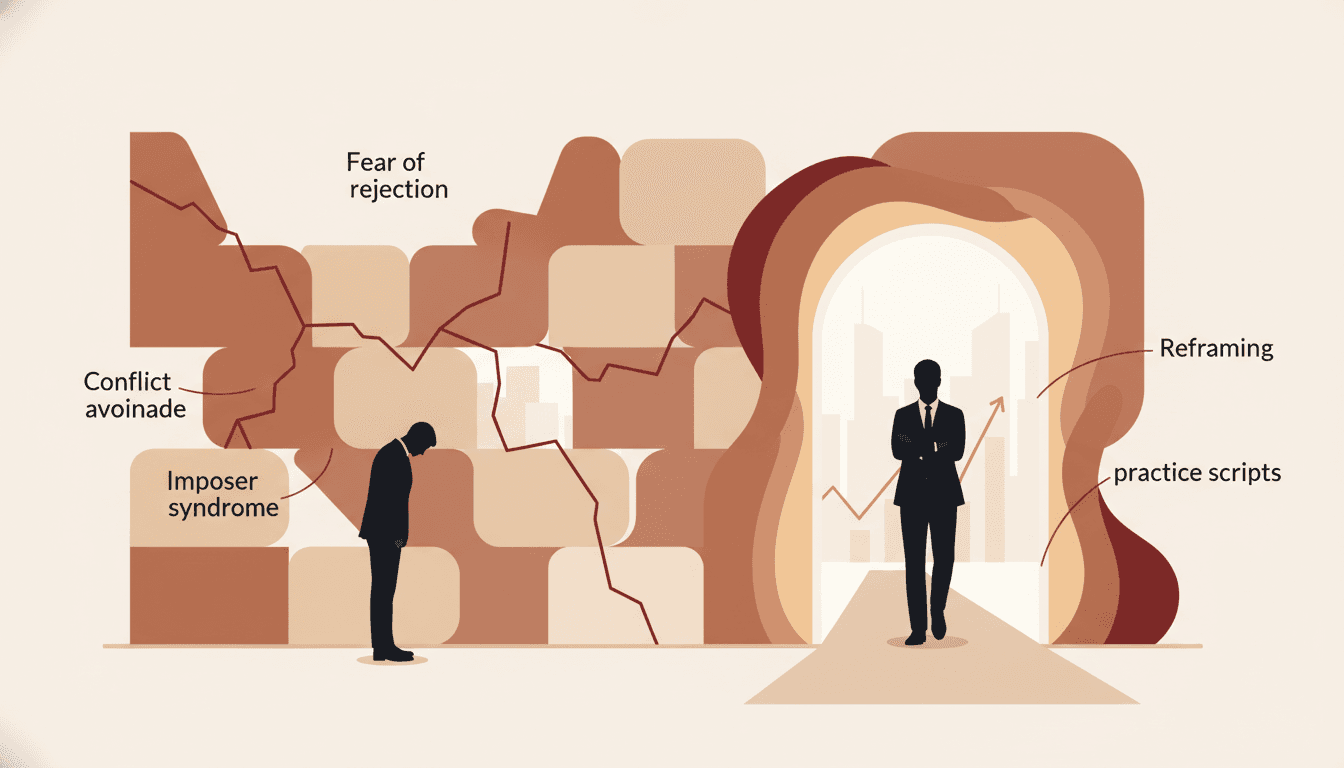
What Is Fear-Based Negotiation (and Why It's Holding You Back)?
Fear-based negotiation is the pattern of avoiding, undervaluing, or sabotaging your own negotiation outcomes because of psychological discomfort — not a lack of skill. It shows up as accepting the first offer without countering, over-explaining your requests, apologizing before stating your needs, or avoiding the conversation entirely.
This isn't a character flaw. It's a conditioned response that most professionals develop through years of workplace norms that reward compliance over advocacy. According to a 2023 survey by Salary.com, 58% of workers don't negotiate their salary — and the top reason cited is discomfort with the process, not lack of information.
Fear-based negotiation costs you more than money. It erodes your professional credibility, trains others to undervalue your contributions, and creates a compounding gap between what you deserve and what you accept. If you've noticed patterns of weak communication habits undermining your authority, fear-driven negotiation is likely one of them.
The Three Psychological Barriers That Kill Negotiation Confidence
Before you can negotiate without fear, you need to understand exactly what's generating that fear. It almost always traces back to one — or a combination — of three root causes.

1. Fear of Rejection: "They'll Say No and It Will Be Awkward"
Fear of rejection is the most common negotiation barrier. It's not really about hearing "no." It's about what you believe "no" means — that you overstepped, that you're not worth it, that the relationship is now damaged.
Research from Columbia Business School found that people consistently overestimate the likelihood of rejection by 30-50% when making requests (Flynn & Lake, 2008). In other words, the "no" you're bracing for is far less likely than your brain predicts.
Reframe: A "no" in negotiation is almost never final. It's information. It tells you where the boundary is, and skilled negotiators use that boundary as a starting point, not an ending.2. Conflict Avoidance: "I Don't Want to Damage the Relationship"
Many professionals — especially those in collaborative or team-oriented roles — equate negotiation with conflict. They fear that advocating for themselves will make them seem difficult, ungrateful, or aggressive.
This is particularly acute for women and introverts. A study published in the Journal of Personality and Social Psychology found that women face social backlash for initiating negotiations at rates significantly higher than men (Bowles, Babcock & Lai, 2007). The fear isn't irrational — it's based on real dynamics. But avoiding negotiation doesn't protect you. It just guarantees you lose.
If conflict avoidance is your primary barrier, you'll benefit from learning how to be more assertive at work without being aggressive — a skill that applies directly to negotiation.
3. Imposter Syndrome: "Who Am I to Ask for This?"
Imposter syndrome tells you that your accomplishments aren't real, that you'll be exposed as a fraud, and that you certainly don't deserve more than what you've already been given. In negotiation, this shows up as self-undermining language: "I'm not sure if this is reasonable, but..." or "I know this might be a lot to ask..."
According to a 2020 review in the International Journal of Behavioral Science, an estimated 70% of people experience imposter syndrome at some point in their careers (Bravata et al., 2020). If you're struggling with this, our guide on overcoming imposter syndrome at work provides a deeper framework.
The antidote isn't waiting until you "feel ready." It's building a case based on evidence — market data, documented results, and clear value — so your negotiation stands on facts, not feelings.
The Confidence-First Negotiation Framework (C.A.L.M.)
Negotiation fear thrives in ambiguity. The more structured your approach, the less room fear has to operate. The C.A.L.M. framework gives you a repeatable process for any workplace negotiation — salary, workload, deadlines, resources, or role scope.
C — Clarify Your Position Before the Conversation
Most negotiation anxiety comes from walking in unprepared. Before any negotiation, answer these four questions in writing:
- What specifically am I asking for? (Be precise — not "more money" but "a 12% salary increase to $95,000.")
- Why is this justified? (Market data, performance metrics, expanded responsibilities.)
- What is my BATNA? (Best Alternative to a Negotiated Agreement — what will you do if they say no?)
- What is my walk-away point? (The minimum you'll accept before the deal no longer works for you.)
This preparation eliminates the vagueness that feeds anxiety. When you know your numbers and your reasoning, you're not "hoping" for a good outcome — you're presenting a case.
A — Anchor with Authority
The first number or position stated in a negotiation sets the psychological anchor. Research from Harvard's Program on Negotiation confirms that first offers have a powerful effect on final outcomes — the party that anchors first typically ends up closer to their target.
This means you should not wait for the other party to make the first move. State your position clearly, early, and without hedging. Compare these two approaches:
- Weak anchor: "I was kind of hoping we could maybe discuss my compensation? I'm not sure what's possible, but..."
- Strong anchor: "Based on my contributions to the Q3 product launch and current market rates for this role, I'm requesting a salary adjustment to $95,000. Here's the data I've compiled."
The difference isn't aggression — it's preparation and clarity. For more on eliminating undermining language, see our post on how to sound confident in a meeting even when you're not.
L — Listen More Than You Speak
Fear makes you talk too much. You over-explain, fill silences, and negotiate against yourself before the other person has even responded. The most powerful negotiation tool is silence.
After you state your position, stop talking. Let the other person respond. Then listen — not to formulate your rebuttal, but to understand their constraints, priorities, and flexibility.
Use phrases like:
- "Help me understand the constraints on your end."
- "What would need to be true for this to work?"
- "I'd like to hear your perspective on this."
These phrases signal confidence and collaboration simultaneously. They show you're not desperate — you're problem-solving.
M — Maintain Composure Under Pressure
Negotiations rarely go exactly as planned. The other party might push back, delay, or counter with something unexpected. Fear-based negotiators crumble here — they capitulate, apologize, or retreat.
Confident negotiators pause. They use bridging phrases to buy time:
- "That's an interesting point. Let me think about that for a moment."
- "I appreciate you sharing that. Here's how I see it..."
- "I understand the constraint. Can we explore alternatives?"
Your ability to hold your ground in negotiations is what separates professionals who get what they ask for from those who settle for what they're given.
Practice Scripts for Five Common Workplace Negotiations
Frameworks are essential, but practice is what eliminates fear. Below are word-for-word scripts you can adapt for the most common professional negotiations.
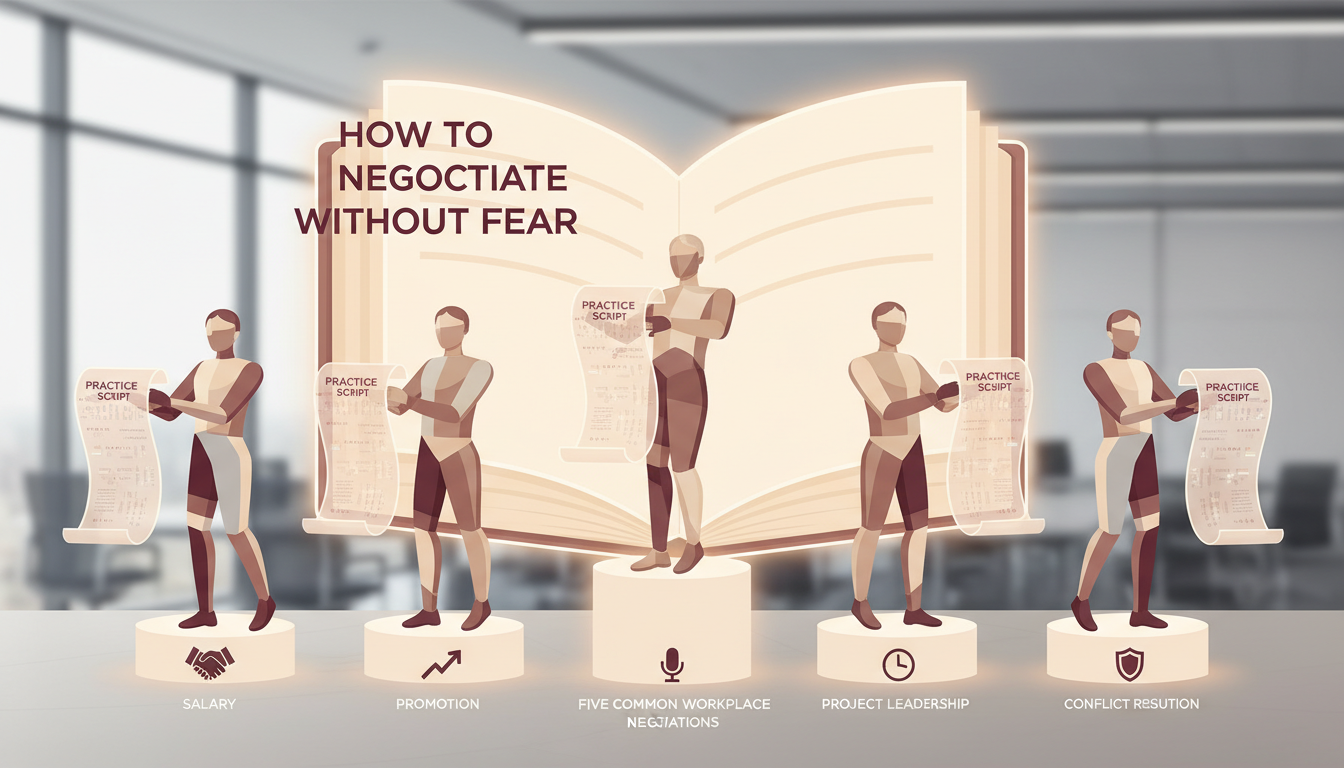
Script 1: Negotiating a Salary Increase
Setup: You've been in your role for 18 months, taken on additional responsibilities, and your market research shows you're underpaid by 10-15%."I'd like to discuss my compensation. Over the past 18 months, I've taken on [specific responsibility], delivered [specific result], and my role has expanded significantly beyond the original scope. Based on market data from [source — Glassdoor, Payscale, industry report], comparable roles are compensated in the range of $X to $Y. I'm requesting an adjustment to $Z, which reflects both my contributions and the current market. I'd love to hear your thoughts."
For a deeper dive into salary-specific strategies, see our complete guide on how to negotiate salary confidently with scripts and strategies.
Script 2: Negotiating a Deadline
Setup: Your manager assigns a project with an unrealistic timeline."I want to make sure I deliver this at the quality level you're expecting. Given the current scope, I'd need [realistic timeframe] to do this well. If the original deadline is firm, I'd like to discuss which elements to prioritize so we're aligned on what 'done' looks like by [date]."
This approach doesn't say "I can't." It says "Here's what I need to deliver excellence." For more on this, read our guide on how to negotiate deadlines professionally.
Script 3: Negotiating Your Workload
"I want to be strategic about where I'm spending my time so I can have the highest impact. Right now, I'm carrying [list key projects]. To take on [new request] at the level it deserves, I'd need to deprioritize [specific item]. Which would you prefer I focus on?"
This frames you as strategic, not overwhelmed. It's a technique we cover in depth in our post on how to negotiate your workload without seeming lazy.
Script 4: Pushing Back on a Decision You Disagree With
"I appreciate the direction, and I want to flag a concern before we move forward. Based on [data/experience/precedent], I think [alternative approach] would give us [specific benefit]. I'm committed to whatever direction we go — I just want to make sure we've considered this angle."
Script 5: Negotiating Resources or Budget
"To hit the targets we've set for Q2, I'll need [specific resource — headcount, budget, tool]. Here's the business case: [specific ROI or impact data]. I've also identified [alternative if full ask isn't possible]. What's feasible on your end?"
How to Build Negotiation Confidence Through Progressive Exposure
You don't overcome negotiation fear by reading about it. You overcome it by doing it — starting small.
Start with Low-Stakes Negotiations
Practice negotiating in environments where the outcome doesn't matter much:
- Ask for a better table at a restaurant.
- Negotiate a fee waiver on a subscription service.
- Request an upgrade at a hotel.
- Counter-offer on a marketplace purchase.
These micro-negotiations build your tolerance for the discomfort of asking. Each small success rewires your brain's association between negotiation and threat.
Use the "Pre-Negotiation Rehearsal" Technique
Before any significant workplace negotiation, rehearse out loud — not in your head. Stand up, speak at full volume, and practice your opening statement, your key points, and your response to the two most likely objections.
A study by the University of Chicago found that practicing arguments out loud significantly improved persuasive performance compared to mental rehearsal alone (Schroeder & Epley, 2015). Your voice needs to hear itself saying the words before the stakes are real.
Track Your Negotiation Wins
Fear has a short memory for success and a long memory for failure. Keep a simple log of every negotiation you attempt — what you asked for, what you got, and what you learned. Over time, this evidence base dismantles the narrative that "negotiation doesn't work for people like me."
Turn Confidence Into Your Career Advantage. Negotiation is just one piece of professional authority. Discover The Credibility Code — a complete system for building the kind of credibility that makes people take you seriously in every room you enter. Discover The Credibility Code
The Body Language of Confident Negotiators
What you say matters. How you physically deliver it matters just as much. Research by Albert Mehrabian (often cited, frequently misunderstood) suggests that in emotionally charged communication, nonverbal cues account for up to 55% of the message received.
Posture and Positioning
- Sit or stand with an open posture — uncrossed arms, shoulders back, feet planted.
- Lean slightly forward when making your key ask. This signals engagement and conviction.
- Avoid self-soothing gestures (touching your face, fidgeting with a pen) — they broadcast anxiety.
Vocal Delivery
- End statements with a downward inflection. Upward inflections turn statements into questions and undermine authority.
- Speak at a measured pace. Rushing signals nervousness.
- Use strategic pauses — especially after your key ask. Silence communicates confidence.
For a comprehensive guide to nonverbal authority, explore our post on body language for leadership presence.
Eye Contact
Maintain steady (not unblinking) eye contact when delivering your core position. Research consistently shows that appropriate eye contact increases perceived credibility and trustworthiness. If sustained eye contact feels uncomfortable, focus on the triangle between the other person's eyes and nose.
Frequently Asked Questions
How do I negotiate without fear of losing my job?
The fear of retaliation is common but usually disproportionate to reality. Professionals who negotiate respectfully are rarely penalized — in fact, managers often expect it. Prepare a data-backed case, use collaborative language ("I'd like to discuss" rather than "I demand"), and frame your request around mutual benefit. If your workplace genuinely punishes reasonable negotiation, that's a signal about the culture, not about you.
What's the difference between being assertive and being aggressive in negotiation?
Assertiveness means clearly stating your needs while respecting the other party's perspective. Aggression means pursuing your needs at the expense of the other person. Assertive negotiators say, "Here's what I need and why." Aggressive negotiators say, "Give me what I want or else." The distinction lies in tone, language, and willingness to listen. Our guide on assertive communication at work breaks this down further.
Can introverts be good negotiators?
Absolutely. Introverts often excel at negotiation because they tend to prepare thoroughly, listen actively, and avoid the impulsive concessions that extroverts sometimes make. The key is leveraging your natural strengths — deep preparation, thoughtful responses, and strategic silence — rather than trying to mimic an extroverted style. Read our complete guide on how to negotiate as an introvert.
How do I negotiate when I have no leverage?
You always have more leverage than you think. Your leverage might be your institutional knowledge, your relationships, your specialized skills, or simply the cost of replacing you. Identify what the other party values and what it would cost them if you weren't there. Even in low-power positions, framing your request around the other party's interests creates leverage where none seemed to exist.
How do I handle rejection after a negotiation attempt?
First, don't treat it as final. Ask, "What would need to change for us to revisit this?" or "Is there a timeline when this might be possible?" Second, document the conversation and any commitments made. Third, continue performing at a high level — your next negotiation will be stronger with additional evidence. Rejection is data, not a verdict.
How long does it take to become a confident negotiator?
Most professionals see a significant shift within 3-6 months of deliberate practice. The key word is deliberate — not just hoping your next negotiation goes better, but actively using frameworks, rehearsing scripts, and tracking outcomes. Confidence in negotiation is a skill, not a personality trait, and like any skill, it responds to structured practice.
Negotiate From a Position of Credibility
The Credibility Code shows you how to state your case without hedging, so your ask is heard as a professional position rather than a favor.
Discover The Credibility CodeRelated Articles

How to Negotiate Without Being Pushy: Firm Yet Respectful
Negotiating without being pushy means replacing demands and pressure tactics with collaborative framing, calibrated questions, and confident language patterns that protect relationships while advancing your position. The key is to anchor your requests in shared interests and objective criteria rather than personal insistence. You don't need to be aggressive to be effective — research shows that negotiators who use integrative (win-win) strategies consistently achieve better outcomes than those w

How to Negotiate When You Feel Powerless: 6 Power Shifts
Negotiating when you feel powerless starts with one critical insight: perceived power matters more than actual power. You don't need a bigger title, more leverage, or a backup offer to negotiate effectively. By shifting how you prepare, frame, and communicate your position, you can create credibility and influence even from an apparent position of weakness. The six power shifts below will help you transform feelings of powerlessness into strategic advantages that produce real results.

Confident Negotiation Techniques for Professionals
Confident negotiation techniques for professionals combine internal state management, strategic vocal delivery, and deliberate body language to help you secure better outcomes in salary discussions, project scope conversations, vendor agreements, and workplace negotiations. The key difference between average and exceptional negotiators isn't just knowing *what* to say—it's projecting genuine authority through your presence, managing anxiety in real time, and using tools like strategic silence, a