
How to Project Confidence in Interviews (Even When You're Nervous)

What Is Interview Confidence?
Interview confidence is the ability to communicate your value, expertise, and leadership potential clearly and calmly — even under the pressure of evaluation. It's not arrogance or bravado. It's a combination of prepared messaging, controlled body language, and vocal authority that signals to interviewers: "This person is credible, capable, and ready."
True interview confidence is a skill, not a personality trait. It can be practiced, refined, and deployed on demand. Research from the Journal of Applied Psychology found that interview anxiety negatively predicts hiring decisions independent of actual qualifications — meaning how you present matters as much as what you present (McCarthy & Goffin, 2004). Projecting confidence is therefore not optional — it's a career-critical competency.
Why Confidence Matters More Than You Think in Interviews
Interviewers Decide Fast — and Confidence Is the First Filter
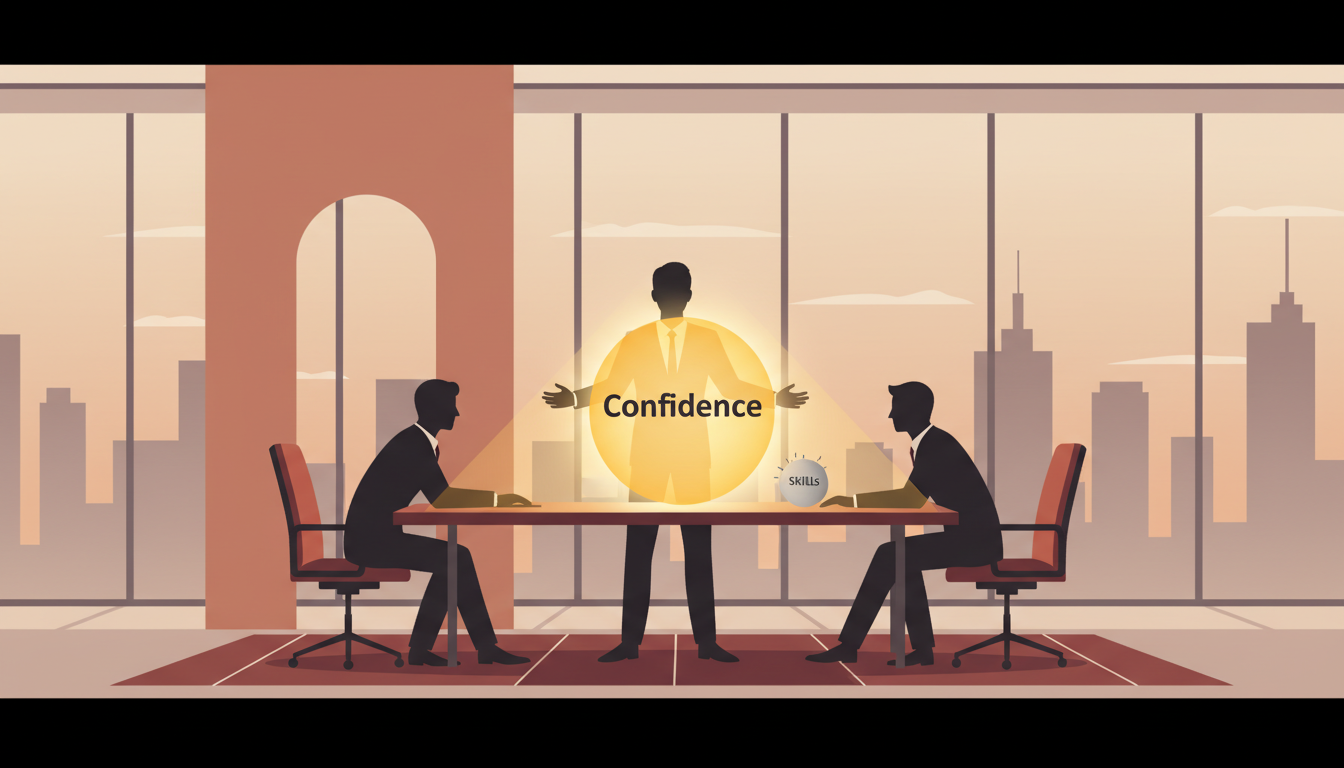
A landmark study published in the Journal of Occupational and Organizational Psychology found that interviewers form initial impressions within the first 10 seconds of meeting a candidate, and those impressions heavily influence final hiring decisions (Barrick, Swider, & Stewart, 2010). In those first moments, the interviewer isn't evaluating your resume. They're reading your handshake, your posture, your eye contact, and the steadiness of your voice.
This means the opening 30 seconds of an interview function like a credibility checkpoint. If you pass it — with a calm greeting, a steady gaze, and a confident introduction — you earn the benefit of the doubt for the rest of the conversation. If you don't, you spend the remaining 45 minutes trying to recover from a deficit you may not even know exists.
Confidence Signals Competence (Even When It Shouldn't)
Psychologists call it the "confidence heuristic." When people can't directly assess someone's competence — which is almost always the case in an interview — they use confidence as a proxy. A 2012 study in the Journal of Personality and Social Psychology found that individuals who displayed more confidence were consistently perceived as more competent by observers, regardless of their actual ability (Anderson, Brion, Moore, & Kennedy, 2012).
This isn't about faking it. It's about ensuring that your genuine competence isn't undermined by nervous habits — fidgeting, hedging language, vocal fry, or apologetic body language. You've earned your skills. Confidence ensures the interviewer actually sees them. For a deeper dive into how this applies across professional settings, explore our guide on how to sound confident at work.
The Confidence-Anxiety Paradox
Here's what most interview advice gets wrong: it tells you to "just relax." But research from Harvard Business School by Alison Wood Brooks (2014) found that reframing anxiety as excitement — rather than trying to suppress it — led to significantly better performance in high-stakes situations like public speaking and negotiations.
Nervousness and confidence are not opposites. They coexist. The goal isn't to eliminate butterflies. It's to make them fly in formation.
The Body Language Blueprint for Interview Confidence
Your Posture Sets the Tone Before You Speak
Walk into the room like you belong there. That means shoulders back, chin level (not tilted up arrogantly or down submissively), and arms relaxed at your sides. When you sit, take up appropriate space — don't shrink into the chair or sprawl across it. Plant both feet on the floor, lean slightly forward to signal engagement, and keep your hands visible on the table or in your lap.
A study by researchers at Columbia and Harvard found that adopting expansive, open postures for just two minutes before a stressful social evaluation increased feelings of power and decreased cortisol levels (Carney, Cuddy, & Yap, 2010). While the "power pose" research has been debated, the core finding holds: how you hold your body directly influences how you feel and how others perceive you.
Scenario: Imagine two candidates with identical qualifications. Candidate A walks in with rounded shoulders, avoids eye contact during the greeting, and sits with crossed arms. Candidate B enters with an upright posture, makes warm eye contact, and offers a firm handshake. Before a single question is asked, Candidate B has already established more credibility. Our comprehensive guide on body language for leadership presence covers these principles in full detail.Master the Eye Contact Balance
Steady eye contact communicates honesty, engagement, and confidence. But too much feels aggressive, and too little signals insecurity. The sweet spot is maintaining eye contact for roughly 60-70% of the conversation — holding it while making key points, then naturally breaking it when thinking or transitioning between ideas.
In panel interviews, direct your primary eye contact to the person who asked the question, but periodically include other panelists with brief glances. This signals awareness and leadership — you're not just answering a question, you're commanding a room.
Eliminate Confidence-Killing Micro-Behaviors
Small, unconscious habits can silently erode your credibility:
- Touching your face or neck — signals discomfort or deception
- Fidgeting with a pen, ring, or hair — broadcasts anxiety
- Nodding excessively — undermines your authority and looks approval-seeking
- Crossing your arms — creates a barrier and signals defensiveness
- Foot tapping or leg bouncing — visible nervous energy that distracts
Record yourself in a mock interview. You'll likely discover at least two or three of these habits you didn't know you had. Awareness is the first step to elimination.
Know exactly what to say next time. The Pushback Playbook has 50 word-for-word scripts for moments like this one: what they say, what you say, why it works, and what to do if they push back. Get The Pushback Playbook — $27
The Vocal Authority Framework for Interviews
Speak Slower Than You Think You Should

When we're nervous, we speed up. It's a primal response — our brain wants to get through the threat as quickly as possible. But rapid speech signals anxiety to interviewers, and it makes your answers harder to follow.
The fix is counterintuitive: speak about 20% slower than feels natural. What feels painfully slow to you will sound calm and deliberate to the listener. Practice this in mock interviews until a measured pace becomes your default under pressure.
Pair this with strategic pausing. When you receive a tough question, take a full breath before answering. A two-second pause signals that you're thoughtful, not scrambling. It also gives you time to organize your response. For a complete breakdown of vocal techniques, read our post on vocal authority and how to sound like a leader.
Use Downward Inflections to Sound Decisive
Upward inflections — where your voice rises at the end of a statement — make declarative sentences sound like questions. This is one of the most common confidence killers in interviews, and most people don't realize they're doing it.
Compare these two deliveries of the same answer:
- Uptalk: "I led a team of twelve people? And we increased revenue by 30%?"
- Downward inflection: "I led a team of twelve people. We increased revenue by 30%."
The content is identical. The credibility gap is enormous. Practice ending your sentences with a firm, downward tone. It communicates certainty and authority.
Eliminate Filler Words Strategically
"Um," "uh," "like," "you know," "so," and "basically" dilute your message and signal uncertainty. According to a study by the University of Texas, listeners perceive speakers who use fewer filler words as more credible, more prepared, and more intelligent (Brennan & Williams, 1995).
You don't need to eliminate every filler word — that would sound robotic. But reducing them by even 50% dramatically improves your perceived confidence. The technique: replace fillers with silence. A brief pause is always more powerful than an "um." Our detailed guide on how to stop using filler words provides practical drills you can start using today.
Frameworks for Answering Tough Questions With Confidence
The STAR-L Method for Behavioral Questions
Most professionals know the STAR method (Situation, Task, Action, Result). But confident communicators add a fifth element: L for Leadership Insight. This final step shows the interviewer not just what you did, but what you learned and how it shaped your leadership approach.
Example — "Tell me about a time you handled a difficult team conflict."- Situation: "Two senior engineers on my team had fundamentally different approaches to our platform migration, and the disagreement was stalling the project."
- Task: "As the project lead, I needed to resolve the conflict without alienating either contributor and get us back on timeline."
- Action: "I scheduled individual conversations with each engineer to understand their concerns, then facilitated a structured working session where we evaluated both approaches against our success criteria."
- Result: "We adopted a hybrid approach that incorporated the strongest elements of both proposals. The project launched two weeks ahead of schedule."
- Leadership Insight: "That experience taught me that technical disagreements are often rooted in different assumptions about priorities. Now I establish shared success criteria at the start of every project to prevent alignment issues before they escalate."
The Leadership Insight is what separates a competent answer from a confident, authoritative one. It shows strategic thinking and self-awareness — exactly what hiring managers look for in leadership candidates.
The Bridge Technique for Questions You Don't Know
Every candidate dreads the question they can't answer. Confident candidates handle it differently than nervous ones.
The nervous response: "Oh, I'm not sure... I haven't really dealt with that... I guess maybe..." The confident bridge: "That's not an area I've had direct experience with yet. What I can tell you is [related experience that demonstrates transferable skills]. And I'd approach this by [clear, logical plan]."This technique does three things: it demonstrates honesty (credibility), redirects to your strengths (strategy), and shows problem-solving ability (competence). You haven't dodged the question — you've answered it like a leader. This approach mirrors the principles in our guide on confidence in high-stakes conversations.
The Concise Answer Architecture
Rambling is one of the fastest ways to lose credibility in an interview. Confident communicators structure their answers with what we call the Headline-Evidence-Impact framework:
- Headline — Lead with your main point in one sentence
- Evidence — Support it with one specific example or data point
- Impact — Close with the result or what it means for the role
- Headline: "I bring a combination of deep technical expertise and proven team leadership that directly matches what this role requires."
- Evidence: "In my current position, I built and led the data analytics function from scratch, growing it from two analysts to a team of eight while reducing reporting turnaround time by 60%."
- Impact: "I'd bring that same builder mentality here — the ability to scale systems and develop people simultaneously."
Total delivery time: about 30 seconds. Clear, specific, confident. For more on this approach, check out our framework for how to speak concisely at work.
Managing Nervous Energy Before and During the Interview
The 5-Minute Pre-Interview Protocol
What you do in the five minutes before an interview matters more than the five hours of preparation that preceded it. Here's a tactical pre-interview routine:
- Minutes 5-4: Find a private space (a bathroom stall works). Stand tall, take three deep belly breaths (inhale for 4 counts, hold for 4, exhale for 6).
- Minutes 4-3: Review your three key talking points — the three things you want the interviewer to remember about you, no matter what questions are asked.
- Minutes 3-2: Do a physical warm-up. Roll your shoulders, stretch your jaw, hum to warm up your vocal cords. This releases physical tension that manifests as vocal strain or stiff body language.
- Minutes 2-1: Reframe your mindset. Instead of "I hope they like me," think "I'm here to have a professional conversation about mutual fit." This shifts you from evaluation mode to collaboration mode.
- Final minute: Smile genuinely. Research from the University of Kansas found that smiling — even during stressful tasks — reduces heart rate and lowers stress response (Kraft & Pressman, 2012).
Reframe the Power Dynamic
Most candidates walk into interviews feeling like they're being judged. This one-down mindset is the single biggest driver of interview anxiety. Confident professionals reframe the dynamic: an interview is a two-way evaluation, not an audition.
You are also assessing whether this company, this team, and this role are right for you. When you genuinely adopt this mindset, your body language shifts naturally — you lean in with curiosity rather than shrinking with fear. You ask better questions. You listen more actively. You respond rather than react.
This reframe isn't just a mental trick. It's the truth. And interviewers can feel the difference between a candidate who's desperate for approval and one who's genuinely evaluating fit.
The Recovery Move When You Stumble
Even the most confident professionals stumble in interviews. You lose your train of thought. You misunderstand a question. You give a weak answer. What separates confident candidates from anxious ones isn't the absence of mistakes — it's the recovery.
The confident recovery formula:- Pause. Take a breath. Don't rush to fill the silence.
- Acknowledge briefly. "Let me rephrase that" or "Actually, a better example would be..."
- Reset and deliver. Give your corrected answer with the same vocal authority as any other response.
What you absolutely should not do: apologize excessively, laugh nervously, or say "Sorry, I'm so nervous." One brief acknowledgment, then move forward. The interviewer will follow your lead. If you treat the stumble as minor, they will too. This is a core principle of leadership presence and commanding any room.
Your Interview Confidence Preparation Checklist
Before your next interview, run through this tactical checklist:
- [ ] Research completed: Company, role, interviewer backgrounds, recent news
- [ ] Three key messages identified: The three things you want them to remember
- [ ] Five STAR-L stories prepared: Covering leadership, conflict, achievement, failure, and collaboration
- [ ] Questions prepared for them: At least three thoughtful questions that demonstrate strategic thinking
- [ ] Outfit selected and tested: Wear it the day before to ensure comfort and confidence
- [ ] Mock interview recorded: Review for filler words, uptalk, fidgeting, and pacing
- [ ] Pre-interview protocol planned: Know where you'll do your 5-minute warm-up
- [ ] Opening introduction rehearsed: A confident, concise self-introduction you can deliver smoothly (see our guide on how to introduce yourself professionally)
Frequently Asked Questions
How can I look confident in an interview if I'm extremely nervous?
Focus on the physical signals you can control: maintain steady eye contact, keep your hands still and visible, sit with an open posture, and speak at a measured pace. Nervousness is internal — confidence is what the interviewer sees externally. Use the pre-interview protocol (deep breathing, physical warm-up, mindset reframe) to reduce visible anxiety. Remember, even seasoned executives feel nervous. The difference is they've practiced channeling that energy into focused presence.
What body language mistakes make you look unconfident in interviews?
The most damaging body language mistakes are avoiding eye contact, fidgeting with objects or your hair, crossing your arms, slouching, and nodding excessively. These signal insecurity, discomfort, or approval-seeking — none of which convey leadership potential. Record a mock interview to identify your specific habits, then practice replacing them with open, steady, deliberate movements.
How do I answer interview questions I don't know the answer to?
Use the Bridge Technique: honestly acknowledge the gap, pivot to related experience or transferable skills, and outline how you'd approach the problem. For example: "I haven't managed that specific technology, but I led the adoption of a similar platform and would approach this by [clear plan]." This demonstrates honesty, adaptability, and problem-solving — all of which signal confidence and competence.
Confidence vs. arrogance in interviews — what's the difference?
Confidence is grounded in evidence and delivered with warmth. Arrogance is grounded in ego and delivered without regard for others. Confident candidates say "I led a project that achieved X result." Arrogant candidates say "I'm the best person you'll interview." The key difference: confident people acknowledge team contributions, show curiosity about the role, and ask thoughtful questions. Arrogant people make it all about themselves.
How long should my interview answers be?
Aim for 60-90 seconds for behavioral questions and 30-45 seconds for direct questions. Research from interview coaching firm The Muse suggests that answers exceeding two minutes cause interviewer attention to drop significantly. Use the Headline-Evidence-Impact framework to keep answers tight and impactful. If the interviewer wants more detail, they'll ask — and that's a good sign.
Does what I wear affect how confident I appear in interviews?
Yes. A study in the Journal of Experimental Social Psychology found that wearing formal clothing increases abstract thinking and feelings of power (Slepian et al., 2015). More practically, wearing an outfit you've tested for comfort eliminates a source of distraction and self-consciousness. Choose clothing one level above the company's dress code, ensure it fits well, and wear it at least once before interview day so it feels like yours.
Never Be Caught Without the Right Words Again
50 word-for-word scripts for being talked down to, interrupted, dismissed, and put on the spot at work, plus five worksheets. PDF, 50 pages.
Get The Pushback Playbook — $27Related Articles

How to Handle Being Talked Down to at Work Professionally
To handle being talked down to at work, stay calm and address the behavior directly using neutral, assertive language. Name the specific behavior without attacking the person by saying something like, "I'd appreciate it if we could discuss this as equals—I have relevant expertise here." Set clear boundaries, document patterns of condescension, and escalate to HR if the behavior continues. The goal is to protect your credibility and professional standing without matching their tone or becoming re

How to Advocate for Yourself at Work Without Bragging
Advocating for yourself at work means proactively communicating your contributions, articulating your value, and asking for what you deserve—without crossing the line into arrogance. The key is to frame self-advocacy around impact, not ego. Use data-driven language, connect your work to organizational outcomes, and make it easy for decision-makers to recognize your contributions. When done well, self-advocacy doesn't feel like bragging—it feels like leadership.

How to Project Confidence in a Job Interview: 11 Signals
To project confidence in a job interview, focus on 11 key signals hiring managers watch for: a firm handshake, steady eye contact, upright posture, a controlled vocal pace, concise answers using structured frameworks, strategic pausing, power language (no hedging), prepared questions that show research, calm hand gestures, a composed entrance, and a strong closing statement. Master these signals, and you shift from "hopeful applicant" to "obvious choice."