
How to Present Without Being Nervous: 6 Pro Methods

What Is Presentation Nervousness?
Presentation nervousness is the physiological and psychological stress response triggered when a person anticipates or begins delivering a presentation to an audience. It manifests as sweating palms, a racing heart, shaky voice, dry mouth, and mental blanking—symptoms caused by your nervous system interpreting social evaluation as a threat.
It's important to distinguish this from a clinical anxiety disorder. For most professionals, presentation nerves are a normal adrenaline response that can be managed—and even leveraged—with the right techniques. According to the National Institute of Mental Health, approximately 73% of the population experiences some degree of glossophobia, or fear of public speaking, making it one of the most common professional challenges.
Method 1: Cognitive Reframing — Turn Anxiety Into Fuel
The most powerful shift you can make happens before you ever open your mouth. Cognitive reframing changes how your brain interprets the adrenaline surge that accompanies presenting.

Why Your Brain Misreads the Situation
When you stand up to present, your body releases cortisol and adrenaline. Your brain reads this as danger. But physiologically, the symptoms of anxiety and excitement are nearly identical—elevated heart rate, heightened alertness, faster breathing.
A landmark study published in the Journal of Experimental Psychology by Harvard Business School professor Alison Wood Brooks found that participants who told themselves "I am excited" before a high-pressure task performed significantly better than those who tried to calm down. The reappraisal group sang more accurately, spoke more persuasively, and scored higher on math tasks.
How to Apply Reframing Before Your Next Presentation
Here's the practical framework:
- Notice the sensation. When your heart rate spikes before a presentation, label it: "My body is preparing me to perform."
- Restate the narrative. Say aloud or internally: "I'm excited about this. This energy is going to make me sharper."
- Anchor to purpose. Remind yourself why this presentation matters—not to you, but to your audience. Shifting from self-focus to audience-focus immediately reduces the threat response.
This isn't positive thinking fluff. It's a clinically supported technique called anxiety reappraisal, and it works because it doesn't fight the adrenaline—it redirects it.
If you struggle with the mental game of high-stakes moments, you'll also benefit from learning how to project confidence when nervous at work, which covers broader workplace scenarios beyond presentations.
The "Pre-Frame" Statement Technique
Before your presentation, write a single sentence that frames the opportunity positively. Examples:
- "This is my chance to position our team's work in front of decision-makers."
- "I'm the most knowledgeable person in this room on this topic."
- "The audience wants me to succeed—they're here because they need this information."
Read this statement three times in the 10 minutes before you present. It primes your brain to interpret the situation as an opportunity rather than a threat.
Method 2: Physiological Control — Breathing and Body Reset
Your mind follows your body. If you can control your physiology, you can control your nervousness.
Box Breathing: The Navy SEAL Standard
Box breathing is used by Navy SEALs, surgeons, and elite athletes to regulate their nervous system under extreme pressure. Here's the protocol:
- Inhale through your nose for 4 seconds.
- Hold for 4 seconds.
- Exhale through your mouth for 4 seconds.
- Hold for 4 seconds.
- Repeat 4-6 cycles.
Do this in the 5 minutes before your presentation—ideally in a private space. Research published in Frontiers in Human Neuroscience (2018) confirms that controlled breathing techniques activate the parasympathetic nervous system, reducing cortisol levels and lowering heart rate within minutes.
The Physiological Sigh: A 10-Second Reset
Stanford neuroscientist Dr. Andrew Huberman has popularized the physiological sigh as the fastest known method to reduce real-time stress. It involves a double inhale through the nose (one full breath followed by a short "top-off" sniff) and then a long, slow exhale through the mouth.
You can use this discreetly even mid-presentation. If you feel a wave of nervousness while speaking, pause for a "breath moment," execute one physiological sigh, and continue. Your audience will perceive it as a thoughtful pause—not a panic response.
For a deeper dive into managing the physical symptoms of speaking anxiety, check out our guide on how to calm nerves before a presentation: 11 proven methods.
Power Posture: What the Science Actually Says
Amy Cuddy's original "power pose" research has been debated, but a 2018 meta-analysis published in Psychological Bulletin found that expansive postures do have a modest but real effect on feelings of power and confidence. The practical takeaway: in the 2 minutes before presenting, stand tall, shoulders back, feet shoulder-width apart, hands on hips or at your sides. Avoid collapsing inward, crossing arms, or hunching over your phone.
This isn't about "faking" confidence. It's about not sending your nervous system signals that reinforce threat.
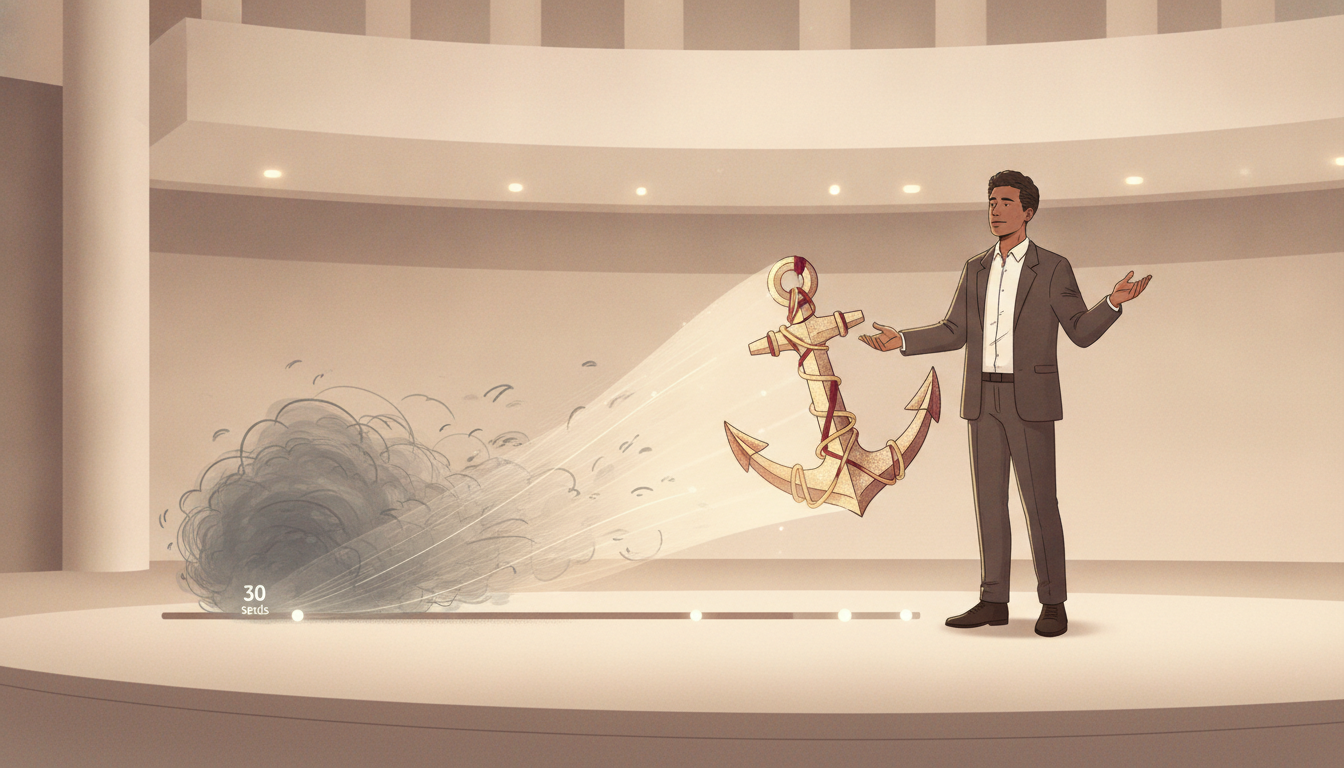
Method 3: The Anchor Opening — Eliminate the Hardest 30 Seconds
The first 30 seconds of any presentation are when nervousness peaks. Your voice is most likely to shake, your thoughts most likely to scatter. The Anchor Opening method eliminates this vulnerability.
What an Anchor Opening Is
An Anchor Opening is a memorized, rehearsed first 30-60 seconds that you can deliver on autopilot. It's designed so that even if your brain is flooded with adrenaline, your mouth knows exactly what to say.
How to Build Your Anchor Opening
Use this three-part structure:
- A grounding statement. Something factual and concrete. Example: "Last quarter, our team processed 14,000 customer requests—a 23% increase from the previous year."
- A bridge to relevance. Connect that fact to why the audience should care. "That growth is great news, but it's also straining our current infrastructure."
- A roadmap. Tell them what you'll cover. "Today I'll walk you through three solutions we've evaluated, with my recommendation for the path forward."
This structure works because it's factual (easy to remember under stress), audience-focused (reduces self-consciousness), and directional (gives you momentum into the body of your talk).
For more techniques on powerful presentation openings, see our article on how to open a presentation with confidence: 8 openers.
Rehearsal Protocol for the Anchor
Rehearse your Anchor Opening at least 10 times out loud. Not in your head—out loud. Stand up. Use your presentation voice. According to presentation coach Carmine Gallo, author of Talk Like TED, the most confident speakers rehearse their openings and closings far more than the middle of their talks, because those are the moments the audience remembers most vividly.
Method 4: Progressive Exposure — Train Your Nervous System
You cannot think your way out of presentation anxiety permanently. You have to expose your nervous system to the stimulus repeatedly until it stops overreacting.
The Exposure Ladder for Presentation Confidence
Cognitive behavioral therapists use exposure hierarchies to treat anxiety. You can apply the same principle to presentations:
- Level 1: Present to yourself in a mirror or on camera (record and review).
- Level 2: Present to one trusted colleague and ask for feedback.
- Level 3: Present to a small group of 3-5 people in a low-stakes setting.
- Level 4: Present in a team meeting with moderate stakes.
- Level 5: Present to senior leadership or a large audience.
The key is to move through levels sequentially, not skip to Level 5 and hope for the best. Each successful exposure teaches your amygdala that the situation is safe, reducing the threat response next time.
Micro-Presentations: Daily Practice in Disguise
You don't need a formal presentation to practice. Every day offers micro-presentation opportunities:
- Summarize a project update in a team standup.
- Volunteer to walk through a document in a meeting.
- Explain a concept to a colleague at their desk.
These low-stakes moments build the same neural pathways as formal presentations. Over time, speaking in front of others becomes familiar rather than threatening. If you want to build this kind of daily speaking confidence, our guide on how to speak with confidence in meetings: 11 shifts offers a practical framework.
A study from the University of Mannheim (2019) found that individuals who engaged in regular public speaking practice—even informal—showed a 40% reduction in self-reported anxiety over a 12-week period compared to a control group.
Method 5: Visualization and Mental Rehearsal
Elite performers across every domain—athletes, musicians, surgeons—use mental rehearsal. Presenters should too.
The Difference Between Visualization and Wishful Thinking
Effective visualization is specific, sensory, and process-focused. You don't just imagine "it going well." You imagine the specific actions you'll take.
A 5-Minute Visualization Protocol
Do this the night before and the morning of your presentation:
- Close your eyes. Picture the room. Where will you stand? What does the screen look like? Who is in the audience?
- Walk through your opening. Hear yourself saying your Anchor Opening. Notice your voice is steady. Your hands are still.
- Visualize a challenge moment. Imagine a tough question or a momentary blank. See yourself pausing, breathing, and recovering smoothly.
- End with the close. Picture yourself delivering your final statement. The audience nods. You feel composed.
This isn't imagination—it's neural priming. Research from the Journal of Consulting and Clinical Psychology shows that mental rehearsal activates the same motor cortex regions as physical practice, effectively giving you additional "reps" without stepping on stage.
Pair Visualization with Physical Rehearsal
Visualization works best as a complement to real practice, not a replacement. The combination of mental and physical rehearsal is what builds genuine, durable confidence.
For a comprehensive approach to preparing for career-defining presentations, explore our guide on how to prepare for a high-stakes presentation.
Method 6: Delivery Frameworks That Project Calm Authority
Even if you feel nervous, your audience doesn't have to know. Specific delivery techniques create the perception of calm authority regardless of your internal state.
The Pace-Pause-Project Formula
Nervous presenters rush. They speak faster, skip pauses, and drop their volume. Counter this with:
- Pace: Deliberately slow your speaking rate by 15-20%. If it feels uncomfortably slow to you, it sounds perfectly natural to your audience.
- Pause: After key statements, pause for a full 2 seconds. Pauses signal confidence and give your audience time to absorb your point. They also give you time to breathe and reset.
- Project: Speak to the back wall, not the front row. This naturally increases your volume and forces you to use your diaphragm, which stabilizes your voice.
A study by the University of Michigan's Communication Studies department found that speakers who used deliberate pauses were rated 30% more credible and 25% more confident by audiences, compared to speakers who filled silence with filler words.
Build Unshakeable Presentation Confidence. If you're ready to go beyond managing nerves and start commanding every room you walk into, Discover The Credibility Code — the professional's system for building lasting authority and presence. Discover The Credibility Code
Eye Contact Anchoring
Instead of scanning the room nervously, use the "lighthouse" technique: hold eye contact with one person for a full sentence or thought (3-5 seconds), then move to another person in a different section of the room. This creates the impression of direct, confident engagement without the overwhelm of trying to "look at everyone."
What to Do With Your Hands
Nervous energy often shows up in fidgeting. Give your hands a job:
- At rest: Hold them loosely at your sides or lightly together at waist height.
- While making a point: Use purposeful, open-palm gestures.
- Never: Put them in your pockets, clasp them behind your back, or grip the podium.
For a complete breakdown of physical presence during presentations, see our guide on body language that conveys authority: 12 proven signals.
Frequently Asked Questions
How long does it take to overcome presentation nervousness?
Most professionals see meaningful improvement within 4-8 weeks of consistent practice using cognitive reframing and progressive exposure. Complete elimination of nerves isn't the goal—and isn't realistic. The objective is to manage adrenaline so it enhances your performance rather than undermining it. Daily micro-presentations and regular rehearsal accelerate progress significantly.
What's the difference between presentation anxiety and stage fright?
Stage fright is typically an acute, in-the-moment fear response triggered by performing in front of an audience. Presentation anxiety is broader—it includes the anticipatory dread in the hours, days, or weeks before a presentation. Both involve the same physiological stress response, but presentation anxiety often requires cognitive strategies (like reframing and visualization) in addition to in-the-moment techniques like breathing.
Can introverts become confident presenters?
Absolutely. Introversion is about energy management, not ability. Many of history's most compelling speakers—including Susan Cain, Warren Buffett, and Barack Obama—identify as introverts. Introverts often excel at preparation, thoughtfulness, and deep content mastery, which are the foundations of credible presenting. The key is building a leadership presence without extroversion through structured practice.
Is it better to memorize a presentation or use notes?
Neither extreme works well. Memorizing word-for-word creates rigidity and increases the risk of blanking. Reading from notes destroys eye contact and authority. The best approach is to memorize your opening and closing (your Anchor Opening and your final statement), then use a keyword outline for the body. This gives you structure without a script. Learn more in our guide on how to present without reading slides.
What should I do if my mind goes blank during a presentation?
Pause. Take a breath. Look at your notes or your slide. Then say: "Let me come back to the key point here..." and continue. Audiences are far more forgiving of brief pauses than presenters expect. A 3-second pause feels like an eternity to you but barely registers for your audience. The worst response is to panic and start rambling—silence is always better than filler.
Do beta-blockers or supplements help with presentation nerves?
Some professionals use beta-blockers (like propranolol) to manage the physical symptoms of presentation anxiety, such as trembling and rapid heartbeat. These require a prescription and medical supervision. Natural alternatives like L-theanine and magnesium have some research support for mild anxiety reduction. However, behavioral techniques like those in this article address the root cause rather than just the symptoms, and they build lasting confidence over time.
Speak So the Room Takes You Seriously
The Credibility Code covers the verbal patterns that make presenters sound authoritative, and the ones that make audiences tune out.
Discover The Credibility CodeRelated Articles

How to Speak With Authority in Presentations: 8 Keys
Speaking with authority in presentations comes down to eight core elements: vocal pacing, strategic pausing, power positioning, opening with conviction, commanding body language, handling silence with confidence, structuring your message for impact, and closing with a decisive call to action. Master these keys and you shift from a presenter who shares information to an authority who commands attention and drives decisions.

How to Speak With Authority in Presentations: A Framework
Speaking with authority in presentations requires five core elements: a commanding opening that establishes credibility within the first 30 seconds, the elimination of hedging language that dilutes your message, strategic pauses that signal confidence and control, a structured approach to Q&A that maintains your expert positioning, and a close that drives action. This framework gives mid-career professionals a repeatable system for projecting authority every time they present.

How to Speak Without Notes: A Professional's Guide
To speak without notes professionally, build a mental structure before you speak—not a script. Use a framework like the "Three-Point Anchor" (one opening statement, three key points, one closing action) to internalize your message. Practice retrieval, not memorization: rehearse by recalling your structure from memory rather than reading it repeatedly. Pair this with deliberate pausing and confident delivery techniques, and you'll speak with authority in any professional setting—boardroom, stage,