
How to Speak With Authority as a Woman at Work

To speak with authority as a woman at work, focus on five core areas: use declarative sentence structures instead of hedging language, lower your vocal pitch slightly at the end of statements, claim physical and verbal space in meetings, prepare strategic talking points in advance, and address double-bind dynamics with confident warmth. These research-backed strategies help women project credibility and command respect without sacrificing authenticity.
What Does It Mean to Speak With Authority as a Woman?
Speaking with authority as a woman means communicating in a way that conveys competence, confidence, and credibility — while navigating the unique social dynamics women face in professional environments. It is the ability to share ideas, lead conversations, and influence outcomes without being dismissed, interrupted, or penalized for being "too assertive."
This goes beyond simply talking louder. It involves mastering vocal delivery, strategic language choices, body language, and conversational positioning. The goal isn't to mimic a stereotypically masculine communication style — it's to develop an authentic authoritative voice that earns respect on your terms.
Why Women Face Unique Challenges With Vocal Authority
Before diving into strategies, it's important to understand the landscape. Women don't struggle with authority because they lack skill — they face structural and perceptual barriers that men rarely encounter.

The Double-Bind Dilemma
Research from Harvard Kennedy School found that women who speak assertively in professional settings are perceived as less likable, while women who speak warmly are perceived as less competent. This "double bind" creates a narrow corridor of acceptable behavior that men don't face.
For example, a male director who firmly pushes back on a budget proposal is seen as "decisive." A female director doing the exact same thing risks being labeled "difficult" or "aggressive." According to a 2022 study published in The Leadership Quarterly, women leaders who displayed dominant communication behaviors received 35% lower likability ratings than male counterparts displaying identical behaviors.
Understanding this dynamic isn't about accepting it — it's about strategically navigating it while working to change it.
The Interruption Gap
A Georgetown University study found that women are interrupted 33% more often than men in professional meetings. Being consistently interrupted erodes perceived authority over time, creating a cycle where women speak less, get heard less, and are seen as less authoritative.
If you've ever been talked over in meetings, you know this isn't a minor annoyance — it's a credibility issue that compounds with every occurrence.
Vocal Perception Bias
Research from Duke University's Fuqua School of Business found that both men and women prefer leaders with lower-pitched voices. Since women's voices are naturally higher-pitched, they face an automatic perception disadvantage in authority contexts. This doesn't mean women need to artificially lower their voices — but it does mean vocal delivery techniques matter more.
Five Language Strategies That Build Instant Authority
The words you choose shape how people perceive your competence. These language shifts are immediate, actionable, and backed by communication research.
Replace Hedging Language With Declarative Statements
Hedging words — "I think," "I just," "maybe," "sort of" — signal uncertainty. Research from the University of Texas found that speakers who use hedge words are rated 25% less credible than those who make direct statements.
Here's what this looks like in practice:
- Before: "I just think maybe we should consider looking at the Q3 data."
- After: "The Q3 data tells a different story. Let me walk you through it."
- Before: "I'm not sure, but I sort of feel like this timeline is too aggressive."
- After: "This timeline doesn't account for the compliance review. Here's what's realistic."
Notice that the "after" versions aren't rude or aggressive. They're clear. Clarity is authority. For a deeper dive into this concept, see our guide on words that undermine your credibility at work.
Use the "State-Support-Stake" Framework
When presenting an idea or recommendation, structure your contribution using this three-part framework:
- State your position clearly in one sentence.
- Support it with one piece of evidence or reasoning.
- Stake your claim by connecting it to a business outcome.
"I recommend we delay the product launch by three weeks. [State] Our beta testing revealed two critical UX issues that will drive negative reviews. [Support] Fixing them now protects our Net Promoter Score and saves us from a costly post-launch patch. [Stake]"
This framework works because it mirrors how executives structure their thinking before speaking — concise, evidence-based, outcome-oriented.
Eliminate Upspeak and Permission-Seeking Phrases
Upspeak — raising your pitch at the end of a declarative sentence so it sounds like a question — undermines authority instantly. Similarly, phrases like "Does that make sense?" or "Can I add something?" signal that you're asking permission to be heard.
Replace "Does that make sense?" with "Here's why that matters." Replace "Can I add something?" with "I want to build on that point." Replace "Sorry, but I disagree" with "I see it differently, and here's why."
These aren't cosmetic changes. They fundamentally shift how your contributions are received.
Say it once, and be taken seriously. The Authority Toolkit gives you 8 frameworks, the 7 shifts that make speech sound sure, and 100+ phrases for meetings and email, so the point lands the first time you make it. Get The Authority Toolkit — $27
Vocal Delivery Techniques That Command Attention
What you say matters, but how you say it determines whether people listen. These vocal techniques are used by executive communication coaches and backed by speech science research.

Master the Downward Inflection
The single most impactful vocal change women can make is ending statements with a downward pitch inflection. A downward inflection signals certainty and finality. An upward inflection signals questioning and uncertainty.
Practice this with a simple exercise: Say "We need to move forward with this plan" three times. The first time, let your pitch rise at the end. The second time, keep it flat. The third time, let it drop slightly. Record yourself and listen to the difference. The third version sounds the most authoritative.
This technique is explored in depth in our guide on how to develop a commanding voice at work.
Use Strategic Pausing
According to research from the University of Michigan, speakers who pause for 2-3 seconds before key points are perceived as more thoughtful and credible. Many women rush through their points — especially when they sense they might be interrupted — which inadvertently signals nervousness.
Try this approach: Before your most important statement in a meeting, pause for a full two seconds. Make eye contact with one or two people. Then deliver your point at a slightly slower pace than your normal speech.
The pause does three things: it creates anticipation, it signals confidence, and it gives you a moment to ground yourself. For more on this, read our piece on how to stop rushing when presenting.
Control Your Volume Strategically
You don't need to be loud to be authoritative. But you do need to be heard clearly. A study from Quantified Communications found that speakers whose volume varied by 10-15% throughout their delivery were rated as 28% more engaging and 17% more authoritative than monotone speakers.
The technique is called "dynamic volume." Start a key statement at your normal volume, then drop slightly lower for the most important phrase. Counterintuitively, dropping your voice — not raising it — pulls people in and signals command.
Example: "The data shows we're losing market share in three segments" [normal volume] — then, slightly quieter and slower — "and if we don't act this quarter, we lose our window." People lean in. That's authority.Body Language and Physical Presence Strategies
Your body communicates before you open your mouth. Research from Amy Cuddy's work at Harvard Business School (published in Psychological Science) demonstrated that expansive body postures increase feelings of power and confidence, while contractive postures decrease them.
Claim Physical Space Deliberately
Women are socialized to take up less space — crossing legs, tucking arms, pulling shoulders in. In professional settings, this physical contraction signals subordination.
Instead, practice these habits:
- In meetings: Place both forearms on the table. Spread your materials out. Sit back in your chair rather than perching on the edge.
- When presenting: Stand with feet hip-width apart. Use gestures that extend beyond your shoulder width. Move deliberately — don't pace nervously.
- In one-on-ones: Maintain an open posture. Avoid crossing your arms, even if it feels comfortable.
These aren't power plays — they're physical signals that match the authority of your words. Our comprehensive guide on body language that conveys authority covers twelve specific signals you can practice today.
Use Eye Contact as a Power Tool
Sustained eye contact is one of the most potent authority signals available. Research published in the Journal of Nonverbal Behavior found that speakers who maintained eye contact for 60-70% of their speaking time were rated significantly more credible and persuasive.
A practical technique: When making a key point in a meeting, choose one person and maintain eye contact for the full sentence. Then shift to another person for the next point. This creates a sense of direct, personal communication that's hard to dismiss or talk over.
The "Arrival Ritual" for Meetings
How you enter a room sets the tone for how you'll be treated in it. Develop a consistent arrival ritual:
- Enter the room without rushing.
- Make eye contact and greet at least two people by name before sitting down.
- Arrange your materials calmly — don't fumble.
- Sit in a position of visibility (not the corner, not the back row).
This ritual signals that you belong in the room and expect to be a full participant. It's a cornerstone of leadership presence in meetings.
Handling Interruptions, Dismissals, and Credit-Stealing
Even with perfect delivery, women face specific interpersonal challenges that require tactical responses. Here are evidence-based strategies for the most common scenarios.
When You're Interrupted
Don't stop talking and don't raise your voice. Instead, use the "continuation technique": maintain your volume, hold up one finger briefly (a universal "one moment" signal), and continue your sentence to completion. Then say, "Go ahead, [name]."
This does two things: it establishes that you will finish your thought, and it graciously gives them the floor after you've made your point. It's assertive without being combative.
If interruptions are chronic, address the pattern directly: "I've noticed I'm being cut off before I finish my points. I'd like to complete my thought, and then I'm happy to hear your perspective." This is a boundary, not a complaint. For more scripts, see our guide on how to handle being interrupted in meetings professionally.
When Your Idea Is Attributed to Someone Else
This happens frequently to women in professional settings. When someone restates your idea and receives credit, use the "reclaim and expand" technique:
"Thanks for reinforcing my earlier point, [name]. I'd like to build on what I originally proposed by adding..." This publicly re-establishes ownership without creating a confrontation.
You can also build alliances. Before meetings, ask a trusted colleague to amplify your contributions: "Great point — and as [your name] mentioned earlier..." Research from the Obama White House showed that this "amplification strategy," used deliberately by female staffers, significantly increased women's visibility in meetings.
When You're Told You're "Too Aggressive"
This is the double bind in action. A useful response: "I appreciate the feedback. Can you point to the specific words or behaviors you're referring to? I want to make sure I'm communicating clearly."
This response does three things: it doesn't apologize, it doesn't get defensive, and it forces the other person to articulate what they actually mean — which often reveals that the issue is their discomfort with a woman's directness, not an actual communication problem.
For a broader framework on navigating this dynamic, explore our guide on assertive communication at work without creating conflict.
Building Long-Term Authority: Beyond Individual Conversations
Speaking with authority isn't just about what happens in a single meeting. It's about building a sustained reputation for credibility and competence.
Develop Your Strategic Voice
Authority comes from being known for a specific area of expertise. Identify one or two domains where you want to be the go-to voice and consistently contribute insights in those areas.
For example, if you want to be known for operational excellence, make it a habit to bring data-driven operational insights to every relevant conversation. Over time, people will begin deferring to you on those topics — not because you demanded it, but because you earned it through consistent, valuable contributions. Our guide on how to position yourself as an expert at work offers a detailed framework for this.
Build Your Authority Across Channels
Your voice in meetings is only one dimension. Reinforce it through authoritative emails, clear written communication, and visible thought leadership. When your written communication matches your verbal authority, the effect compounds.
This means eliminating hedging language from your emails too — no "just checking in" or "sorry to bother you." For specific before-and-after examples, see our guide on how to be more assertive in professional emails.
Create a Confidence Recovery Practice
Even with the best strategies, there will be days when you feel dismissed or undermined. Having a recovery practice prevents one bad experience from eroding your long-term confidence.
After a difficult interaction, use this three-step reset:
- Name it: "I was interrupted and my idea was dismissed. That's a systemic pattern, not a reflection of my competence."
- Reframe it: "My idea was strong enough that someone else wanted to claim it."
- Prepare for next time: Choose one specific technique from this article to deploy in your next meeting.
This practice builds resilience and keeps you from retreating into silence — which is exactly what undermining behaviors are designed to do. For a deeper framework, explore confidence at work after a setback.
Frequently Asked Questions
How can I speak with authority without being seen as aggressive?
The key is pairing directness with warmth signals. Use clear, declarative language while maintaining a collaborative tone. Say "I recommend we take a different approach — here's why" instead of hedging or apologizing. Research shows that women who combine competence cues (clear language, evidence, steady voice) with warmth cues (inclusive pronouns, acknowledgment of others' points) navigate the double bind most effectively. Authority and likability aren't mutually exclusive — they require intentional calibration.
What's the difference between speaking with authority and speaking with confidence?
Confidence is an internal state — feeling sure of yourself. Authority is an external perception — others recognizing your credibility and expertise. You can feel confident but not project authority (if your delivery undermines your message), and you can project authority even when you feel nervous (through practiced vocal and language techniques). The most effective communicators build both. Our guide on how to speak with authority and confidence explores this distinction in detail.
How do I lower my voice to sound more authoritative?
You don't need to artificially lower your natural pitch. Instead, focus on three things: breathe from your diaphragm (which naturally grounds your voice), end statements with a downward inflection (which signals certainty), and slow your speaking pace by 10-15% (which adds weight to your words). Practice reading a paragraph aloud while placing one hand on your chest to feel the resonance. Over two to three weeks of daily practice, your voice will naturally settle into a more grounded register.
Why do people not take me seriously at work even though I'm qualified?
Credibility perception is driven by three factors: what you say (content), how you say it (delivery), and how consistently you show up (reputation). If you're qualified but not being taken seriously, the gap is usually in delivery or visibility — not competence. Common culprits include hedging language, upspeak, deferential body language, or not speaking early enough in meetings. Our article on why people don't take you seriously at work diagnoses the most common causes and fixes.
How can introverted women speak with authority?
Authority doesn't require extroversion. Introverted women can leverage their natural strengths — thoughtfulness, deep preparation, and listening skills — by speaking strategically rather than frequently. Prepare two or three high-impact contributions before each meeting. Use the "State-Support-Stake" framework to make each contribution count. Introverts who speak less but with greater precision are often perceived as more authoritative than extroverts who fill airtime. See our guide on how to build presence as a quiet leader for a complete framework.
How do I speak with authority in virtual meetings?
Virtual meetings amplify vocal delivery and diminish body language cues. Position your camera at eye level, look directly into the lens when speaking (not at the screen), and use a slightly slower pace with more deliberate pauses. Eliminate filler words, which are more noticeable on video. Unmute and speak within the first five minutes to establish your presence early. Frame your contributions with clear structure: "I have two points on this" — which prevents interruptions and signals preparation.
Stop Sounding Uncertain in Everyday Conversations
8 communication frameworks, the 7 speech shifts with 30 before-and-after rewrites, 6 email templates, and 100+ phrases for speaking and writing with calm authority at work. PDF.
Get The Authority Toolkit — $27Related Articles

5 Professional Communication Frameworks Leaders Use Daily
The difference between professionals who get heard and those who get overlooked often comes down to one thing: structure. The most effective leaders don't wing their messages—they use professional communication frameworks to organize their thinking before they speak or write. The five most widely used professional communication frameworks are PREP (Point, Reason, Example, Point), SBI (Situation, Behavior, Impact), the Minto Pyramid, STAR for Influence (Situation, Task, Action, Result), and the W

How to Sound Authoritative: 9 Shifts That Work Instantly
To sound authoritative, focus on nine specific shifts across your voice, language, and behavior: lower your vocal pitch at the end of sentences, eliminate hedging words like "just" and "I think," slow your speaking pace by 10-15%, use declarative sentence structures, pause before key points instead of filling silence, ground your body language, lead with conclusions rather than context, choose precise vocabulary, and maintain steady eye contact. These changes work immediately because they signal
How to Speak Concisely in Meetings: 6 Clarity Frameworks
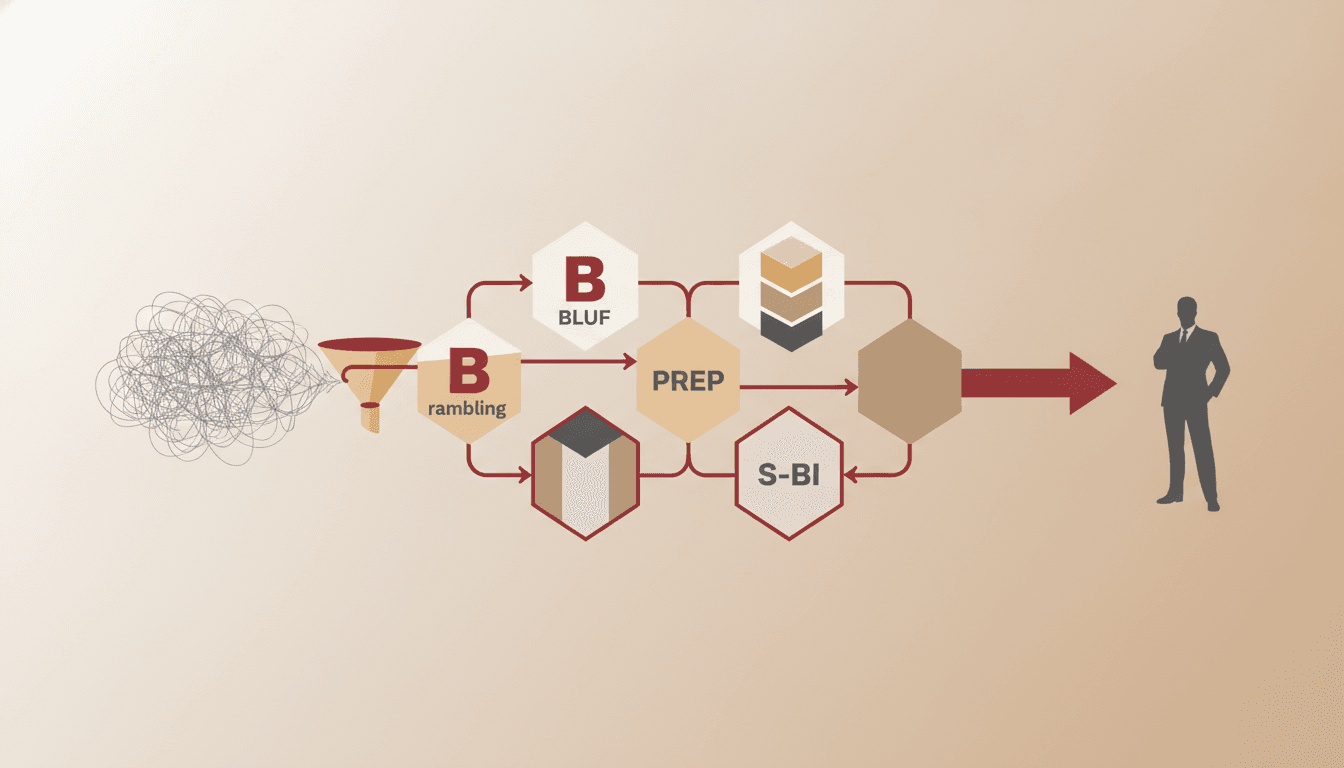
To speak concisely in meetings, use a structured communication framework that forces you to lead with your point and cut filler. The most effective approach is BLUF (Bottom Line Up Front): state your conclusion first, then provide only the supporting evidence your audience needs. Pair this with the PREP, SBI, What-So What-Now What, Rule of Three, and CEO frameworks outlined below to match any meeting scenario—from status updates to executive briefings.