
How to Stop Sounding Nervous When Speaking at Work

What Is "Sounding Nervous" in Professional Settings?
Sounding nervous when speaking is the collection of vocal, verbal, and physical markers that signal uncertainty or anxiety to your listeners. These include speaking too fast, using excessive filler words ("um," "uh," "like"), upspeak (ending statements as questions), a shaky or thin voice, hedging language ("I just think maybe…"), and visible tension in the body.
What makes this particularly important is that listeners form judgments about your competence based on how you sound, often more than what you say. A 2017 study published in the Journal of Experimental Social Psychology found that vocal confidence cues—including pace, pitch stability, and volume—significantly influenced perceptions of a speaker's competence and trustworthiness, independent of the content delivered.
In professional settings, sounding nervous doesn't just undermine a single moment. It erodes your credibility over time, making colleagues and leaders less likely to trust your ideas, defer to your judgment, or advocate for your advancement.
Why You Sound Nervous (Even When You Know Your Material)
The Physiology Behind Nervous Speech

When you perceive a high-stakes speaking situation—a presentation to executives, a tough meeting, a negotiation—your sympathetic nervous system activates a stress response. Your body floods with cortisol and adrenaline. This is the same fight-or-flight mechanism that kept our ancestors alive, but in a conference room, it creates vocal chaos.
Adrenaline tightens the muscles around your vocal cords, raising your pitch. Your breathing becomes shallow and rapid, reducing the air support your voice needs for resonance and steadiness. Your mouth dries out, making articulation harder. Your heart rate spikes, which accelerates your speaking pace without you even noticing.
According to the Anxiety and Depression Association of America, approximately 73% of the population experiences some degree of glossophobia (fear of public speaking). This means the physiological response you're fighting isn't a personal flaw—it's a near-universal human reaction.
The Cognitive Load Problem
Nervousness also fragments your thinking. When your brain is processing anxiety ("Are they judging me? Did I lose my place? Do I sound stupid?"), it has fewer cognitive resources available for clear, organized speech. This is why even subject matter experts start rambling, losing their thread, or reaching for filler words when anxiety hits.
The result is a vicious cycle: anxiety causes poor delivery, poor delivery increases self-consciousness, and self-consciousness deepens anxiety. Breaking this cycle requires addressing both the physical symptoms and the mental patterns simultaneously.
The Perception Gap
Here's what most professionals don't realize: you almost always sound more nervous than you feel. Research from the University of Groningen found that speakers consistently overestimate how much their anxiety is visible to audiences. Your internal experience of racing thoughts and a pounding heart feels enormous, but listeners typically perceive only a fraction of it.
This matters because it means you don't need to eliminate nervousness entirely. You just need to eliminate the signals of nervousness. That's a far more achievable goal—and the techniques below are designed to do exactly that.
Speed Control: The Single Most Powerful Fix
Why Pace Is the First Thing to Address
Speaking too fast is the number-one marker of nervousness that audiences detect. When you rush, you signal that you're trying to get through your words before something bad happens—before you're interrupted, before you forget, before your anxiety overwhelms you. Listeners read this instinctively.
A study by the University of Michigan's Institute for Social Research found that speakers who maintained a moderate pace of roughly 3.5 words per second were rated as significantly more credible and persuasive than those who spoke faster or slower. Fast speakers were perceived as anxious or pushy; slow speakers were perceived as uncertain or disengaged.
The problem is that when adrenaline hits, your internal clock speeds up. What feels like a normal pace to you is actually 30-40% faster than your baseline. You literally cannot trust your perception of your own speed when you're nervous.
The Tactical Pause Method
Instead of trying to "speak slower" (vague advice that's nearly impossible to implement under pressure), use tactical pauses—deliberate, brief silences inserted at specific structural points in your speech.
Here's the framework:- Pause after your opening statement. Start with your main point, then stop for a full beat. This signals control and gives your audience time to register your message.
- Pause before key numbers or conclusions. Silence before important information creates anticipation and emphasis. "Our team delivered the project… pause… three weeks ahead of schedule."
- Pause instead of using filler words. When you feel "um" or "uh" forming, close your mouth and pause for one to two seconds. Silence feels eternal to you but sounds authoritative to your audience.
- Pause after someone asks you a question. Taking two seconds before responding signals thoughtfulness, not uncertainty. Senior leaders do this reflexively—it's one of the patterns explored in how executives structure their thinking before speaking.
Practice this in low-stakes situations first: phone calls, casual team check-ins, conversations with peers. Once pausing becomes a habit, it will be available to you automatically when the stakes rise.
The Three-Sentence Reset
When you catch yourself speeding up mid-presentation or mid-meeting, use this micro-technique: commit to saying your next three sentences at what feels uncomfortably slow. Internally, it will feel like you're dragging. Externally, you'll sound measured and composed.
After three deliberately slow sentences, your nervous system begins to recalibrate. Your breathing deepens, your heart rate drops slightly, and your natural pace resets closer to your baseline. This technique works because it interrupts the acceleration cycle before it spirals.
Breath Management: The Foundation of Vocal Control
Why Breathing Is Non-Negotiable
Every vocal marker of nervousness—shaky voice, thin tone, pitch spikes, running out of air mid-sentence—traces back to breathing. When you're anxious, your breathing shifts from deep diaphragmatic breathing to shallow chest breathing. This reduces the volume of air supporting your voice, which makes it thinner, higher, and less stable.
You cannot have a commanding voice without adequate breath support. It's a physical impossibility. This is why breathing techniques aren't optional add-ons—they're the foundation of every other vocal improvement.
The 4-4-6 Pre-Speaking Protocol
Before any high-stakes speaking moment, use this breathing pattern for 60-90 seconds:
- Inhale for 4 counts through your nose, expanding your belly (not your chest)
- Hold for 4 counts
- Exhale for 6 counts through your mouth, slowly and steadily
The extended exhale is the key. It activates your parasympathetic nervous system—the "rest and digest" response that directly counteracts the fight-or-flight activation causing your vocal symptoms. A 2023 study published in Cell Reports Medicine by Stanford researchers found that cyclic physiological sighing (extended exhales) was more effective at reducing anxiety than mindfulness meditation.
Use this protocol in the bathroom before a presentation, at your desk before a difficult call, or in the hallway before walking into a meeting. For a deeper dive into pre-speaking calming techniques, see our guide on how to calm nerves before speaking.
The Mid-Speech Breath Anchor
During your actual speaking, use punctuation as breathing cues. Every period is a breath. Every comma is a micro-breath. This prevents the most common nervous speaking pattern: stringing sentences together without pausing to breathe, which leads to gasping, rushing, and vocal instability.
Here's a practical drill: take a paragraph from a recent email you wrote. Read it aloud, and at every period, take a full belly breath before continuing. At every comma, take a quick sip of air. Practice this for five minutes daily for two weeks. You'll rewire the connection between speaking and breathing so it becomes automatic.
Filler Word Elimination: Cleaning Up Verbal Static
Why Filler Words Signal Nervousness
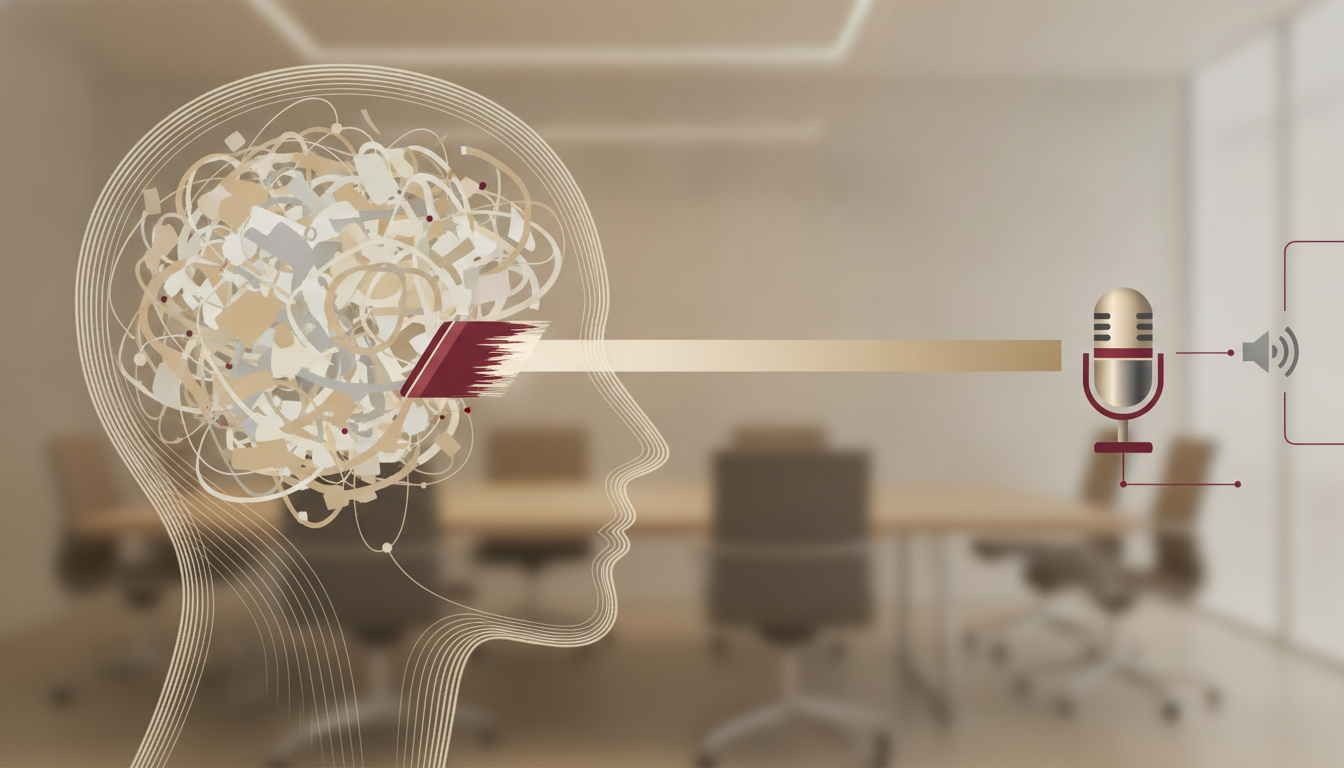
Filler words—"um," "uh," "like," "you know," "so," "basically," "actually"—are verbal placeholders. Your brain uses them to hold the conversational floor while it searches for the next word or idea. Everyone uses them occasionally. But under stress, their frequency skyrockets, and that's when they become credibility killers.
Research from the University of Texas found that speakers who used frequent filler words were rated as less prepared, less competent, and less confident by listeners—even when the actual content of their speech was identical to speakers who used fewer fillers. The content was the same; the perception was dramatically different.
This aligns with what we cover in 12 credibility killers in workplace communication—small verbal habits that quietly erode how seriously people take you.
The Awareness-First Approach
You can't fix what you can't hear. Most people have no idea how many filler words they use because the words have become invisible to their own ears. Start with awareness:
- Record yourself during a low-stakes meeting or practice session (even a voice memo of yourself summarizing your day works).
- Count your fillers in a three-minute segment. Note which specific words you default to.
- Identify your trigger moments. Fillers typically spike during transitions between ideas, when answering unexpected questions, and when you're uncertain about your next point.
Once you know your patterns, you can target them. Most people have one or two dominant fillers, not ten. Focus on those.
The Replacement Strategy
Don't try to eliminate fillers through willpower alone—that creates a new kind of cognitive load that can make you sound more stilted. Instead, replace the filler with silence.
When you feel a filler word forming:
- Close your mouth. Physically pressing your lips together for a beat interrupts the filler reflex.
- Take a breath. The pause fills the space the filler would have occupied.
- Begin your next phrase. The silence that felt awkward to you sounded deliberate and confident to your listeners.
This is the same technique that professional news anchors and executives use when presenting. They don't speak without pauses—they use silence as a tool.
The Practice Ladder
Build filler-free speaking in stages:
- Week 1: Awareness only. Count fillers without trying to change them.
- Week 2: Eliminate fillers in prepared statements (presentations, planned remarks).
- Week 3: Reduce fillers in semi-structured situations (team meetings, updates).
- Week 4: Work on fillers in unstructured conversation (brainstorms, Q&A, spontaneous discussion).
This graduated approach prevents the "overcorrection freeze" where people become so focused on not saying "um" that they can't speak naturally at all.
Physical Grounding: How Your Body Shapes Your Voice
The Body-Voice Connection
Your voice doesn't exist in isolation—it's produced by your entire body. Tension in your shoulders raises your pitch. A clenched jaw muffles your articulation. Locked knees create a rigid, strained quality. Shallow posture compresses your diaphragm and reduces breath support.
When you're nervous, your body contracts. Shoulders rise, muscles tighten, weight shifts forward onto your toes. This physical contraction directly produces the vocal markers of nervousness. Addressing your body is often faster and more effective than trying to control your voice directly.
The Grounding Checklist (30 Seconds Before Speaking)
Run through this physical reset before any speaking moment:
- Feet: Plant both feet flat on the floor, hip-width apart. Feel your weight distributed evenly. If seated, press both feet firmly into the ground.
- Hands: Place them on the table, on the podium, or at your sides. Avoid clasping, gripping, or fidgeting—these tension behaviors telegraph anxiety.
- Shoulders: Drop them. Consciously pull them down and back one inch. Most people carry their shoulders near their ears when nervous without realizing it.
- Jaw: Unclench it. Let your tongue rest on the floor of your mouth. A relaxed jaw produces a richer, more resonant voice.
- Breath: Take one slow belly breath before your first word.
This 30-second checklist addresses the physical root causes of nervous-sounding speech. It's a technique used in leadership presence training and by professional speakers worldwide.
Power Posture in Practice
Amy Cuddy's research on power posing has been debated, but the underlying principle is well-supported: expansive posture reduces cortisol and increases feelings of confidence. A 2018 meta-analysis published in Psychological Bulletin confirmed that adopting expansive (versus contractive) body positions has a small but reliable effect on emotional states and behavior.
You don't need to strike a superhero pose in the bathroom. Simply standing or sitting with an open chest, uncrossed arms, and a stable base sends feedback to your nervous system that you are safe and in control. This feedback loop reduces the physiological stress response that causes nervous-sounding speech.
For a comprehensive exploration of how body language signals authority, see our guide on body language that conveys authority.
Mental Reframes: Changing the Story Your Brain Tells
From "Performance" to "Conversation"
One of the most effective mental shifts for reducing nervous speech is reframing speaking situations from performances to conversations. When you frame a presentation as a performance, you create a binary: succeed or fail. That framing amplifies anxiety.
Instead, tell yourself: "I'm sharing information with colleagues who need it." This reframe reduces the perceived stakes without reducing your preparation or professionalism. It shifts your focus from "How am I doing?" to "What do they need to hear?"—which is exactly the focus that produces clear, composed delivery.
The Authority Anchor
Before speaking, remind yourself of one specific, concrete reason you belong in this conversation. Not a vague affirmation ("I'm confident!") but a factual anchor:
- "I've managed this project for eight months. No one knows these numbers better than I do."
- "I was invited to this meeting because my perspective on the customer data matters."
- "I've solved this exact type of problem three times before."
This technique works because it interrupts the imposter narrative ("They'll see I don't belong here") with evidence. It's a practice we explore in depth in how to stop feeling like a fraud at work.
Reframing Physical Symptoms
Your racing heart, sweaty palms, and adrenaline surge before speaking are physiologically identical to excitement. Harvard Business School research by Alison Wood Brooks found that participants who reframed their anxiety as excitement ("I am excited") performed significantly better in public speaking tasks than those who tried to calm down ("I am calm").
This works because trying to suppress anxiety fights your body's arousal state—a battle you'll usually lose. Reframing the arousal as positive energy channels it rather than fighting it. The next time your heart pounds before a meeting, try saying internally: "Good. My body is giving me energy for this."
Build Unshakable Speaking Confidence Nervous delivery holds back more careers than lack of skill ever will. Discover The Credibility Code and learn the complete system for communicating with authority, composure, and presence—even under pressure. Discover The Credibility Code
Putting It All Together: A Pre-Speaking Protocol
Here's a complete, practical routine you can use before any high-stakes speaking moment at work. It takes less than three minutes:
Two minutes before:- Find a private space (bathroom, hallway, your desk with headphones on).
- Do the 4-4-6 breathing pattern for 60 seconds.
- Run through the physical grounding checklist: feet, hands, shoulders, jaw, breath.
- State your authority anchor silently: "I know this material. I belong here."
- Reframe your arousal: "This energy will help me deliver with impact."
- Deliver your first sentence at a deliberately measured pace.
- Pause for a full beat after your opening statement.
- Breathe at every period.
This protocol doesn't eliminate nervousness. It eliminates the sound of nervousness—which is what actually matters for your professional credibility and career trajectory. For additional techniques specifically for presentations, see how to sound confident in a presentation even when nervous.
Frequently Asked Questions
How long does it take to stop sounding nervous when speaking?
Most professionals notice measurable improvement within two to three weeks of consistent practice. Breathing and pace control show results fastest—often within days. Filler word reduction takes longer because it requires building new neural pathways. Full vocal confidence typically develops over two to three months of deliberate practice in progressively higher-stakes situations.
Is sounding nervous the same as lacking confidence?
No. Sounding nervous is a set of vocal and physical habits triggered by your stress response. Many deeply confident professionals sound nervous because they've never learned to manage their physiology under pressure. Conversely, some people with significant self-doubt have learned delivery techniques that make them sound composed. Confidence and the sound of confidence are related but separate skills.
What's the difference between nervousness and excitement when speaking?
Physiologically, almost nothing. Both produce elevated heart rate, adrenaline release, and heightened alertness. The difference is cognitive interpretation. When you label the sensation as nervousness, your brain looks for threats and your delivery contracts. When you label it as excitement, your brain looks for opportunities and your delivery expands. Research shows that deliberately reframing anxiety as excitement improves speaking performance.
Can you completely eliminate speaking anxiety at work?
Complete elimination isn't realistic or even desirable. A moderate level of arousal improves focus, energy, and performance—this is known as the Yerkes-Dodson Law. The goal isn't zero anxiety; it's managing anxiety so it fuels your delivery rather than undermining it. The techniques in this article are designed to keep you in the optimal performance zone, not to make you feel nothing.
Why do I sound nervous in meetings but not in casual conversation?
Perceived stakes drive your stress response. In casual conversation, there's no evaluation pressure—you're not worried about judgment, promotion implications, or looking incompetent. In meetings, especially with senior leaders, the perceived consequences of poor performance activate your fight-or-flight system. The solution is applying the same relaxed vocal patterns from casual speech to professional settings through deliberate practice.
What's the fastest fix for sounding nervous right now?
Slow down and pause. Speaking pace is the single most impactful variable you can change instantly. Before your next sentence, take a breath. After your next key point, pause for two full seconds. These two adjustments—slower pace and deliberate pauses—immediately reduce the perception of nervousness more than any other technique.
Speak So the Room Takes You Seriously
The Credibility Code covers the verbal patterns that make presenters sound authoritative, and the ones that make audiences tune out.
Discover The Credibility CodeRelated Articles

Managing Speaking Anxiety at Work: 8 Proven Methods
To manage speaking anxiety at work, use evidence-based techniques that target your body's stress response before and during everyday speaking moments. The most effective methods include controlled breathing to lower cortisol, cognitive reframing to shift your threat response, structured preparation frameworks for impromptu moments, and progressive exposure to build tolerance over time. These techniques work for team updates, all-hands questions, and hallway conversations — not just formal presen

How to Sound Confident in a Presentation: 9 Proven Tactics
To sound confident in a presentation, focus on three pillars: vocal delivery, verbal precision, and structural clarity. Slow your speaking pace to 130–150 words per minute, use strategic pauses instead of filler words, replace hedging language ("I think maybe…") with power phrases ("The data shows…"), and open with your strongest point. Confidence isn't about feeling fearless — it's about controlling the signals your audience receives.

How to Build Confidence Before a Presentation Fast
To build confidence before a presentation fast, follow a structured 30-minute pre-presentation protocol: spend the first 10 minutes on mental rehearsal and mindset reframing, the next 10 minutes on physiological calming techniques like box breathing and power posing, and the final 10 minutes on vocal warm-ups and opening line practice. This timed routine shifts your nervous system from threat mode to performance mode, so you walk in feeling prepared, grounded, and authoritative.