Leadership Presence

How leaders signal authority through posture, pacing, and word choice, and how to build that presence deliberately when you do not have a title that does it for you.

95 articles

Leadership Presence, page 2

How to Build Executive Presence: A 5-Pillar Framework

How to Build Executive Presence: A 5-Pillar Framework

Executive presence is built on five core pillars: gravitas, communication, appearance, emotional intelligence, and decisiveness. To develop it, you need to cultivate the weight behind your words, speak with clarity and conviction, project a polished image, read the room with precision, and make confident decisions under pressure. Executive presence isn't a personality trait you're born with—it's a skill set you build through deliberate daily practice across each of these pillars.

Leadership Presence in Group Settings: 7 Proven Habits

Leadership Presence in Group Settings: 7 Proven Habits

Leadership presence in group settings comes down to seven core habits: strategic timing of contributions, deliberate physical positioning, high-signal speaking, active listening that shapes the room, managing group energy, anchoring conversations to outcomes, and composure under pressure. These habits help you command attention without dominating—so your voice carries weight even when multiple people compete for airtime. Below, you'll learn each habit in detail with frameworks you can use starti

Leadership Presence Without Charisma: A Quiet Framework

Leadership Presence Without Charisma: A Quiet Framework

Leadership presence doesn't require charisma. While many professionals assume they need a magnetic personality, natural charm, or the ability to "work a room" to be seen as a leader, research shows otherwise. Leadership presence without charisma is built through consistent preparation, structured communication, and deliberate behavioral patterns. Quiet, methodical professionals can command just as much authority as their extroverted peers — often more — by mastering a repeatable framework rooted

How to Communicate Like a Leader: 12 Daily Habits

How to Communicate Like a Leader: 12 Daily Habits

Learning how to communicate like a leader comes down to daily habits, not grand gestures. Leaders distinguish themselves through how they frame ideas, respond to conflict, give direction, and create followership—every single day. The 12 habits below cover the specific language patterns, vocal techniques, and presence signals that separate leaders from individual contributors. Practice even three of these consistently, and you'll notice a measurable shift in how colleagues perceive your authority

Leadership Presence: What It Is and How to Build It

Leadership Presence: What It Is and How to Build It

Leadership presence is the ability to project confidence, competence, and composure in a way that inspires trust and commands attention — even before you speak. It combines gravitas, communication skills, professional appearance, and emotional composure into a unified impression that signals authority. Unlike charisma, leadership presence is a learnable set of behaviors, not an innate personality trait. This article defines each component and gives you a practical framework to develop your own.

Leadership Presence in Meetings Without Talking Too Much

Leadership Presence in Meetings Without Talking Too Much

Leadership presence in meetings without talking too much comes down to strategic contribution over constant contribution. The most influential people in any room rarely speak the most — they speak at the right moments, with the right framing, and let their body language and listening do the rest. You build authority by choosing when to weigh in, asking high-impact questions, and using non-verbal cues that signal confidence. This article gives you the exact frameworks to do all three.

How to Develop Executive Gravitas Quietly (No Bravado)

How to Develop Executive Gravitas Quietly (No Bravado)

Quick Answer: You develop executive gravitas quietly by mastering five subtle behavioral signals: physical stillness, strategic silence, deliberate word choice, emotional composure under pressure, and consistent follow-through. These signals communicate authority without volume or bravado. The most credible leaders in any room are rarely the loudest—they're the ones who speak less, choose words carefully, hold steady eye contact, and remain composed when others react emotionally.

Leadership Presence in Difficult Situations: A Framework

Leadership Presence in Difficult Situations: A Framework

Leadership presence in difficult situations is the ability to maintain composure, communicate with clarity, and project credibility when stakes are highest—during layoffs, project failures, team conflicts, or public criticism. It requires a repeatable framework built on three pillars: emotional regulation, strategic messaging, and visible steadiness. Leaders who master this don't avoid hard moments—they use them to cement their authority and earn lasting trust from their teams and stakeholders.

How to Communicate Change as a Leader With Authority

How to Communicate Change as a Leader With Authority

To communicate change as a leader with authority, start by anchoring your message in a clear "why" before explaining the "what." Structure every change announcement using a four-part framework: context, decision, impact, and next steps. Lead with honesty about what you know and what you don't. Maintain credibility by calibrating your tone—balancing conviction with genuine empathy—and by following up consistently so your words match your actions.

How to Develop a Leadership Voice That Commands Respect

How to Develop a Leadership Voice That Commands Respect

Developing a leadership voice requires deliberate work across five dimensions: vocal authority (tone, pace, and projection), strategic word choice, conviction in delivery, structured thinking before speaking, and consistent daily practice. The professionals who command respect don't just speak louder—they speak with clarity, brevity, and certainty. This guide walks you through specific frameworks, daily exercises, and real-world before/after examples to help you cultivate a leadership voice that

Leadership Presence in Your First 90 Days: A Playbook

Leadership Presence in Your First 90 Days: A Playbook

Establishing leadership presence in your first 90 days in a new role requires a deliberate, phased approach: spend weeks 1–3 listening and mapping stakeholders, weeks 4–6 communicating your vision and securing early wins, and weeks 7–12 cementing your authority through consistent communication rituals and visible results. The leaders who command respect fastest don't wing it—they follow a system that builds credibility before organizational habits and perceptions harden around them.

How to Build Presence as a Leader: A Daily System

How to Build Presence as a Leader: A Daily System

Leadership presence isn't a trait you're born with—it's a skill you build through deliberate daily practice. To build presence as a leader, implement a micro-habit system targeting four pillars: voice (pace, tone, projection), posture (expansive, grounded stance), language (precise, decisive word choice), and interpersonal dynamics (active listening, strategic pausing, eye contact). Commit to one small shift per day, and within 30 days, you'll command noticeably more authority in every room you

How to Influence Without Authority at Work: 6 Strategies

How to Influence Without Authority at Work: 6 Strategies

You can influence without authority at work by building credibility through expertise, using strategic relationship mapping to identify key stakeholders, framing ideas around shared outcomes rather than personal agendas, and communicating with the language of leadership—even without a title. The six strategies below give you a repeatable framework for driving decisions, aligning teams, and earning respect when you have no formal power to lean on.

How to Develop Leadership Presence: A 5-Step Framework

How to Develop Leadership Presence: A 5-Step Framework

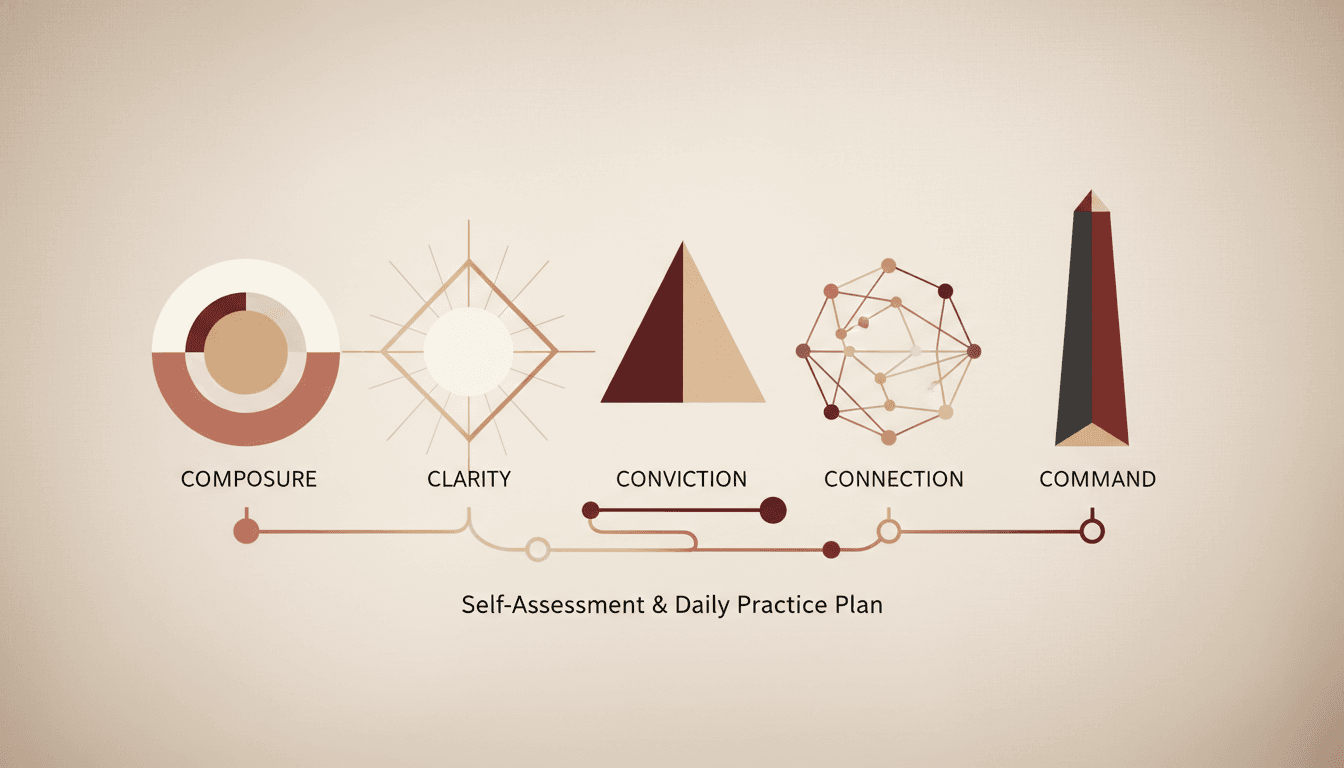
To develop leadership presence, build five core dimensions: composure (staying calm under pressure), clarity (communicating with precision), conviction (speaking with certainty), connection (building trust through empathy), and command (directing attention and action). Leadership presence isn't an inborn trait—it's a set of learnable skills. By assessing yourself across these five dimensions and practicing targeted daily habits, you can transform how others perceive your authority, credibility,

Leadership Presence Body Language: 11 Cues That Signal Power

Leadership Presence Body Language: 11 Cues That Signal Power

Leadership presence body language cues are the specific nonverbal signals—such as expansive posture, deliberate gestures, steady eye contact, controlled facial expressions, and strategic spatial positioning—that communicate authority and confidence before you say a single word. Research from Harvard Business School shows that nonverbal cues account for over 55% of how your message is perceived. The 11 cues below, backed by behavioral science, will help you project power in meetings, presentation

Leadership Presence in Meetings: 8 Habits That Command

Leadership Presence in Meetings: 8 Habits That Command

Leadership presence in meetings comes down to eight specific habits: arriving with intentional energy, claiming physical space confidently, speaking with strategic timing, using deliberate vocal authority, holding attention through structured contributions, managing silence as a power tool, redirecting conversations with purpose, and closing discussions with decisive clarity. These habits are learnable, repeatable, and separate leaders who command respect from those who merely attend.

How to Build Executive Presence: A Complete Roadmap

How to Build Executive Presence: A Complete Roadmap

Executive presence is the combination of gravitas, communication skill, and professional appearance that signals leadership readiness. To build executive presence, start by developing your gravitas through decisive action and emotional composure. Then sharpen your communication by speaking concisely, structuring your thoughts before speaking, and eliminating hedging language. Finally, align your appearance and body language with the authority you want to project. The 90-day roadmap below walks y

Project Authority Without Arrogance: A Leader's Guide

Project Authority Without Arrogance: A Leader's Guide

Projecting authority without arrogance comes down to leading with competence, not ego. The most credible leaders combine confident decision-making with genuine curiosity, active listening, and a willingness to share credit. Instead of demanding respect through dominance or status, they earn it by demonstrating expertise, staying composed under pressure, and elevating the people around them. The result is a commanding presence that draws people in rather than pushing them away.

Leadership Presence in One-on-One Meetings: 6 Key Habits

Leadership Presence in One-on-One Meetings: 6 Key Habits

Leadership presence in one-on-one meetings comes down to six core habits: intentional preparation, active listening signals, strategic questioning, controlled vulnerability, decisive framing, and purposeful follow-through. Unlike group settings where presence is about commanding a room, one-on-ones demand a quieter authority—one built on focused attention, trust, and the ability to make the other person feel both challenged and valued in a single conversation.

Leadership Presence in Town Halls: How to Command Any Room

Leadership Presence in Town Halls: How to Command Any Room

Leadership presence in town halls is your ability to project calm authority, engage a large audience, and communicate vision clearly during company-wide meetings. To command any room, focus on five pillars: intentional preparation, confident stage presence, strategic storytelling, skillful Q&A handling, and authentic emotional connection. The leaders who excel at town halls don't wing it — they rehearse their opening, anchor every message in a clear theme, use deliberate pauses and eye contact t

How to Speak With Authority in a New Role: First 30 Days

How to Speak With Authority in a New Role: First 30 Days

Speaking with authority in a new role starts with three things: how you frame your contributions, how you use your voice, and how quickly you establish credibility through listening before leading. In your first 30 days, focus on asking strategic questions, using decisive language (cutting hedging words like "just" and "I think"), anchoring your statements in data, and matching the communication norms of your new environment. Authority isn't about volume — it's about precision, timing, and earne

How to Develop Executive Presence as a New Manager

How to Develop Executive Presence as a New Manager

To develop executive presence as a new manager, focus on three pillars: gravitas (how you carry yourself under pressure), communication (how you speak and write with authority), and appearance (how you show up visually and energetically). Start by eliminating individual-contributor habits like over-explaining and hedging. Then build daily micro-practices—structured speaking, deliberate body language, and strategic visibility—over a 90-day window. Executive presence isn't a personality trait. It'

How to Develop Gravitas as a Leader: A Complete Guide

How to Develop Gravitas as a Leader: A Complete Guide

Developing gravitas as a leader requires deliberate work across four core dimensions: confidence under pressure, depth of knowledge, decisiveness, and emotional regulation. Gravitas isn't a personality trait you're born with—it's a set of learnable behaviors that signal weight, substance, and trustworthiness. This guide breaks each dimension into specific daily practices and provides a 30-day development plan so you can cultivate genuine leadership gravitas starting today.

How to Present Yourself as a Leader: 10 Authority Signals

How to Present Yourself as a Leader: 10 Authority Signals

To present yourself as a leader, you need to master ten specific authority signals that shape how others perceive you—before you ever hold a formal title. These signals span three categories: verbal (what you say), nonverbal (how you carry yourself), and behavioral (what you consistently do). Leaders aren't simply appointed; they're recognized. When you deliberately project clarity in your communication, composure under pressure, and consistency in your actions, colleagues, executives, and stake

Other topics