Workplace Confidence

What to say when you are talked down to, interrupted, or second-guessed at work, with scripts you can use the same day and the mindset shifts that make them stick.

120 articles

Workplace Confidence, page 5

Be More Assertive at Work Without Being Aggressive

Be More Assertive at Work Without Being Aggressive

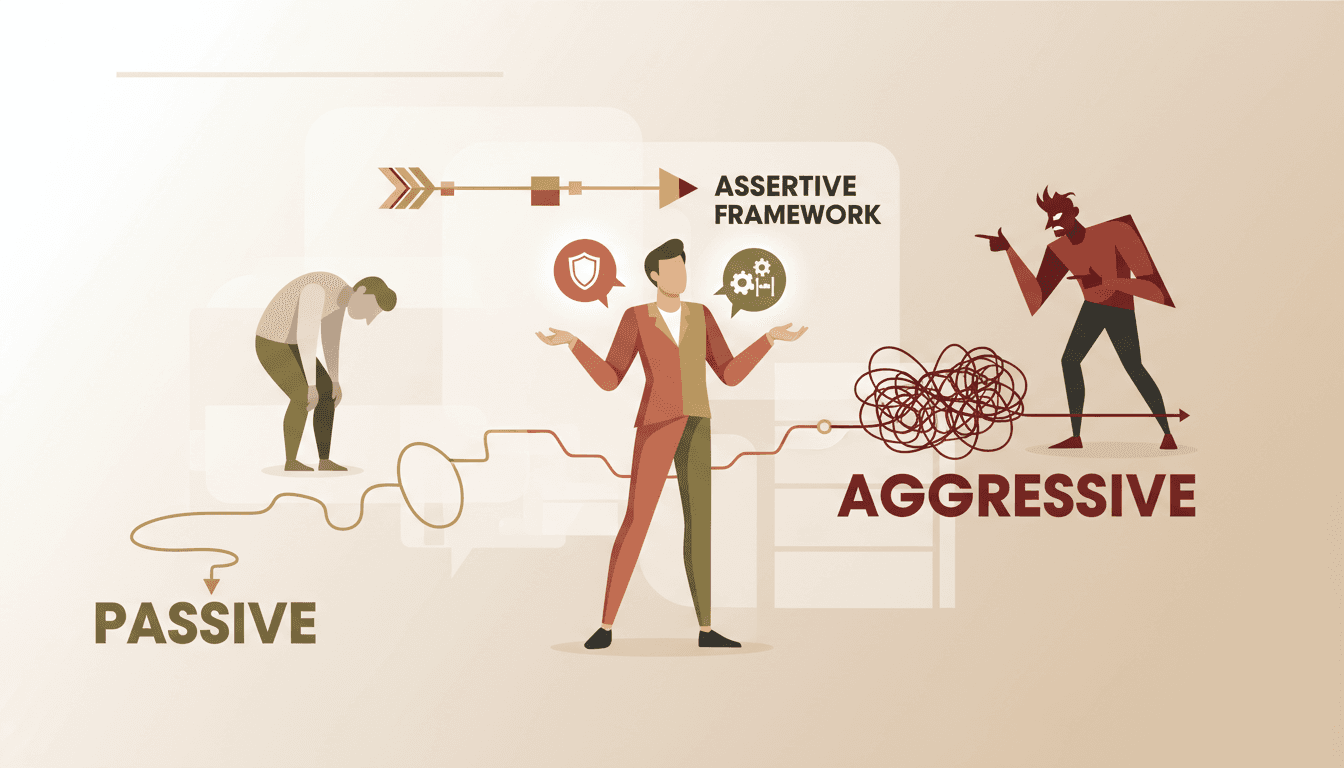
Being assertive at work without being aggressive comes down to one core skill: expressing your needs, opinions, and boundaries with clarity and respect—while staying open to others' perspectives. The key difference is intent. Assertiveness aims for mutual understanding; aggression aims to dominate. By using direct language, steady body language, and structured frameworks like the DESC method (Describe, Express, Specify, Consequence), you can speak up confidently without damaging professional rel

Be More Assertive in Meetings Without Being Aggressive

Be More Assertive in Meetings Without Being Aggressive

To be more assertive in meetings without being aggressive, focus on three pillars: speak with clear intent using "I" statements, anchor your contributions in data and evidence rather than emotion, and use confident body language—steady eye contact, open posture, and a measured vocal pace. Assertiveness is about advocating for your perspective while respecting others. Aggression shuts people down; assertiveness opens doors. The difference lies in your delivery, timing, and the language frameworks

How to Respond When Put on the Spot at Work (Framework)

How to Respond When Put on the Spot at Work (Framework)

When you're put on the spot at work, use the ACE framework: Acknowledge the question, Collect your thoughts with a brief stalling phrase, and Execute a structured response. The key is buying yourself 5–10 seconds of thinking time without appearing flustered. Techniques like paraphrasing the question, using a bridging phrase ("That's an important consideration—here's how I see it"), and structuring your answer in two or three clear points will help you sound composed, credible, and authoritative—

How to Stop Over-Apologizing at Work (And What to Say Instead)

How to Stop Over-Apologizing at Work (And What to Say Instead)

To stop apologizing at work, start by recognizing your triggers — unnecessary "sorry" responses in emails, meetings, and conversations — then replace them with confident alternatives. Instead of "Sorry for the delay," say "Thanks for your patience." Instead of "Sorry, but I disagree," say "I see it differently." This shift isn't about being rude. It's about communicating accountability and confidence without undermining your own authority. The professionals who command the most respect use preci

How to Speak Up in Meetings as an Introvert (Without Forcing It)

How to Speak Up in Meetings as an Introvert (Without Forcing It)

Speaking up in meetings as an introvert doesn't require you to become someone you're not. The most effective approach combines strategic pre-meeting preparation, low-risk entry points like asking clarifying questions or building on others' ideas, and concise contribution frameworks that play to introvert strengths — deep thinking, careful observation, and substance over volume. The goal isn't to talk more; it's to contribute in ways that carry weight.

How to Gain Respect at Work: A Credibility-First Framework

How to Gain Respect at Work: A Credibility-First Framework

To gain respect at work, focus on five core behavioral pillars: deliver consistent results, communicate with clarity and conviction, set and enforce professional boundaries, demonstrate genuine competence through action (not self-promotion), and treat every person—regardless of title—with equal regard. Respect isn't demanded or requested. It's earned through repeated, observable signals that tell colleagues, "This person is credible, reliable, and worth listening to." The framework below breaks

How to Challenge Your Boss Respectfully (And Be Heard)

How to Challenge Your Boss Respectfully (And Be Heard)

To challenge your boss respectfully, lead with curiosity instead of criticism. Frame your disagreement as a question or alternative perspective — not a personal attack. Use phrases like "I want to make sure we've considered…" or "Can I share a different angle?" Choose private settings over public forums, anchor your pushback in shared goals, and always bring data or a proposed solution alongside your concern. The professionals who advance fastest aren't silent — they're strategically candid.


How to Be More Confident at Work as an Introvert

How to Be More Confident at Work as an Introvert

Being more confident at work as an introvert doesn't require becoming someone you're not. It means leveraging your natural strengths — deep preparation, thoughtful communication, and focused listening — while building strategic visibility habits. The most effective approach combines thorough pre-meeting preparation, written communication mastery, selective but high-impact verbal contributions, and intentional relationship-building that works *with* your introversion rather than against it.

How to Speak With Confidence in Meetings: 8 Techniques

How to Speak With Confidence in Meetings: 8 Techniques

To speak with confidence in meetings, prepare two to three key points before every session, use a structured speaking framework like Point–Evidence–Recommendation, sit in a high-visibility seat, lower your vocal pitch at the end of sentences, and eliminate filler words with strategic pauses. These eight techniques—covering preparation, body language, vocal delivery, and real-time recovery—will help you contribute with authority and be taken seriously in any meeting, starting today.

Be More Assertive at Work Without Being Rude: A Framework

Be More Assertive at Work Without Being Rude: A Framework

Being more assertive at work without being rude comes down to one principle: advocate for your position while respecting the other person's. The framework that makes this practical is the ACR Method—Acknowledge, Communicate, Reinforce. First, acknowledge the other person's perspective. Then, communicate your position with clear, direct language. Finally, reinforce the relationship by proposing a path forward. This approach lets you hold your ground, set boundaries, and speak up—without damaging

Why People Don't Take You Seriously at Work (Fix It)

Why People Don't Take You Seriously at Work (Fix It)

If people don't take you seriously at work, the cause is almost always invisible communication habits—not your competence. The most common culprits include hedging language ("I just think maybe…"), chronic over-apologizing, uptalk (ending statements like questions), weak physical presence, and poor strategic positioning. The good news: each of these has a concrete, learnable fix. This article diagnoses the specific habits undermining your credibility and gives you an actionable correction for ev

How to Project Confidence in Interviews (Even When You're Nervous)

How to Project Confidence in Interviews (Even When You're Nervous)

To project confidence in interviews, focus on three controllable areas: your body language (steady eye contact, open posture, firm handshake), your vocal delivery (slower pace, downward inflections, elimination of filler words), and your message structure (concise, evidence-based answers using frameworks like STAR or CAR). Confidence in interviews isn't about eliminating nerves — it's about channeling nervous energy into focused, credible presence so the interviewer sees a leader, not a candidat

How to Disagree Professionally Without Burning Bridges

How to Disagree Professionally Without Burning Bridges

To disagree professionally, use the Acknowledge-Bridge-Propose (ABP) framework: first, validate the other person's point ("I see the logic in that approach"), then bridge to your concern ("One thing I want to make sure we consider…"), and finally propose your alternative ("What if we tried X instead?"). This structure separates the idea from the person, preserves the relationship, and positions your dissent as collaboration — not confrontation.

How to Be Assertive at Work Without Being Aggressive

How to Be Assertive at Work Without Being Aggressive

Being assertive at work without being aggressive comes down to one skill: expressing your needs, opinions, and boundaries with clarity and respect—while staying open to others' perspectives. The key is shifting from reactive emotion to intentional communication. Use "I" statements instead of "you" accusations, state facts before feelings, and propose solutions rather than issuing demands. Assertiveness protects your credibility; aggression destroys it. The difference lies in your delivery, not y

How to Sound Confident at Work: 9 Proven Strategies

How to Sound Confident at Work: 9 Proven Strategies

To sound confident at work, focus on eliminating vocal fillers ("um," "just," "I think"), speaking with a slower and more deliberate pace, using declarative sentences instead of hedging language, and lowering your pitch slightly at the end of statements. Confident-sounding professionals also pause strategically before responding, choose precise words over vague ones, and match their body language to their verbal message. These habits can be learned and practiced by anyone, regardless of personal

How to Be Taken Seriously at Work: 11 Proven Strategies

How to Be Taken Seriously at Work: 11 Proven Strategies

To be taken seriously at work, you need to align what you say, how you say it, and what you do. The most credible professionals master eleven core strategies: speaking with precision, setting firm boundaries, controlling body language, preparing obsessively, building strategic visibility, eliminating credibility-killers like upspeak and over-apologizing, delivering results consistently, dressing with intention, managing emotional reactions, owning your expertise, and advocating for yourself in h

How to Build Confidence in Meetings (Even as an Introvert)

How to Build Confidence in Meetings (Even as an Introvert)

Building confidence in meetings starts with shifting from reactive participation to strategic contribution. Instead of pressuring yourself to speak constantly, prepare two or three high-value points before every meeting, arrive early to claim your physical and psychological space, and use the "first five minutes" rule—contributing one comment early to break the silence barrier. Confidence in meetings isn't about being the loudest voice; it's about being the most prepared and intentional one.

Overcoming Imposter Syndrome at Work: A Leader's Guide

Overcoming imposter syndrome at work starts with recognizing that self-doubt is not evidence of incompetence—it's a signal that you're growing. The most effective approach combines cognitive reframing techniques, strategic communication adjustments, and daily credibility-building habits. Rather than trying to eliminate self-doubt entirely, leaders can learn to act with authority *despite* it, turning internal uncertainty into outward confidence that earns trust and respect.

Other topics