Blog, page 18

Practical scripts, frameworks, and examples for the conversations that decide how seriously people take you.

Articles

Negotiation Confidence for Women: Scripts That Work
Negotiation

Negotiation Confidence for Women: Scripts That Work

Women who negotiate earn an average of $1 million more over their careers than those who don't — yet research shows women initiate negotiations four times less often than men. The gap isn't about skill; it's about navigating a real double bind where assertiveness is penalized differently. This guide gives you research-backed scripts, strategic framing techniques, and word-for-word language that projects authority without triggering backlash — across salary, role scope, resources, and flexible wo


How to Open a Speech Memorably: 11 Proven Openers
Public Speaking

How to Open a Speech Memorably: 11 Proven Openers

To open a speech memorably, lead with a technique that disrupts your audience's autopilot within the first 30 seconds. The most effective openers include a bold, surprising statement, a vivid story, a provocative question, a striking statistic, or a powerful quote. Top executives and thought leaders rarely start with "Thank you for having me" — they start with a moment that commands attention, earns trust, and sets the emotional trajectory for everything that follows. The 11 techniques below giv

Leadership Presence in Tough Conversations: A Framework
Leadership Presence

Leadership Presence in Tough Conversations: A Framework

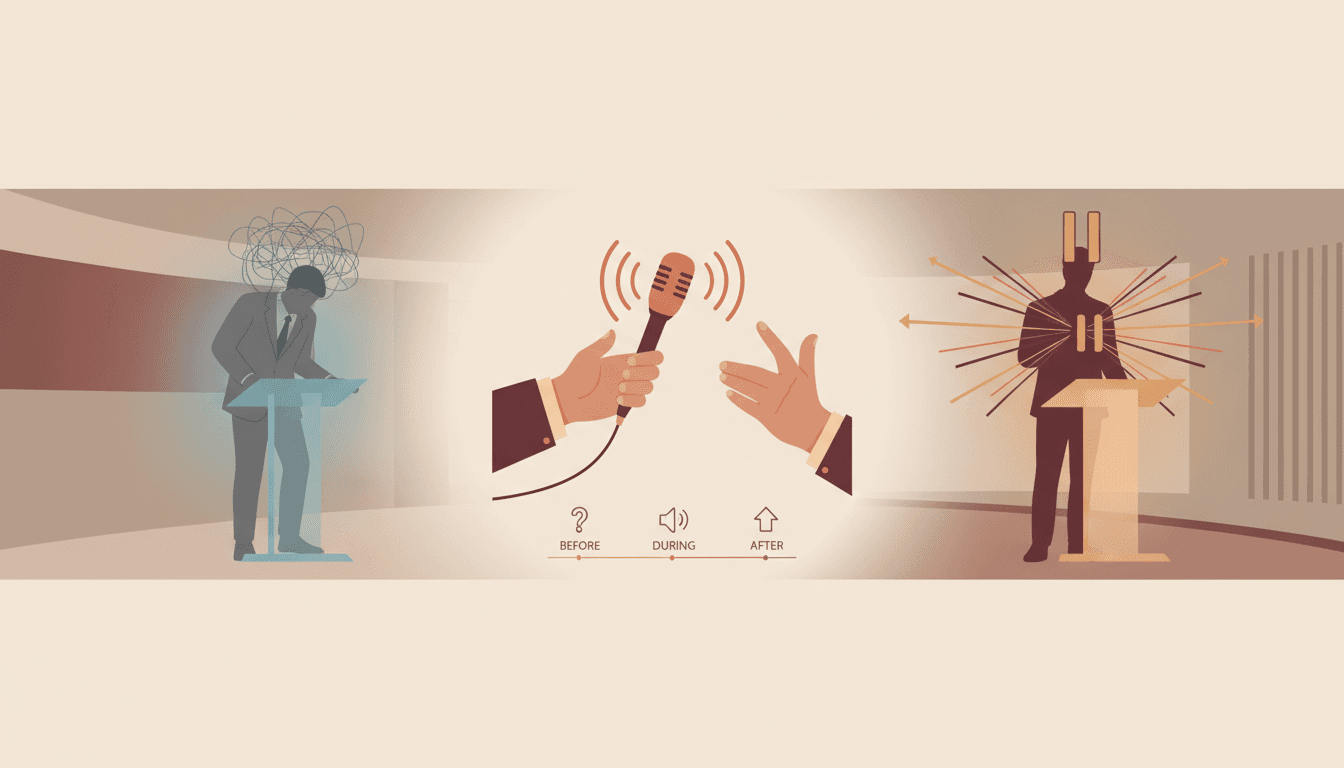
Leadership presence in tough conversations means maintaining composure, authority, and credibility when the stakes are highest—during performance disputes, budget cuts, organizational pushback, or any high-tension workplace exchange. The framework involves three phases: strategic preparation (anchoring your message and emotional state before the conversation), in-the-moment regulation (using vocal control, deliberate pausing, and structured responses to stay grounded), and post-conversation reco

How to Speak With Gravitas: 9 Shifts That Command Respect
Professional Communication

How to Speak With Gravitas: 9 Shifts That Command Respect

Speaking with gravitas means communicating with a weight and authority that makes people stop, listen, and take you seriously. It's not about being loud or dominating—it's about making every word count. To speak with gravitas, you need to make nine deliberate shifts: slow your pace, lower your pitch, eliminate filler words, use declarative language, pause with purpose, anchor your body language, lead with insight, speak concisely, and own the room's silence. These shifts transform how others per

How to Negotiate When You Have No Power: 9 Proven Moves
Negotiation

How to Negotiate When You Have No Power: 9 Proven Moves

When you feel powerless in a negotiation, shift your strategy from leverage-based bargaining to credibility-based influence. The most effective moves include reframing the conversation around shared interests, leveraging information asymmetry, building a strong BATNA (Best Alternative to a Negotiated Agreement), using anchoring language, and asking calibrated questions that redirect power dynamics. You don't need a title, budget authority, or market dominance to negotiate effectively—you need a

How to Sound Confident in a Presentation (Even If You're Not)
Public Speaking

How to Sound Confident in a Presentation (Even If You're Not)

To sound confident in a presentation, focus on three vocal pillars: slow your pace by 20%, use deliberate pauses instead of filler words, and drop your pitch at the end of sentences instead of rising. Pair these with structured preparation—knowing your first 30 seconds cold—and grounded body language. Confidence in a presentation isn't about feeling fearless; it's about controlling the signals your audience reads as authority, even when nerves are running high.

Disagree With Leadership Without Losing Credibility
Workplace Confidence

Disagree With Leadership Without Losing Credibility

To disagree with leadership without losing credibility, prepare evidence-based reasoning before the conversation, choose the right timing and setting, lead with alignment on shared goals, frame your disagreement as a strategic concern rather than a personal objection, and propose an alternative solution. The professionals who gain the most credibility aren't those who stay silent—they're the ones who push back thoughtfully, with data and composure.

How to Present Yourself as an Expert at Work: 7 Signals
Career Authority

How to Present Yourself as an Expert at Work: 7 Signals

To present yourself as an expert at work, you need to consistently send seven credibility signals: framing contributions with authority, sharing knowledge strategically, leading with informed opinions, demonstrating pattern recognition, curating your professional visibility, communicating with precision, and building a track record of follow-through. These signals shape how colleagues and leaders perceive your expertise—often more than your actual knowledge does.

Professional Communication Mistakes Hurting Your Career
Professional Communication

Professional Communication Mistakes Hurting Your Career

The professional communication mistakes that hurt your career most are the ones you don't notice: hedging language ("I just think maybe…"), over-explaining simple requests, reactive email tone, verbal fillers during high-stakes moments, and apologizing when no apology is needed. These habits silently erode your credibility, making colleagues and leaders perceive you as less competent than you are. The good news: each mistake has a concrete fix you can implement today.

Communicate With Difficult Senior Leaders: A Playbook
Executive Communication

Communicate With Difficult Senior Leaders: A Playbook

To communicate with difficult senior leaders, first identify their leadership archetype—dismissive, impatient, micromanaging, or intimidating—then adapt your approach accordingly. Lead with outcomes over process, use concise framing techniques like the "Bottom Line Up Front" method, and manage your emotional state before entering the conversation. The key is not changing who they are, but strategically adjusting how you deliver your message so it lands with impact and earns respect.

How to Introduce Yourself Professionally: Authority Scripts
Personal Branding

How to Introduce Yourself Professionally: Authority Scripts

To introduce yourself in a professional setting with authority, use this three-part formula: Lead with your name and role, state the specific value you deliver, and connect it to your audience's context. For example: "I'm Sarah Chen, Head of Product at Meridian — I help enterprise teams cut product launch cycles by 40%." Skip generic job descriptions. Instead, frame your introduction around outcomes, relevance, and a clear reason for the other person to remember you.

How to Stop Seeking Validation at Work: 7 Mindset Shifts
Workplace Confidence

How to Stop Seeking Validation at Work: 7 Mindset Shifts

To stop seeking validation at work, shift from external approval to internal authority by anchoring your confidence in evidence-based self-assessment rather than others' reactions. The seven key mindset shifts include: replacing approval-seeking with self-evaluation, redefining success on your own terms, building a personal credibility inventory, decoupling feedback from identity, practicing decisive action without consensus, cultivating strategic silence, and developing an inner authority ancho

Leadership Presence in Difficult Meetings: A Playbook
Leadership Presence

Leadership Presence in Difficult Meetings: A Playbook

Leadership presence in difficult meetings is your ability to remain composed, authoritative, and influential when conversations become heated, politically charged, or emotionally volatile. It requires a deliberate combination of vocal control, strategic language, body language mastery, and de-escalation techniques. The professionals who maintain credibility in these moments don't rely on luck—they follow repeatable frameworks. This playbook gives you the exact scripts, strategies, and mental mod

How to Communicate with Gravitas: 10 Daily Practices
Professional Communication

How to Communicate with Gravitas: 10 Daily Practices

Gravitas isn't a personality trait you're born with—it's a communication skill you build through deliberate daily practice. To communicate with gravitas, focus on ten core habits: choosing precise words over filler, slowing your pace, using strategic pauses, listening before responding, grounding your body language, leading with evidence, structuring your thoughts before speaking, managing your vocal tone, asking powerful questions, and closing conversations with clarity. These practices, repeat

How to Negotiate When You Feel Undervalued at Work
Negotiation

How to Negotiate When You Feel Undervalued at Work

To negotiate when you feel undervalued, start by separating your emotions from your evidence. Document your measurable contributions—revenue generated, problems solved, projects delivered—and benchmark your compensation against market data. Then request a dedicated meeting (never ambush your manager), frame the conversation around the value you bring rather than what you lack, and present a specific ask with a clear rationale. Staying composed and evidence-driven transforms a vulnerable moment i

How to Build Gravitas as a Woman Leader: A Framework
Leadership Presence

How to Build Gravitas as a Woman Leader: A Framework

Building gravitas as a woman leader requires mastering three interconnected dimensions: presence (how you show up physically and energetically), voice (how you communicate verbally and in writing), and substance (the depth and strategic value of your contributions). Unlike outdated advice that pushes women to mimic masculine communication styles, genuine gravitas comes from developing an authentic authority rooted in competence, composure, and clarity. This framework gives you specific, actionab

Rebuild Workplace Confidence After Being Overlooked
Workplace Confidence

Rebuild Workplace Confidence After Being Overlooked

Rebuilding workplace confidence after being overlooked starts with understanding that the damage is both internal (eroded self-belief) and external (diminished perception by colleagues). The recovery requires a deliberate 30-day plan: first, reframe the narrative in your own mind; second, increase your strategic visibility through high-impact communication; and third, reclaim authority by consistently demonstrating expertise in ways others can't ignore. Below is the concrete roadmap to do exactl

Communicate With Confidence in Difficult Conversations
Professional Communication

Communicate With Confidence in Difficult Conversations

To communicate with confidence in difficult conversations, prepare your key message in advance, regulate your emotional state using grounding techniques, and use a structured framework like Acknowledge–Position–Path Forward to stay composed and credible. Focus on slowing your pace, choosing precise language, and separating the person from the problem. Confidence in high-tension moments isn't about winning—it's about maintaining authority while keeping the relationship intact.

Build Career Authority Without Being Self-Promotional
Career Authority

Build Career Authority Without Being Self-Promotional

You can build career authority without being self-promotional by shifting your focus from talking about yourself to consistently delivering visible value. The most credible professionals don't announce their expertise — they demonstrate it through strategic question-asking, contribution framing, knowledge sharing, and solving problems others avoid. Authority built this way feels earned rather than claimed, which makes it far more durable and respected than any self-promotion ever could.

A Professional Communication Framework for Influence
Professional Communication

A Professional Communication Framework for Influence

A professional communication framework for influence is a repeatable structure you use to organize your message so it lands with clarity, credibility, and persuasive power in any workplace interaction. The most effective model is the PEIA framework: Position–Evidence–Impact–Ask. It works across emails, meetings, presentations, and one-on-ones by forcing you to lead with a clear stance, back it with proof, connect it to what stakeholders care about, and close with a specific request. Below, you'l

Build Leadership Presence as a New Director: A Playbook
Leadership Presence

Build Leadership Presence as a New Director: A Playbook

Building leadership presence as a new director requires a deliberate 90-day identity shift — moving from peer-level contributor to strategic leader. The fastest path involves three pillars: reframing how you communicate (fewer details, more direction), establishing visible credibility rituals in your first cross-functional interactions, and breaking the "still proving myself" mindset that keeps most new directors stuck in manager-mode. This playbook gives you the exact daily habits, scripts, and

Negotiation Confidence: 7 Exercises That Build It Fast
Negotiation

Negotiation Confidence: 7 Exercises That Build It Fast

Negotiation confidence isn't something you're born with — it's a skill you build through deliberate practice. The seven exercises below are designed to progressively train your negotiation muscles, starting with low-risk daily interactions and advancing to high-stakes salary and scope conversations. Each exercise includes a script, a difficulty level, and a self-assessment rubric so you can measure your progress. Practice them consistently for two to three weeks and you'll walk into your next ne

How to Speak Up in Meetings With Senior Leaders
Workplace Confidence

How to Speak Up in Meetings With Senior Leaders

To speak up in meetings with senior leaders, prepare one high-value contribution in advance, use entry-point phrases like "Building on that…" or "One thing I'd add from my experience…" to join the conversation naturally, and anchor your confidence in a pre-meeting preparation ritual. The key is shifting from trying to sound impressive to focusing on adding specific, relevant value. When you prepare strategically and use proven conversation-entry techniques, speaking up becomes far less intimidat

How to Establish Credibility in a Presentation Fast
Public Speaking

How to Establish Credibility in a Presentation Fast

To establish credibility in a presentation fast, anchor your authority within the first 60 seconds. Open with a specific, relevant credential or result—not a generic introduction. Use a confident vocal tone, plant your feet with open body language, and share a brief piece of social proof that connects your expertise to the audience's problem. The first minute sets the frame for everything that follows: if you win trust early, your message lands harder.