Blog, page 21

Practical scripts, frameworks, and examples for the conversations that decide how seriously people take you.

Articles

How to Control Your Voice When Nervous Presenting
Public Speaking

How to Control Your Voice When Nervous Presenting

To control your voice when nervous presenting, focus on three fundamentals: diaphragmatic breathing to stabilize airflow, deliberate pacing to prevent rushing, and vocal warm-ups before you speak. Nervousness triggers shallow breathing, which causes a shaky voice, rising pitch, and speed. By anchoring your breath low in your abdomen, pausing intentionally between key points, and warming up your vocal cords, you can sound steady, authoritative, and in control — even when your nerves are firing.


How to Rebuild Confidence After Being Micromanaged
Workplace Confidence

How to Rebuild Confidence After Being Micromanaged

Rebuilding confidence after being micromanaged starts with recognizing that the damage is real — and reversible. Prolonged micromanagement erodes your trust in your own judgment, makes you second-guess routine decisions, and shrinks your professional voice. Recovery requires a deliberate process: separating your manager's controlling behavior from your actual competence, reclaiming small decisions daily, rebuilding your internal authority, and learning to communicate boundaries so it never happe

How to Build Leadership Presence as an Introvert
Leadership Presence

How to Build Leadership Presence as an Introvert

Building leadership presence as an introvert starts with leveraging your natural strengths—deep listening, thoughtful preparation, and strategic silence—rather than mimicking extroverted behaviors. The most effective introverted leaders build credibility through consistent, high-quality contributions, deliberate one-on-one influence, and mastering the art of saying less but meaning more. You don't need to be the loudest voice; you need to be the most trusted one.

How to Communicate Change to Your Team With Authority
Leadership Presence

How to Communicate Change to Your Team With Authority

To communicate change to your team effectively, lead with clarity, not comfort. State the change directly, explain the business reason behind it, acknowledge the emotional impact, and outline concrete next steps. The leaders who maintain trust through transitions are those who project calm authority while remaining genuinely transparent — even when they don't have all the answers. A clear framework, practiced delivery, and consistent follow-through separate credible change leaders from those who

How to Disagree With Your Boss in a Meeting (Respectfully)
Workplace Confidence

How to Disagree With Your Boss in a Meeting (Respectfully)

You can disagree with your boss in a meeting without damaging the relationship by using a three-step approach: acknowledge their perspective first, frame your dissent around shared goals, and propose an alternative rather than simply objecting. The key is treating disagreement as strategic alignment, not confrontation. Timing, tone, and framing determine whether you're seen as a thoughtful contributor or a difficult employee. This guide gives you the exact scripts, decision frameworks, and recov

How to Be Seen as a Leader at Work (Before the Title)
Career Authority

How to Be Seen as a Leader at Work (Before the Title)

You don't need a formal title to be seen as a leader at work. The professionals who get tapped for leadership roles consistently demonstrate seven behavioral signals: they communicate with clarity under pressure, frame problems strategically, advocate for others, take ownership of outcomes, stay composed in crises, make decisions with conviction, and build trust across levels. Start practicing these behaviors now, and decision-makers will view you as a leader long before the promotion arrives.

How to Brief Executives Quickly: The 60-Second Framework
Executive Communication

How to Brief Executives Quickly: The 60-Second Framework

To brief executives quickly, use the Context-Headline-Ask (CHA) framework: open with one sentence of context, deliver your headline (the key insight or update), and close with a clear ask or recommendation. This structure respects executive time, demonstrates strategic thinking, and positions you as someone who communicates with authority. The best executive briefings take 60 seconds or less and always lead with the conclusion, not the backstory.

How to Pause Effectively in Public Speaking (With Examples)
Public Speaking

How to Pause Effectively in Public Speaking (With Examples)

To pause effectively in public speaking, use intentional silence lasting 2–5 seconds at strategic moments: before key points (dramatic pause), between sections (transitional pause), after important statements (emphasis pause), when posing questions (reflective pause), and when commanding attention (authority pause). The most credible speakers don't rush to fill silence—they use it as a tool to signal confidence, let ideas land, and hold the room's attention.

Rebuilding Confidence After Being Passed Over for Promotion
Workplace Confidence

Rebuilding Confidence After Being Passed Over for Promotion

You found out someone else got the role you wanted. The sting is real, and so is the self-doubt creeping in. But being passed over for a promotion doesn't define your career trajectory — how you respond does. Rebuilding confidence after being passed over for a promotion starts with processing the disappointment, seeking honest feedback, recalibrating your visibility strategy, and positioning yourself as the undeniable choice for the next opportunity. This article gives you the exact playbook to

How to Sound More Senior at Work: 9 Language Shifts
Professional Communication

How to Sound More Senior at Work: 9 Language Shifts

To sound more senior at work, replace tentative, permission-seeking language with decisive, outcome-oriented communication. Senior-level professionals speak in solutions rather than problems, own their recommendations instead of hedging, and frame contributions around business impact rather than task completion. The nine language shifts below—covering emails, meetings, status updates, and negotiations—will immediately elevate how colleagues and leaders perceive your seniority and credibility.

How to Negotiate as a New Manager: Scripts & Strategy
Negotiation

How to Negotiate as a New Manager: Scripts & Strategy

Negotiating as a new manager requires a different playbook than negotiating as an individual contributor. The fastest way to succeed is to anchor every request in team outcomes rather than personal preference, use data to replace perceived inexperience, and lead with collaborative framing ("Here's what I need to deliver results for us") instead of adversarial demands. Below, you'll find role-specific scripts, proven frameworks, and confidence-building strategies designed for managers in their fi

How to Speak With Poise Under Pressure: 7 Techniques
Public Speaking

How to Speak With Poise Under Pressure: 7 Techniques

Speaking with poise under pressure requires deliberate preparation, not natural talent. The most effective techniques include anchoring your breath before responding, using structured frameworks to organize thoughts in real time, slowing your pace by 20%, leading with your conclusion, and replacing reactive language with composed, authoritative phrasing. These rehearsable methods help professionals maintain clarity, composure, and credibility during boardroom challenges, crisis updates, live Q&A

How to Speak Up to Your Boss Without Damaging Trust
Workplace Confidence

How to Speak Up to Your Boss Without Damaging Trust

Speaking up to your boss requires a combination of strategic timing, respectful framing, and solution-oriented language. Start by requesting a private conversation, then lead with shared goals ("I want to make sure this project succeeds"), state your concern using facts rather than emotions, and propose at least one alternative. This approach shows you're invested in outcomes, not conflict—which actually strengthens trust rather than eroding it.

How to Build Executive Presence Remotely: A Full Guide
Leadership Presence

How to Build Executive Presence Remotely: A Full Guide

Building executive presence remotely requires intentional mastery of three dimensions: how you appear on camera, how you write in digital channels, and how you lead when no one can see you working. Unlike in-person settings, remote environments strip away many natural authority cues—your posture in a hallway, your handshake, your physical command of a conference room. To compensate, you must engineer credibility through deliberate video presence, concise and authoritative written communication,

How to Sound More Strategic at Work: 9 Language Shifts
Professional Communication

How to Sound More Strategic at Work: 9 Language Shifts

To sound more strategic at work, replace tactical, task-focused language with big-picture framing. Instead of saying "I finished the report," say "I completed the competitive analysis to inform our Q3 positioning." Strategic communicators consistently connect their work to business outcomes, use forward-looking language, reference data, and frame decisions in terms of trade-offs and priorities rather than to-do lists. These nine language shifts will reposition you as a strategic thinker in meeti

How to Stop Undermining Yourself at Work: 10 Fixes
Workplace Confidence

How to Stop Undermining Yourself at Work: 10 Fixes

To stop undermining yourself at work, identify and replace the specific communication habits that erode your credibility—like qualifying language ("I just think…"), excessive apologizing, vocal uptick, delayed responses, and chronic deference. Each habit has a concrete fix: swap hedging phrases for direct statements, replace apologies with acknowledgments, and practice assertive body language. The ten fixes below give you exact replacement scripts so you can project confidence and authority star

Communicate With Difficult Senior Leaders: 6 Rules
Executive Communication

Communicate With Difficult Senior Leaders: 6 Rules

Quick Answer: To communicate with difficult senior leaders, follow six rules: lead with their priorities (not yours), use the bottom-line-up-front structure, manage your emotional state before engaging, ask strategic questions instead of defending, match their communication tempo, and build micro-credibility between interactions. These rules help you stay composed, deliver concise messages, and earn respect—even when a senior leader is dismissive, impatient, or intimidating.

Confident Body Language for Public Speaking: 8 Shifts
Public Speaking

Confident Body Language for Public Speaking: 8 Shifts

Confident body language for public speaking comes down to eight specific nonverbal adjustments: grounding your stance, purposeful hand gestures, sustained eye contact patterns, controlled movement, open posture, deliberate pausing with stillness, facial expressiveness, and commanding use of space. These shifts work together to signal authority and credibility to your audience — even before you say a single word. Master them, and you transform how every room perceives you.

How to Negotiate Remote Work: Scripts That Work
Negotiation

How to Negotiate Remote Work: Scripts That Work

To negotiate a remote work arrangement successfully, lead with business value—not personal preference. Frame your request around productivity data, measurable outcomes, and team efficiency. Use a structured proposal that includes a trial period, clear deliverables, and communication protocols. The professionals who win remote work negotiations are those who make it easy for their manager to say yes by removing risk and demonstrating credibility. Below, you'll find word-for-word scripts and a pro

Leadership Presence in Email: Write With Authority
Leadership Presence

Leadership Presence in Email: Write With Authority

Leadership presence in email communication is the ability to convey confidence, clarity, and authority through your written messages—without relying on vocal tone, body language, or physical gravitas. It means structuring your emails so readers immediately recognize you as a credible, decisive professional. You achieve this through deliberate word choice, concise structure, a commanding tone, and strategic brevity. When done right, every email you send reinforces your reputation as a leader wort

How to Speak Up in Meetings When Nervous: A Framework
Professional Communication

How to Speak Up in Meetings When Nervous: A Framework

You already know what you want to say. The insight is there, the answer is ready — but the moment the conversation opens up, something locks. Your throat tightens, your heart rate spikes, and the window closes before you speak. To speak up in meetings when nervous, use a three-phase framework: prepare anchor statements before the meeting, enter the conversation through low-risk contributions first (like asking a clarifying question), and progressively escalate to higher-stakes contributions as y

Daily Workplace Confidence Exercises That Actually Work
Workplace Confidence

Daily Workplace Confidence Exercises That Actually Work

The most effective workplace confidence exercises daily are short, repeatable practices you can do before, during, and after your workday—like power priming (2 minutes before meetings), the "first voice" challenge (speaking within the first 90 seconds of a meeting), vocal warm-ups, confidence journaling, and structured self-advocacy reps. Done consistently for 30 days, these micro-exercises rewire how you carry yourself, speak up, and lead—building a durable sense of professional self-assurance

How to Communicate With Authority at Work: 10 Habits
Professional Communication

How to Communicate With Authority at Work: 10 Habits

To communicate with authority at work, build ten daily habits across verbal, written, and nonverbal channels: lead with your conclusion, eliminate hedging language, use strategic pauses, anchor your body language, control your vocal tone, write concisely, prepare a point of view before every meeting, ask high-value questions, set verbal boundaries, and follow through visibly. These small, repeatable actions compound over time to build a lasting reputation for credibility and leadership presence.

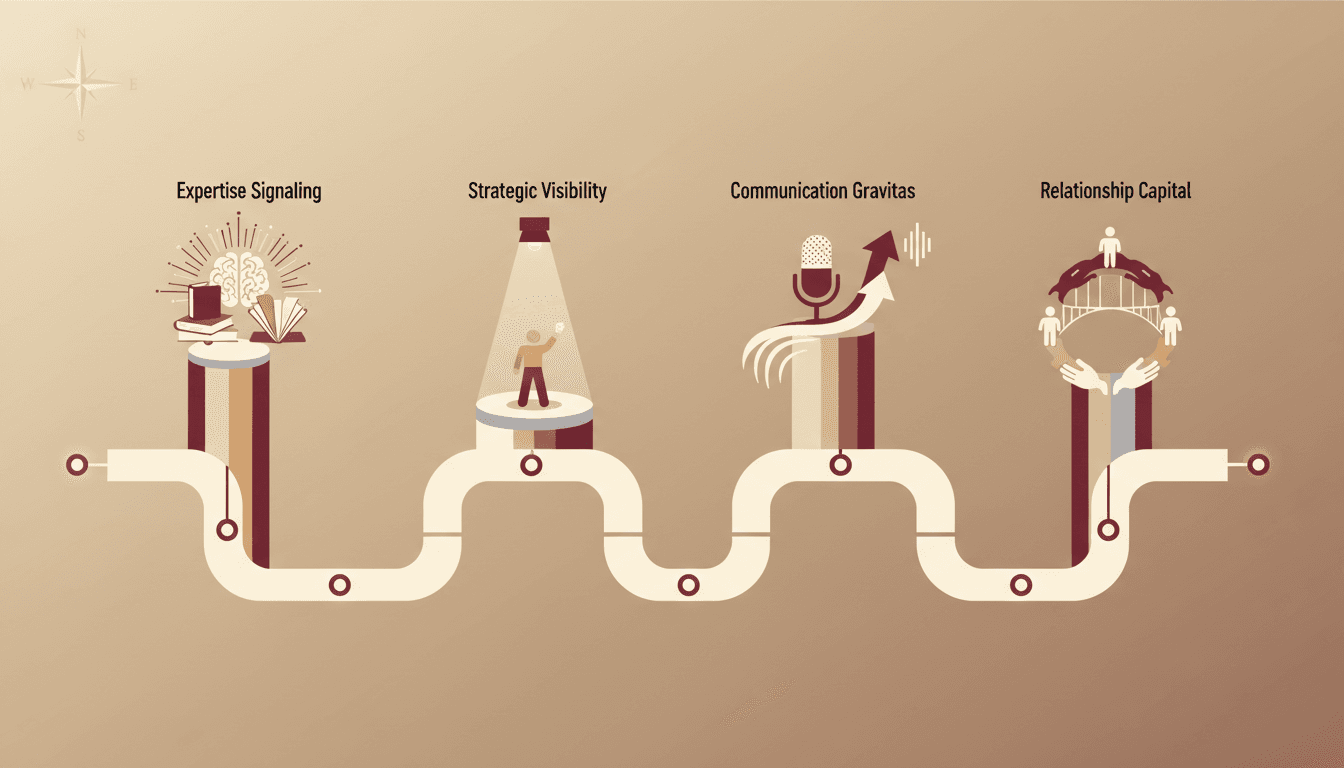
Build Authority in Your Career: The Credibility Roadmap
Career Authority

Build Authority in Your Career: The Credibility Roadmap

To build authority in your career, you need to master four interconnected pillars: expertise signaling, strategic visibility, communication gravitas, and relationship capital. Authority isn't granted by a title—it's earned through consistent, deliberate actions that position you as the go-to person in your domain. This roadmap breaks each pillar into concrete milestones so you can move from competent contributor to recognized authority within 12 to 18 months.