Blog, page 5

Practical scripts, frameworks, and examples for the conversations that decide how seriously people take you.

Articles

Communication Skills for New Managers: 9 Essential Shifts
Professional Communication

Communication Skills for New Managers: 9 Essential Shifts

The transition from individual contributor to manager is one of the most disorienting shifts in any career — not because the work gets harder, but because the communication rules completely change. What made you successful as a peer (deep expertise, heads-down execution, collaborative brainstorming) can actually undermine you as a leader. New managers need to master nine critical communication shifts: moving from sharing opinions to giving direction, from receiving feedback to delivering it, fro


How to Build Professional Credibility at Work: A Complete System
Career Authority

How to Build Professional Credibility at Work: A Complete System

Building professional credibility at work requires a deliberate system across five dimensions: consistent delivery on commitments, strategic communication that signals competence, visible expertise through knowledge sharing, relationship capital built on trust, and a professional presence that commands respect. Credibility isn't a single achievement — it's a compound asset you build through daily habits, starting from your first week and evolving through every career stage.

How to Develop Gravitas as a Leader: The Complete Method
Leadership Presence

How to Develop Gravitas as a Leader: The Complete Method

Developing gravitas as a leader requires deliberate work across three dimensions: confidence (how you carry yourself), composure (how you respond under pressure), and substance (the depth behind your words). It is not an innate trait reserved for a few. You build gravitas by mastering structured thinking, controlling your emotional reactions, training your vocal delivery, and consistently demonstrating expertise. This article provides a complete, step-by-step method — including daily exercises,

How to Speak With Authority at Work: 8 Daily Practices
Professional Communication

How to Speak With Authority at Work: 8 Daily Practices

To speak with authority at work, focus on eight daily practices: anchoring your voice in a lower register, eliminating hedging language, using declarative sentence structures, pausing strategically before key points, leading with conclusions, structuring thoughts in threes, practicing assertive body language, and rehearsing high-stakes statements aloud. These habits, practiced consistently over 30 days, transform how colleagues perceive your credibility and competence in every professional inter

Personal Branding for Leadership Roles: A Strategic Guide
Personal Branding

Personal Branding for Leadership Roles: A Strategic Guide

Personal branding for leadership roles is the deliberate process of shaping how colleagues, executives, and stakeholders perceive your leadership capability — before you ever get the title. It goes beyond LinkedIn optimization or self-promotion. It means building a reputation through consistent communication, visible expertise, and strategic relationship management so that when leadership opportunities arise, your name surfaces naturally. This guide breaks down the exact strategies mid-career pr

Confident Communication at Work: 15 Before & After Examples
Workplace Confidence

Confident Communication at Work: 15 Before & After Examples

Confident communication at work means replacing hedging, apologetic, and uncertain language with clear, direct, and authoritative phrasing — without becoming aggressive. The most impactful shifts are often small: swapping "I just wanted to check" for "Following up on," or replacing "I think maybe we could" with "I recommend." Below, you'll find 15 real-world before-and-after examples across emails, meetings, presentations, and one-on-ones that show exactly how to make these transformations — and

How to Communicate Like a Senior Leader: 8 Daily Shifts
Executive Communication

How to Communicate Like a Senior Leader: 8 Daily Shifts

To communicate like a senior leader, shift from reporting details to framing decisions, from hedging your language to stating clear positions, and from reacting in the moment to responding with strategic intent. Senior leaders don't just share information—they shape how people think about it. The eight daily shifts below cover emails, meetings, one-on-ones, and presentations, transforming tentative mid-level communication into the authoritative style that earns trust, drives action, and accelera

How to Negotiate Salary Mid-Career: Scripts & Strategy
Negotiation

How to Negotiate Salary Mid-Career: Scripts & Strategy

To negotiate salary mid-career, start by anchoring your ask to market data and quantified impact—not tenure or loyalty. Research your market value using tools like Glassdoor, Levels.fyi, or Payscale. Prepare a one-page "value brief" documenting your measurable contributions. Then use a collaborative framing script: *"Based on my research and the results I've delivered, I'd like to discuss aligning my compensation with [specific range]."* Mid-career negotiation requires a different playbook than

Present to Senior Leadership Confidently: Complete Method
Public Speaking

Present to Senior Leadership Confidently: Complete Method

To present to senior leadership confidently, prepare by structuring your content around decisions rather than data, leading with your recommendation in the first 60 seconds. Anticipate the three toughest questions executives will ask and rehearse concise answers. On delivery day, slow your pace by 20%, ground your body language, and use strategic pauses to project calm authority. Confidence with executives comes from preparation depth, not personality type.

How to Stop Undermining Yourself at Work: 11 Hidden Habits
Workplace Confidence

How to Stop Undermining Yourself at Work: 11 Hidden Habits

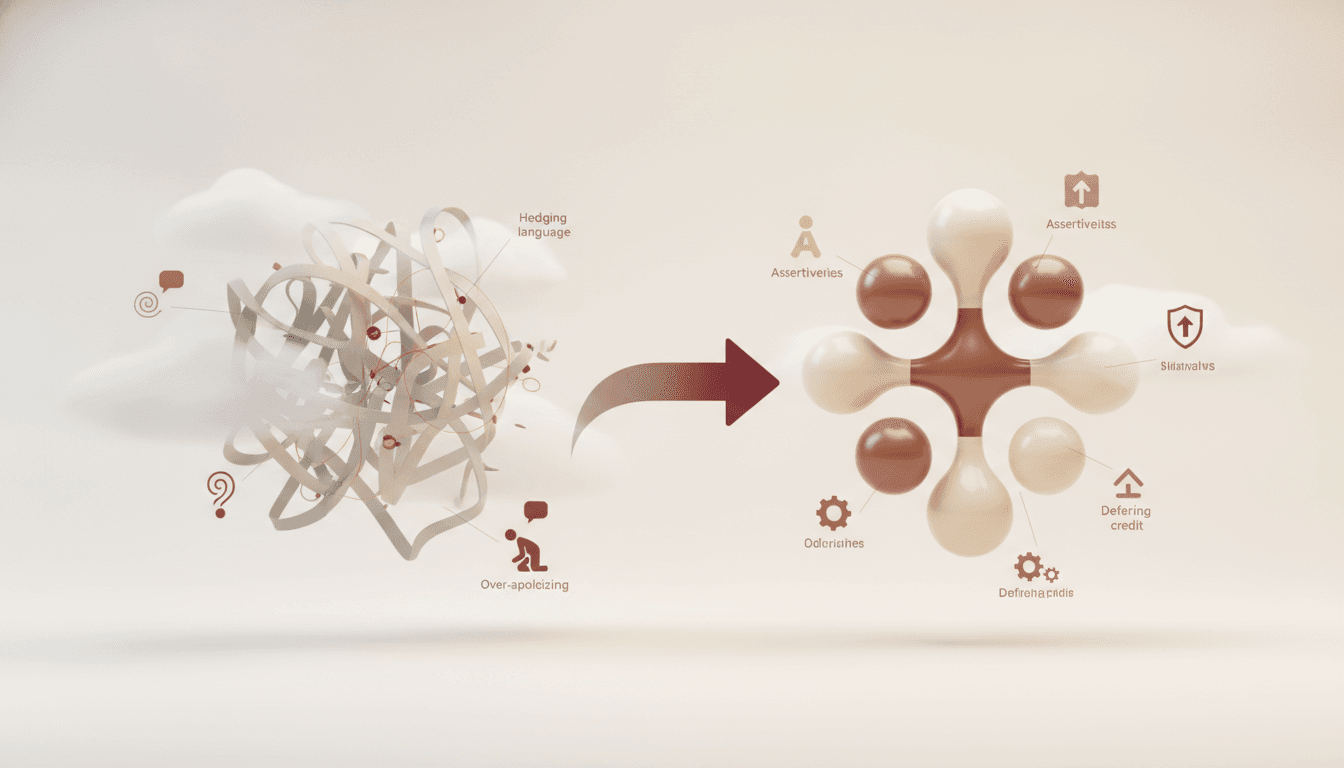
You stop undermining yourself at work by identifying and replacing the subtle communication habits that silently erode your credibility. The most common self-undermining behaviors include hedging your language ("I just think maybe..."), over-apologizing, using upspeak, deferring credit, and shrinking your physical presence. Each habit sends an unintentional signal that you lack conviction—even when your ideas are strong. Below, you'll find all 11 hidden habits with specific before-and-after repl

Executive Presence vs Confidence: Key Differences Explained
Executive Communication

Executive Presence vs Confidence: Key Differences Explained

While confidence is the internal belief in your own abilities, executive presence is the broader, outward-facing ability to project authority, composure, and influence in professional settings. Confidence is one ingredient of executive presence—but it's not the whole recipe. Executive presence combines gravitas, strategic communication, and commanding body language to shape how others perceive your leadership capability. You can be confident without having executive presence, but you cannot have

How to Negotiate When You Feel Unqualified: A Framework
Negotiation

How to Negotiate When You Feel Unqualified: A Framework

Quick Answer: To negotiate when you feel unqualified, shift your focus from credentials you lack to value you deliver. Prepare an evidence portfolio of measurable results, reframe imposter syndrome as a cognitive distortion rather than truth, and use structured scripts that anchor your ask to market data — not self-worth. The key insight: negotiation is about the value of the role and your results, never about whether you feel "enough."

How to Speak With Authority as a Woman at Work
Professional Communication

How to Speak With Authority as a Woman at Work

To speak with authority as a woman at work, focus on five core areas: use declarative sentence structures instead of hedging language, lower your vocal pitch slightly at the end of statements, claim physical and verbal space in meetings, prepare strategic talking points in advance, and address double-bind dynamics with confident warmth. These research-backed strategies help women project credibility and command respect without sacrificing authenticity.

Leadership Presence Coaching Exercises You Can Do Alone
Leadership Presence

Leadership Presence Coaching Exercises You Can Do Alone

Leadership presence coaching exercises are structured, repeatable drills—including vocal warm-ups, posture resets, mental rehearsal, and intentional breathing techniques—that professionals can practice solo each day to develop a commanding, credible presence. You don't need a coach in the room to build these skills. Below, you'll find a complete set of self-coaching exercises organized by category, each designed to strengthen a specific dimension of leadership presence in as little as 10–15 minu

Build Authority at Work Without Being Arrogant: A Guide
Career Authority

Build Authority at Work Without Being Arrogant: A Guide

Building authority at work without being arrogant comes down to three core practices: signal competence through results (not self-promotion), elevate others while leading (collaborative authority), and maintain strategic visibility (so your work speaks before you do). True authority is granted by others based on trust, consistency, and demonstrated expertise—not claimed through dominance or ego. This guide gives you a complete framework for earning that authority while staying genuinely respecte

How to Sound Confident in a Meeting: 9 Proven Shifts
Workplace Confidence

How to Sound Confident in a Meeting: 9 Proven Shifts

To sound confident in a meeting, focus on nine key shifts: eliminate filler words and hedging language, lower your vocal pitch at the end of sentences, pause before responding instead of rushing, lead with your conclusion rather than your reasoning, use definitive language ("I recommend" vs. "I think maybe"), maintain steady eye contact, speak at a measured pace, claim physical space with open posture, and prepare a strong opening line. These vocal, linguistic, and behavioral changes signal auth

How to Develop Professional Presence: 7 Pillars
Leadership Presence

How to Develop Professional Presence: 7 Pillars

Professional presence is the ability to project confidence, credibility, and composure in every professional interaction—and it's entirely learnable. To develop professional presence, you need to master seven interconnected pillars: vocal authority, body language, strategic brevity, composure under pressure, appearance alignment, listening power, and decisive language. Each pillar can be strengthened through deliberate daily practice, and together they create the commanding presence that separat

Personal Brand for New Executives: First 60 Days
Personal Branding

Personal Brand for New Executives: First 60 Days

Building a personal brand for new executives starts before your first all-hands meeting and accelerates through your initial 60 days. The most effective approach follows three phases: define your leadership narrative (days 1–15), demonstrate it through strategic visibility (days 16–40), and deepen it by creating lasting stakeholder impressions (days 41–60). This playbook gives you the exact moves, timelines, and communication strategies to establish authority and credibility from day one — witho

Build Career Authority Online and Offline: 10 Moves
Career Authority

Build Career Authority Online and Offline: 10 Moves

To build career authority online and offline, you need a dual-channel strategy that pairs digital visibility—like LinkedIn thought leadership and content creation—with offline tactics such as strategic meeting contributions, cross-functional collaboration, and internal thought leadership. The professionals who rise fastest don't choose one channel over the other. They create a consistent, credible presence across both, so their reputation reinforces itself whether someone Googles them or sits ac

Negotiation Confidence Building: 6 Proven Methods
Negotiation

Negotiation Confidence Building: 6 Proven Methods

Negotiation confidence building is the deliberate practice of developing mental, verbal, and physical readiness so you can advocate for yourself effectively in any professional conversation. The six most proven methods include structured preparation rituals, cognitive reframing techniques, power language patterns, progressive exposure exercises, body language anchoring, and post-negotiation review cycles. These methods work because they address confidence at its root — replacing uncertainty with

How to Speak With Authority in Presentations
Public Speaking

How to Speak With Authority in Presentations

To speak with authority in presentations, focus on five core areas: slow your speaking pace to 130–150 words per minute, use downward vocal inflections at the end of statements, structure your content with a clear "claim-evidence-action" framework, adopt grounded body language with planted feet and purposeful gestures, and eliminate hedging language like "I think" or "sort of." Authority isn't about volume—it's about vocal control, structural clarity, and unwavering conviction in your message.

Confidence at Work After a Setback: 8 Recovery Steps
Workplace Confidence

Confidence at Work After a Setback: 8 Recovery Steps

Rebuilding confidence at work after a setback requires intentional action, not just time. The most effective recovery involves reframing the setback as data, rebuilding your professional identity through small wins, and re-establishing your credibility with strategic communication. Whether you faced a failed project, a public mistake, or an organizational restructuring, these eight steps will help you move from self-doubt back to commanding presence — often emerging stronger than before.

Leadership Presence Without Authority: A Proven Guide
Leadership Presence

Leadership Presence Without Authority: A Proven Guide

You don't need a title to lead a room. Leadership presence without authority is built through strategic communication, consistent credibility signals, and the ability to influence outcomes without positional power. Professionals who master this skill earn trust, shape decisions, and get tapped for leadership roles faster — often before the promotion is official. This guide gives you a proven framework to build commanding presence from any seat at the table.

How to Sound Credible at Work: 9 Daily Shifts
Professional Communication

How to Sound Credible at Work: 9 Daily Shifts

To sound credible at work, focus on nine daily shifts across three dimensions: what you say (verbal precision), how you say it (vocal authority), and what you do while saying it (behavioral signals). Replace hedging language with direct statements, slow your speaking pace by 10–15%, lead with conclusions before details, and use grounded body language. These small, repeatable shifts compound over time, transforming how colleagues, managers, and executives perceive your competence and authority.